First nanodiamond arrays created by biological molecules
January 14, 2013
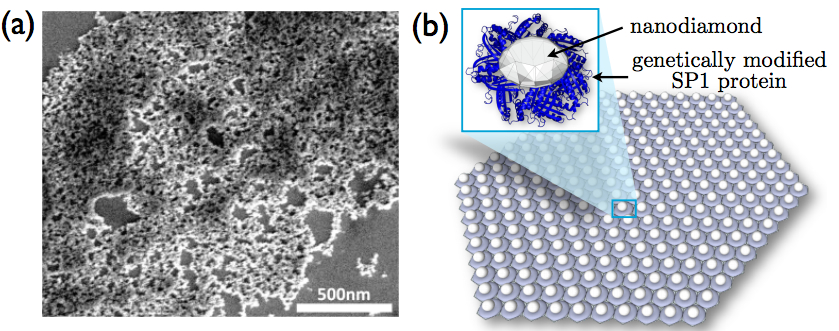
Towards ordered nanodiamond arrays (a) SEM image of a monolayer imaged after deposition of nanodiamonds on an SP1 monolayer. (b) Schematic of an ordered hexagonal array of SP1-nanodiamond hybrids consisting of a nanodiamond attached to the SP1 inner cavity. (Credit: Andreas Albrecht et al.,)
An international team has used biological self-assembly to build nanodiamond arrays, MIT Technology Review reports.
One of the most promising ways to capture, generate and manipulate photons for quantum computing is with tiny diamonds. The secret is to create nanodiamonds with a defect in their structure where a nitrogen atom has taken the place of a carbon.
The researchers plan to bind nanodiamonds together with the required nanometre precision using biological molecules such as DNA and protein and have demonstrated the technique for the first time.
They coated nanodiamonds with a genetically modified protein called SP1. This protein then bonds with the proteins on other nanodiamonds to form them into a hexagonal array, the first step towards larger arrays needed for quantum computing.