First working quantum bit based on a single atom in silicon
September 24, 2012
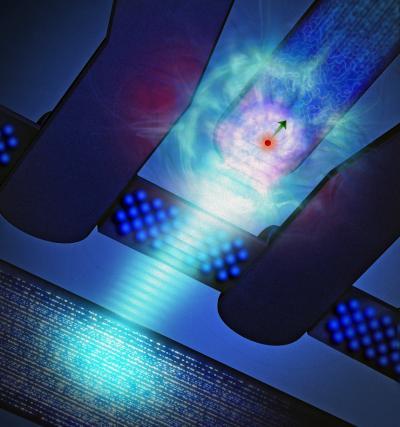
Artist’s impression of a phosphorus atom (red sphere surrounded by electron cloud, with arrow showing the spin direction) coupled to a silicon single-electron transistor. A burst of microwaves (blue) is used to “write” information on the electron spin. (Credit: Tony Melov)
A research team led by Australian engineers has created the first working quantum bit based on a single atom in silicon, opening the way to ultra-powerful quantum computers of the future.
The team was able to both read and write information using the spin, or magnetic orientation, of an electron bound to a single phosphorus atom embedded in a silicon chip.
“For the first time, we have demonstrated the ability to represent and manipulate data on the spin to form a quantum bit, or ‘qubit’, the basic unit of data for a quantum computer,” says UNSW School of Electrical Engineering and Telecommunications Professor Andrew Dzurak. “This really is the key advance towards realizing a silicon quantum computer based on single atoms.”
“This is a remarkable scientific achievement — governing nature at its most fundamental level — and has profound implications for quantum computing,” says Dzurak.
The new finding follows a 2010 study also published in Nature, in which the same UNSW group demonstrated the ability to read the state of an electron’s spin. Discovering how to write the spin state now completes the two-stage process required to operate a quantum bit.
The new result was achieved by using a microwave field to gain unprecedented control over an electron bound to a single phosphorous atom, which was implanted next to a specially-designed silicon transistor.
The team’s next goal is to combine pairs of quantum bits to create a two-qubit logic gate — the basic processing unit of a quantum computer.