Five potential habitable exoplanets now
July 25, 2012
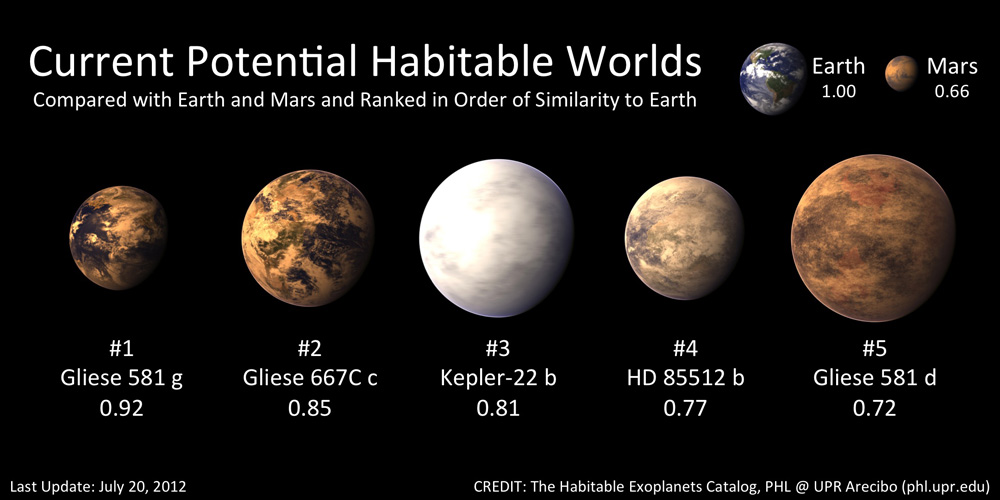
Artistic representation of all the five known potential habitable worlds, now including Gliese 581g, the best candidate for an Earth-like exoplanet so far. All of these planets are superterrans (aka Super-Earths) with masses estimated between two and ten Earth masses. Numbers below the planet names correspond to their similarity with Earth as measured in a scale from zero to one with the Earth Similarity Index, one being identical to Earth. (Credit: Planetary Habitability Laboratory)
New data suggests the exoplanet Gliese 581g is the best candidate so far of a potential habitable exoplanet. The nearby star Gliese 581 — located about 20 light years away from Earth in the constellation Libra — has four planets; the outermost planet, Gliese 581d, was already suspected habitable.
This will be the first evidence for any two potential habitable exoplanets that are orbiting the same star.
Based on the new data, Gliese 581g probably has a radius not larger than 1.5 times Earth radii. It receives about the same light flux as Earth does from the Sun due to its closer orbital position around a dim red dwarf star. These factors combine to make Gliese 581g the most Earth-like planet known with an Earth Similarity Index, a measure of Earth-likeness from zero to one, of 0.92 and higher than the previously top candidate Gliese 667Cc, discovered last year.
Comments (23)
by GatorALLin
I still see lots of problems picking these “habitable” worlds… Wish they would try for some that had a better chance of Earth like conditions.
#1 don’t pick a planet that is tidally locked with its star.
#2 pick a planet that is orbiting a star like our sun (a lot more light energy vs. red dwarf).
#3 we need some better way to determine if there is liquid water on these potential rocks…. way too much guessing going on still (remember they were still arguing if Gliese 581g was even in existence a few months ago as it did not show up on everyone’s data plots).
#4 Maybe we don’t have as much time as I thought? I always thought we had about 4 billion more years with our sun, but now I understand our sun is growing a bit each billion years…maybe 10% or getting warmer… Wondering what happens in only 500 million years from now, if earth gets too hot or we mess up our atmosphere faster than I thought? we already seem to have sparked global melting… http://upload.wikimedia.org/wikipedia/commons/thumb/5/55/Solar_Life_Cycle.svg/2000px-Solar_Life_Cycle.svg.png
Yeah… 1 billion years should still be loads of time to get a few billion spaceships to fly out and inhabit some distant planets…but 1 billion years is a lot less than 4-5 billion. Maybe we get our singularity in 2045 so that could be a mute point, but I still have a bad feeling we may be trapped by speed of light issues and E=mc2 laws that keep us about 10 – 20% of speed of light with travel.
#5 I hope a giant meteor does not wipe us out before then also…. (gee that sounds so negative… and yes, if we find it in time I think we could all pull together to avert it) http://en.wikipedia.org/wiki/Asteroid_impact_avoidance
by rory macleod
two questions:what of the indigenous life-forms,possibly hostile,dangerous flora?dangerous fauna?what about the “heavy”gravitational pull, i.e.walking would be much like walking through a shallow swimming pool(same resistance to movement)?id go as an obsever to help catalog the new species(if there were a “stable “worm-hole of course).
by Jon
Just because they are potentially habitable does not mean we expect there to be life. If there is life there, it is most likely bacterial. The chance of finding developed flora and fauna is still incredibly small.
by GatorALLin
…reply to rory… I agree there could be some big problems once we show up to investigate the surface.. Like what if no atmosphere, or one that is so violent with storms…or surface is unstable…or acid rain x10. I think by the time we fly a probe out to these distant spots, we need to know how to land devices that will build or fix a planet’s atmosphere to be earth like. You should watch this program at what they were able to dream up from a fun “what if” mission http://www.youtube.com/watch?v=BNLfNe12BKE&feature=related
by GatorALLin
this was interesting..
http://www.youtube.com/watch?v=BNLfNe12BKE&feature=related
by Frank Norton
I would think that the planet Pluto would be the safest and most likely of all planets for life. Consider a 60 mile deep ocean covered by a 60 mile thick ice covering, and the heat coming from up from a large core of potasium 40. Once life started, the temperature would be consistantly slowly declining, no threat of comet or asteroid collisions , no volcanos, earthquakes,seasons, and protection from five moons, and a part time icy rings when it exits the inner Oort cloud.
by Steve M
I sure hope you’re joking?!? Pluto is an icy rock with no 60 mile deep ocean or an ocean of any kind…nor a 60 mile thick ice covering an ocean. The heat coming up from a large core of potassium 40??? This suggests that the core is undergoing radioactive decay (such as Earth’s core) which is not. Once life started, the temp would be slowly declining??? Pluto is something like 55 Kelvin. Room temperature is roughly 300 Kelvin. The fifth moon Pluto possesses is new info, so where do you get the unusual inaccurate info from?
P.S. Earthquakes??? Come on, they would be called Plutoquakes:)
by GatorALLin
…Plutoquakes Rock…
by donald
It would take some 20 million years to travil, What we need is a space craft that would fold time & space and a lot of beer!
by Charles
I think I’ve read this story before. It’s called Coyote by Allen Steele.
by Steve
Lets go bring alot of ciggs and beer
by jimmy
walmart has plans to build a store there, so must be habitable
by Mike
One is a theme park planet. The other is an outlet mall planet. That’s how it is everywhere, man.
by curtp41@gmailcom
I think Disney already has dibs on Pluto.
by Mr.x
Time to move!Wait, 20 lightyears? Better lend some books from the local library.
by Scott Batchelor
I can’t even afford the gas across town.
by Jamie
If it has a composition similar to Earth’s ( Just a guess.) then it would have a mass of ~ 3 times our home planet. The mean effect of gravity given it’s radiius should be 1.3 -1.5 times Earths if the radius holds at it present estimate. If it’s density were slightly less, at say 4.6 grams/ cc, then it would be spot on.
by GatorALLin
….An Earth-sized planet with three times the mass of our planet would pull down on your body with three times the force of Earth’s standard gravity. That means if you weighed 120 pounds on Earth, you would weigh about 120 x 3 pounds on an Earth-sized planet with three times the mass, or 360 pounds.
But Gliese 581g also has a somewhat larger radius, so that also factors into the equation. A 120 pound person would weigh about 213 pounds on Gliese 581g at the lower end of the size and mass estimates. This all remains theoretical until astronomers can pin down the actual size and mass.
by Spikosauropod
At 1 gravity, it would take 6 years (ship time) to get there. If someone can build the ship, and no one will miss me for 44 years, I am ready to go.
by GatorALLin
………..A spaceship traveling at a one-tenth of the speed of light would reach Gliese 581g within about 220 years, Vogt said. That would allow the spaceship to begin getting close-up pictures and a sense of the planet’s atmosphere.
by Dan Robinson
Pictures imply we know something about the surface. Is this true? As I understand it, we only know orbital distnce, with maybe clues to temperature, mass and diameter. And we must a good guess on ditance from here, which it seems is never mentioned.
by Editor
Good questions. Distance is about 20 light years (our nearest star, Proxima Centauri, in 4.2 light years away). Space.com has a good
Q&A: http://www.space.com/9247-million-questions-habitable-planet-gliese-581g-12.html. I added this info.
by GatorALLin
..thanks for the great link to more info…. I did a quick copy and paste for some of the posters above…