Formation of carbon-based life leave little room for error
March 15, 2013
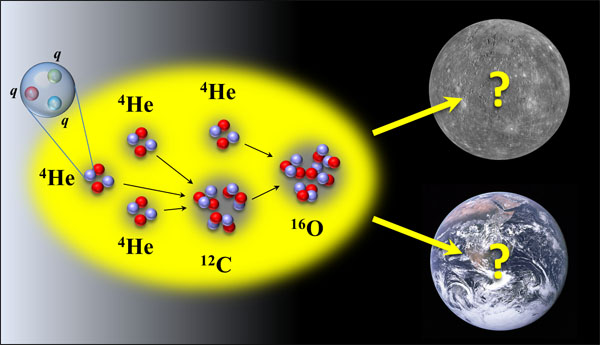
Light quark mass determines carbon and oxygen production and the viability of carbon-based life, with a 2 or 3 percent margin of error (credit: Dean Lee/NC State and NASA)
Life as we know it is based primarily on the elements carbon and oxygen.
Now a team of physicists, including one from North Carolina State University, is looking at the conditions necessary to the formation of those two elements in the universe.
They’ve found that when it comes to supporting life, the universe leaves very little margin for error.
Both carbon and oxygen are produced when helium burns inside of giant red stars. Carbon-12, an essential element we’re all made of, can only form when three alpha particles, or helium-4 nuclei, combine in a very specific way. The key to formation is an excited state of carbon-12 known as the Hoyle state.
(It has a very specific energy — measured at 379 keV (or 379,000 electron volts) above the energy of three alpha particles. Oxygen is produced by the combination of another alpha particle and carbon.)
NC State physicists had previously confirmed the existence and structure of the Hoyle state by simulating how protons and neutrons interact. These protons and neutrons are made up of elementary particles called quarks. The light quark mass is one of the fundamental parameters of nature, and this mass affects particles’ energies.
2 or 3 percent margin of error
In new calculations done at the Juelich Supercomputer Center, the physicists found that just a slight variation in the light quark mass will change the energy of the Hoyle state, and this in turn would affect the production of carbon and oxygen in such a way that life as we know it wouldn’t exist.
“The Hoyle state of carbon is key,” physicist Dean Lee says. “If the Hoyle state energy was at 479 keV or more above the three alpha particles, then the amount of carbon produced would be too low for carbon-based life.
“The same holds true for oxygen,” he adds. “If the Hoyle state energy were instead within 279 keV of the three alphas, then there would be plenty of carbon. But the stars would burn their helium into carbon much earlier in their life cycle.
As a consequence, the stars would not be hot enough to produce sufficient oxygen for life. In our lattice simulations, we find that more than a 2 or 3 percent change in the light quark mass would lead to problems with the abundance of either carbon or oxygen in the universe.”
The researchers’ findings appear in Physical Review Letters.
The work was funded by the U.S. Department of Energy; the Deutsche Forschungsgemeinschaft, Helmholtz-Gemeinschaft Deutscher Forschungszentren and Bundesministerium fuer Bildung und Forschung in Germany; European Union HadronPhysics3 Project and the European Research Council.
UPDATE March 15, 2013: speculations re Fermi paradox removed.
Comments (56)
by Aezel
I don’t even like discussion of the Fermi paradox anymore. It is juvenile in comparison to our current knowledge of the universe. If you look at Fermi and Hart’s original data they used, they took very little to nothing into account about what we now know is required to get life rolling, and then for it to survive in such a hostile universe.
Yes there are other suns out there similar to ours, but even if life starts it is much more likely that it will be violently wiped out than survive to reach an intelligent level. We reached complexity on this planet because of the environment being stable enough to support larger life but just unstable enough to drive evolution. What exact environments on exoplanets lead to complex life? What is the % probability of life surviving to complexity once it has begun? These are questions that we can only wildly guess at for the moment. What is the Fermi paradox? It is a false question, because frankly Fermi didn’t have enough information to make a REALISTIC guess. In his defense, he didn’t know what he didn’t know.
by Editor
Aezel: Agreed. Considering the tiny portion of the universe that has been surveyed in a tiny portion of the electromagnetic spectrum with arbitrary modulation detection assumptions, and for a small number of years, along with factors you mention, I have trouble understanding why it’s a paradox. It’s possible, for example, that an advanced civilization (Type 1 or higher) would be more likely to use high-bandwidth twisted light, or gamma ray bursts, or reflected light from a sun using a vast array of mirrors, or even modulated gravitational waves by modifying the trajectories of binary star systems composed of white dwarfs or neutron stars– none of these more efficient or powerful communication systems have been explored by SETI.
by Tom
Seconded, regarding the Fermi paradox being a false question.
It’s nothing but evidence of how dumb we still are.
Why point the finger at the universe, and life from other worlds, that we know next to nothing, and absolutely nothing, about, respectively?
No, best to take a good look at ourselves ask why it is that we want/need other life to exist, for us to not be the only intelligent life there is the universe.
Is it because we’re worried that we’re afraid we can’t handle it?
That we’ll screw up the job of being the species that ends up having to take care of EVERYthing?
No, let’s stop being so damn arrogant and just assume, for the moment, that we’re not that important or interesting, and that other civilisations are just too busy with their own concerns to be bothered with ours.
by Christian Gehman
Are you so very sure homo sap has reached an “intelligent level”? …. from whose point of view, exactly?
by Delta
If and when we reach a singularity, as many here on this site beleive. Is that not like a black hole of civilization. IE: smaller and smaller and faster and faster . This is something to be feared. And the lack of civilizations out there may be just because of this phenomena.
by Tom
Or maybe going smaller and smaller, and faster and faster, one finds a way to hack the machine we’re running on and get out of this vitual universe into the real one/next one up.
by Christian Gehman
From inside a Black Hole, the universe might appear to be expanding, with plenty of Dark Matter coalescing not just at the outer rim, but “everywhere” as it “decelerates” from “its prior, primordial state” ….
by Pete
The “black hole of civilization” was just an analogy.
I think you are taking the analogy too far.
by Christian Gehman
Barbarism and the triumph of small-minded bullies would be much more like the black hole of civilization than the approaching singularity which, judging only by your confusion, might be something you will neither acknowledge nor participate in; but for the sake of your children, if any, you might do well to hope that the singularity beats the barbarians to the punch.
by Tom
Fermi paradox is explainable by the singularity, but means we are likely the first and only intelligent civilization to emerge in this part of the universe.
If the singularity does happen, and it seems probable, and maybe even inevitable, then the first civilization to which it happens will become the consumer of other worlds and the local area of the universe, eliminating other singularities within that part of the universe.
The closer we get to the singluarity, the more likely it is that we will be the first and therefore only singularity and civilization in our part of the universe, and we’re pretty close already.
I would guess that there is therefore a distribution of singularities throughout the universe with the average separation dependent upon the average time of a singularity to emerge after the big bang.
Making estimates of the latter would give us a good way to estimate how far we’ll have to travel/colonise before we encounter another post-singularity civilization/entity.
by Tom
What happens when two post-singularity entities meet must be quite an interesting event.
by alliwant
Given that this would be the meeting of two extremely sophisticated entities with vast resources, I would imagine it to be one of the most undramatic events of its kind.
by Tom
You don’t think the possiblities of either the exchange of knowledge, the conversations that could take place, the wars that could happen would be, in some way, slightly more intense that what we’re used to?
by Tom
Note that I’m assuming that the singularity of a given civilisation happens, to a relevent tollerance, before, at the same time, or soon after it achieves interstellar travel.
This seems reasonable give the levels of technology required for the two are comparable, and that we are likely to acheive the singularity before interstellar travel.
by Ralph Dratman
Following your theory, the size of “our part of the universe” is not yet known. The upper limit would have something to do with the frequency of serious interstellar hazards, while the lower limit would depend on how many civilizations are trying to get out to the stars at any one time.
by Tom
Serious instersellar hazards could affect the distribution to some degree, but I would think it quite unlikely that it is to a great degree.
Why?
Well, our 1 sample dataset (us) shows a) we’re not wiped out yet, and b) fairly close, some think (maybe/hopefully) to the singularity.
I’m assuming that the biggest threat of any kind to any given singularity X is nearby singularities that eat X’s planet before it reaches singularity.
by Ralph Dratman
Hazards like exploding stars, randomly moving bodies and maybe other events we don’t know about yet would have to be counted as genuine risks to the physical integrity of a ship traveling for, say, a few tens of thousands of years. The longer the ship is out there between origin and destination, the more total risk it incurs.
I think we could build a ship to function that long, as long as there are no accidents. Naturally, then, it would make sense to send out a lot of such ships, so that some of them would be likely to get through.
As for the purpose of sending out exploration ships, I am not quite sure what it would be. Fortunately, however, we have an excellent excuse: we can just tell anyone we meet that we are compulsive life-spreaders. Which, of course, we are. We have a serious disorder called Love, another one called Hope, and other problems too numerous to name. Does the Universe really want us, or our robots, wandering around out there?
by asiwel
Here you go. I just read this clip from Scientific American
http://www.scientificamerican.com/article.cfm?id=puzzling-super-dense-space-objects-could-be-a-new-type-of-planet
It is about nearby mysteriously super-dense earth-sized planets. Speculation is that they are dense cores of ice giant planets like Neptune that wandered too close to their suns and had their atmospheres blown away quickly. Not quite neutronium yet very dense. But I read KurzweilAI.net and immediately wondered about the density of computronium. Naturally I speculate that those super dense planets could be alien race Matrioshka brains. So maybe we aren’t the first and only intelligent race around here to get close to the Singularity.
by asiwel
Upon further research, I now suspect these heavy planets are “Jupiter Brains” optimized for speed of computation rather than full use of all readily available energy in the neighborhood.
by Ralph Dratman
What purpose might a Jupiter Brain serve?
by Pete
Well, the more intelligence you have, the better (the greater the chance of your long term survival). Sufficiently advanced civilizations should build supercomputers as large as possible.
Matrioshka brains are multi-layered Dyson Spheres (or Dyson Swarms) with large part being computronium. I.O.W, Dyson Sphere (or Swarm) sized supercomputer.
Jupiter Brains are planet sized supercomputers. They do not cover whole stars like Dyson Spheres/Swarms do, but they are much faster in processing.
More on Matrioshka Brain: http://en.wikipedia.org/wiki/Matrioshka_brain
I fear that we may not, after 2045, colonize and wake up the whole Universe. Instead, we will stick to our corner of the galaxy and, like these super-dense planet builders, become sessile/sedentary.
by Tom
Computation speed of a Jupiter brain might be faster, but that doesn’t mean it’s optimum, which is a combination of speed, complexity (interconnectedness), and quantity, even at world or greater scales, I would imagine.
Also, it could be possible to overcome the distance and interconnectedness limitations of Matrioshka brains with quantum-entanglement, maybe.
We’ll find out soon enough.
by Hannes Karnoefel ;-)
But, as put before, maybe we ARE the first species in the universe to become intelligent and reach the singularity and become a super-intelligence that can control the universe. And maybe there are shortcuts possible to far-away regions in space. So what can stop us, or our offspring, to transform the entire universe into smart matter?
by Tom
Hopefully nothing.
But I see your first maybe as being quite unlikely in light of the number of worlds we’re discovering and the wide range of environments that can produce the complexity necessary for life, which is what I think is the only prerequisit for life.
And, as previously stated, other singularities would maybe stop us.
And if there is more than one (us), especially true if the universe is infinite, then we will inevitably come across others.
Then how long that will take depends upon what the distribution of singularities is in the universe.
But being first is certainly one possibility, though very unlikely.
by Aezel
The “an advanced civilization would build computers the size of planets” postulation is a false paradigm. With quantum computing you could get all the processing power you would ever need in something much smaller than a planet. Dreaming up such behemoths is for those with an over-active imagination and not enough knowledge of quantum physics.
by Tom
how do you define “all you would ever need”?
What you really mean, I suspect, is all YOU could ever imagine.
I respectfully suggest that members of an advanced civilisation, or that civilisation itself, might have a little more imagination than that.
I certainly do.
by Pete
Luckily, we have quantum computers right now .
Please visit D-Wave Systems’ website for more information.
by Christian Gehman
Look for star systems that might have produced the conditions for carbon-based life before ours did. Look for alternative life systems.
by John Caplinger
But the change in quark mass as noted in the abstract of the above referenced paper is in regard to the fundamental property of the quark, not the total mass of quarks available in a given solar environment. The light quark mass is a constant. Given this provision, the fine tuning of the quark mass is in regard to many-worlds quantum theory and would not impact directly the production of oxygen and carbon in “our” universe. It does, however, suggest that the conditions required for production of these elements may not be highly probable in all stellar nurseries because the process itself is sensitive to conditions overall. This could easily be settled by comparison of stellar spectra for oxygen and carbon across a broad number of stars and nebulae to determine “what are the existing quantities of the required elements”. As I am no astrophysicist, I have to wonder if this has been solved already?
by Astrojensen
But unless the light quark mass varies with the age of the universe – which I consider unlikely – or varies between different parts of the universe, which is similarly unlikely, I don’t see how this applies to the Fermi Paradox [i]in this universe.[/i] Other universes with different quark masses will be entirely different and may not have intelligent life (and then they don’t have a Fermi Paradox!!), but the properties of quarks in other universes doesn’t affect this one. The Fermi Paradox of this universe cannot be explained by how extremely small the variations in particle properties can be, before life is impossible, since this universe is what it is. Life is possible, so it’s strange that we seem to be alone. That’s the paradox.
by Christian Gehman
Fermi’s Question might be easy to answer: “They’re already here.”
by Tom
Fermi’s Paradox is no paradox at all.
It just confuses alone with uninteresting/too far away/too dumb to be worth contacting/…/…/…
Just because we haven’t been contacted by or seen eveidence of other life does not mean there is no other life, just that we haven’t been contacted by or seen any evidence of other life, nothing more.
Any other conclusion in the absence of any other evidence is mere hubris.
by Randolph Garrison
Why does intelligent life have to be carbon based?
by Tom
agreed
or, for that matter, have to appear on Earth-sized planets?
by seeker
so what it have to do with Fermi paradox ?! are you want to suggest that less carbon and oxygen is produced in other part of universe then in our ?
by Editor
There’s an informative discussion over on http://www.kurzweilai.net/earth-sized-planets-in-habitable-zones-are-more-common-than-previously-thought on this.
by Ralph Dratman
Whatever the relevance of the quark-mass discussion, it appears that a recent calculation (see Editor’s link) makes the Fermi Paradox more troubling than ever. The new estimate predicts about three Earth-sized planets in habitable zones within ten light years of Earth. That would imply (I think) about 75 suitable planets within 50 LY. If the numbers are really that big, we should have seen or heard SOMETHING from our exo-neighbors by now… unless the emergence of intelligent life in fertile places is very rare indeed.
by Bjimmer
~
> “….unless the emergence of intelligent life in fertile places is very rare indeed.”
There is no ‘proof’ for Intelligent life anywhere in the Universe.
Surely you do not consider the crazy, hairless, tailless, short lived primates presently infesting the Earth as Intelligent beings?
Now, possibly, those vehicles passing by the Solar System approximately once or twice a week and blasting out a focused Gamma Ray Burst with modulation from a radiator/antenna of less than 180 km of diameter, as have been recorded by NASA (and kept secret) since the 1970′s (see Velas and BATSE -Contact Dr Jerry Fishman, P.I. of the BATSE for further details) might possibly have intelligent life on them.
But why would Intelligent life forms be wasting their time and energy sending signals towards a planet known to only have hairless, tailless, short lived primates occupying it?
~
by Mark
If there’s one thing I learned after more than 30 years of government service, it’s that the government cannot keep a secret. This fact alone makes most, if not all, conspiracy theories wrong.
by Sno
To me, it sounds more like this has nothing to do with the Fermi paradox, and only shows that a universe with slightly different physics may well be unable to support carbon-based life.
by Christian Gehman
Plenty of other universes to choose from around here, I guess — at the bottom of a black hole? Or is that where we are?
by Christian Gehman
Evidently we’ll never know unless we travel to another universe ….
by Editor
As noted, “a 2 or 3 percent change in the light quark mass would lead to problems with the abundance of either carbon or oxygen in the universe.” That may be one possible explanation for the lack of SETI detections of ET. So the question is: what do we know about carbon and oxygen production elsewhere?
by Mark
This has nothing to do with the Fermi Paradox. Your “point” on that is completely nonsensical unless you are suggesting that the laws of physics and elementary particle masses are different outside of our solar system. To the best of our knowledge, they aren’t and all of our astrophysics is based upon that principle. And there isn’t anything to suggest, as far as I know, that the laws of physics or elementary particle masses differ at any point in our universe. You need to rethink this article’s premise.
by Calum
But why assume that life must be based on carbon and oxygen? Especially since we are probably quite close (under a century) to creating consciousness based on silicon.
by Christian Gehman
Ah yes, and then the silicon critters will eat us ALL UP!
by Astrojensen
But does the production of carbon or oxygen in stars vary across the universe, in a fashion only explainable by a variation in the light quark mass? I bet it doesn’t.
How it is in other universes is irrelevant to the Fermi Paradox for our universe.
by Editor
Right. My speculation has been deleted. (Written after an all-nighter — bad idea.)
by Ralph Dratman
Correction: I think that would be not 75 but around 375 candidate planets within 50 LY.
Wow.
If true, this means there may be livable worlds relatively near, but intelligent life may be evolving at a much lower rate than we might have hoped. Actually, on the other hand, if humankind ever really does go out to colonize some of those nice watery planets, it might be a good thing not to meet anyone else out there.
by Delta
It would seem that the Prime Directive is being followed by all intelligent life in the universe. That is very wise.
by Tom
There’s a simpler explanation.
See my other comments.
by Christian Gehman
We are not alone … the “others” look like movie stars ….
by Ralph Dratman
Long night of science writing?
by Editor
Yes
by Christian Gehman
Please put it back, if only as a demonstration of your own willingness to think.
by Editor
It’s stated at the top of this thread. I’d rather not contaminate any more minds. :)