Future foods: what will we be eating in 20 years’ time?
August 6, 2012
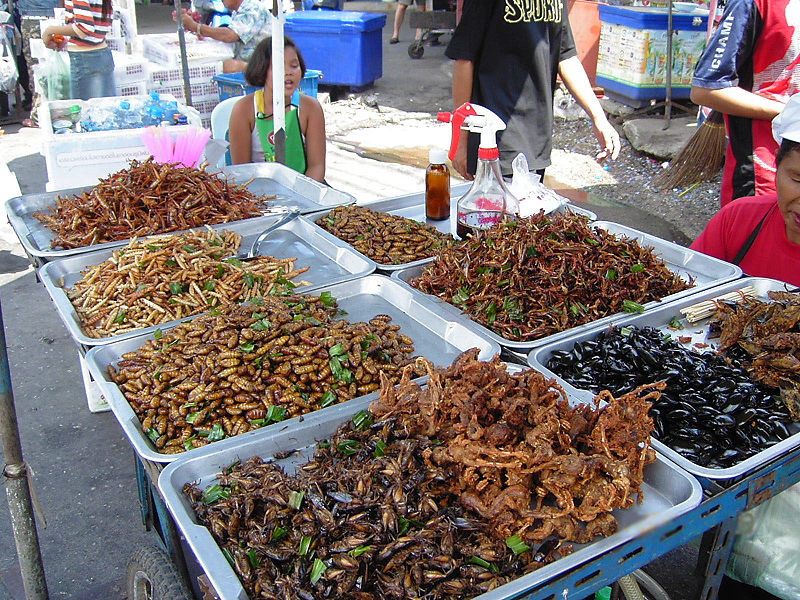
Volatile food prices and a growing population mean we have to rethink what we eat, say food futurologists. So what might we be serving up in 20 years’ time, asks BBC News?
- Insects will become a staple of our diet: a great source of protein, cost less to raise than cattle, consume less water and do not have much of a carbon footprint.
- Sonic-enhanced food: certain sounds could make things taste sweeter or more bitter.
- Lab-grown meat: a more efficient and environmentally friendly way of putting meat on our plates.
- Algae can be grown in the ocean, a big bonus with land and fresh water in increasingly short supply, and the biofuel derived from algae could help reduce the need for fossil fuels.

Comments (26)
by Joyce
Personally, I would like a 40 lb bag of perfectly nutritious “kibble”. designed for people. It should taste OK, but not too good so one is not tempted to over eat.
by Phillfrog
I ate some crickets as a forfeit in a pub quiz a couple of months ago. They weren’t too bad. What I think is much more promising though is David Berry’s genetically modified bacteria that can produce proteins from sunlight, CO2, water & base chemicals much more efficiently than something that wasn’t ‘designed’ specifically to create protein I.e. the cow. He recons with an area the size of Rhode Island (1214 square miles) we could provide nutrition for everyone on the planet. Check out his Google Solve for X talk here: http://www.wesolveforx.com/#t=t&n=ee7350c5
Also check out Mike Cheiky’s talk on ‘Negative carbon liquid fuels’ on the same site. His process creates gasoline from food waste (which has taken CO2 out of the atmosphere) and the bi-product of that is apparently an excellent fertiliser that can improve top soil/reverse desertification.
I believe we can solve our way out of these issues (I’m NOT employed by the site by the way!).
By the way, I’m surprised this site doesn’t link to talks from Solve for X.
by Eric Anderson
More important might be when we eat.
WIll older people switch to alternate day eating?
Studies in animals and humans suggest eating 15 percent of the calories needed to maintain an ideal Body mass Index one day and and 185 percent the next helps obtain ideal weight and cuts illness while increasing lifespan.
Will others switch to an 8 hour eating window?
Will Carbon 60 and olive oil pills double our lifespan?
Freeze Dried meal worms or crickets Humm!
by smb12321
No, old folks will not break with a million years of evolution because some report said it would theoretically be “better”. Insects will surely be added to our diet, first as one of the ingredients (low end) then moving higher and higher in percentage. Then again, if it can be made to taste good, who cares? LOL
by Danko
Find out how some Indian sadhus(ascetics) can live without eating or drinking anything. We could save so much food.
by Beatriz Valdes
Eric, what did you mean by alternate caloric consumption for older people? One day, 15% less, but the next 185 what? could you clarifiy? thanks
by tedhowardnz
I went vegan just over 2 years ago. It took being told that I had a life expectancy of 5 months to shock me into trying it. I’m still here, no detectable trace of the “untreatable terminal cancer”.
Having been a carnivore for the previous 55 years, it wasn’t an easy transition, and I have done it.
It does work.
I lost 17Kgs, then my weight stabilised and has been stable for the last 20 months.
Feeling great.
To say I was sceptical at the start is something of an understatement.
And I didn’t have many other options.
One is a small sample, and it is all that I have – so I offer it, for what it is worth. see http://www.tedhowardnz.wordpress.com/about and http://www.tedhowardnz.wordpress.com/cancer for details.
You will find it hard to find much literature, as there is no profit in promoting something that everyone can do for themselves at little or no cost.
Which seems to make our societal dogmatic belief in money and markets the greatest threat to us and the ecosystems that support us.
Interesting times indeed.
by Daniel
“say food futurologists”
What the heck is a food futurologist? Is that a real job? A quick google search makes it seems like Morgaine Gaye is the only one out there, and that is who this article quotes. Not saying it’s bad information, just sends off some alarm bells is all.
by smb12321
I too have wondered at self-appointed “experts” in a variety of subjects. Where, for example, does one get training or certification for such a job? What does it entail besides talking to folks and rearranging their answers into scientific prose. Food trends are not set by academic experts but by normal people eating what happens to be cheap, plentiful or tasty.
by Mr.x
Yeah, I think I noticed (if it is actually there) that there seems to be a hang to “expertism” in western media (mostly consume those, can’t say anything about other eastern and so on media).Maybe chosing long or “officially” sounding names helps to be taken for serious since most readers (including me) just skim over their newspaper/ don’t concentrate that much on what they see or hear.
It also helps to justify showing click/quota producing nonsense if it seems to be backed up by authority/expertise.
by Conrad Green
*endangered* I’m having typo bad day
by Bob Vasquez
The reason these future foods do not have much of a large carbon footprint is that they have little feet.
by robit
I say take those insects with little feet and feed them to a dixie chicken.
by Ted Rodosovich
Go vegan! Read The China Study by Campbell
by Visitor
The China Study?!
Resoundingly debunked: http://rawfoodsos.com/2010/07/07/the-china-study-fact-or-fallac/
by Mr.x
I’d advise to read a book or two about science and critical thinking before the lecture of Mr.Campbell’s book.
This is not meant to be condescending, but helpful.
Anyway, this predictions don’t seem to be novel, I think I remember BBC predicting the ‘rise’ of insects as a more important part of human nutrition before.In fact, I think I remember them predicting this at several occasions in the past.
by trakk
More than veganism i think vegetarianism ( egg and diary included but no meat) is the better bet. Egg provides all the proteins meat does.
by Bruce Wright
I’d tend to agree – for many people, the “Ick!” factor will prevent adding insects to the diet any time soon. Adding insects to the diet has been being predicted for the past 40 years at least, with no obvious progress having been made during that time.
Vegetarianism, lab-grown meat, algae, yes, I can see all of those going over. Insects, not any time soon, at least for most people in the West.
by BJ
Many tofu and muschrooms have meatlike texture which is great for people who can’t quit meat. As well I personally can accept vat grown meat.
by trakk
Although its fun to read and banter about our diet in the future, i must add that our food consumption will stay exactly the same. It might be grown in different ways but it will remain the same.
Unless we live in some sort of post apocalyptic world. In that case anything is possible….
by Conrad Green
Lets add algae, insects to the engineered species list. And as for lab grown food goes if people aquire a taste for it I guarantee they wont be able to manufacture it fast enough.
by kilgatron
Simply mix it into the beef as “extra protein” and watch people gobble it up.
by Solomon Kleinsmith
It’s much more likely that it’ll be relatively small, subtle and gradual changes to the foods we already eat. If beef starts getting to expensive, then they’ll find ways to add protein to it that won’t change the taste much.
I have a hard time believing that people will start eating bugs a lot… it’s MUCH more likely that we’ll eat meat substitutes made from algae based proteins and/or lab grown meats. The latter especially.
by Joseph Barney
At a local planetarium they sell chocolate covered ants and grasshoppers. It’s alright and it sure beats starving. They’re going to have to work on some recipes though. And some people might be allergic.
by Khannea Suntzu
Om nom nom. The gwasshoppers aw especiawy good today.
by MikeB
Just some thoughts:
There have been break-outs from,say, salmon farms. Fighting diseases in ‘factory’ farmed foods, is an ongoing challenge. All things eat and the goal is to minimize consumption per unit weight of product. Why would those risks be lessened in insects? Ponder an outbreak from a genetically modified grasshopper or spider farm (both popular consumables in SE Asia).
Lab grown meat, to be as nutritious as natural, must surely need all the nutrients supplied to the latter. So where will that come from and will the process truly be more efficient than what you would get from thousands of years of evolution i.e. a cow?
Algae? Whenever it hits the public press, it is as some sort of disaster, choking out ponds, lakes, etc. Growing it in volume in an artificial environment requires space, lots of space, sunshine, and see previous thought about break-outs. And biofuels seem a long shot application, http://www.sciencedaily.com/releases/2012/06/120608100548.htm, so …
None of the alternatives proposed seems to actually be any different from what exists now. Same problems, different packaging, so how could these become the “way of the future”?
Futurologists seem to only reflect linear extrapolations of tidbits of current popular press. Even people you would think are better at non-linear extrapolations aren’t as these science fiction writers show: http://www.gizmag.com/sf-time-capsule/23556/ In particular, in 1987 Asimov predicted widespread hunger in the world of 2012 … and yet, the opposite is true (it is present but less so than 25 years ago). One might conclude that the food situation of the future will not be much different than it is now and exotic alternatives might not be required.