Galaxy may swarm with 100,000 times more ‘nomad planets’ than stars
February 24, 2012
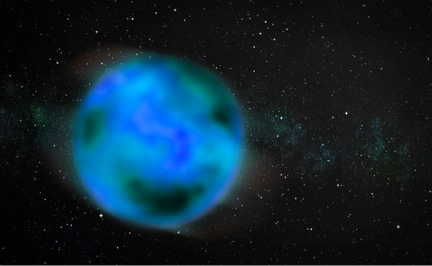
An artistic rendition of a nomad object wandering the interstellar medium (intentionally blurry to represent uncertainty about whether it has an atmosphere). A nomadic object may be an icy body akin to an object found in the outer solar system, a more rocky material akin to asteroid, or even a gas giant similar in composition to the most massive solar system planets and exoplanets. (Credit: Greg Stewart/SLAC National Accelerator Laboratory)
There may be 100,000 times more wandering “nomad planets” in the Milky Way than stars, and some may carry bacterial life, according to a new study by researchers at the Kavli Institute for Particle Astrophysics and Cosmology (KIPAC).
If any of these nomad planets are big enough to have a thick atmosphere, they could have trapped enough heat for bacterial life to exist,” said Louis Strigari, leader of the team that reported the result in a paper submitted to the Monthly Notices of the Royal Astronomical Society.
Last year, researchers detected about a dozen nomad planets, using a technique called gravitational microlensing.
A confirmation of the estimate could lend credence to another possibility mentioned in the paper — that as nomad planets roam their starry pastures, collisions could scatter their microbial flocks to seed life elsewhere.
KIPAC is a joint institute of Stanford University and the SLAC National Accelerator Laboratory.
Ref.: Louis E. Strigari, et al., Nomads of the Galaxy, 12 Jan 2012, ArXiv, http://arxiv.org/abs/1201.2687
Ref.: Jack Singal, Nomadic Planets May Swarm the Galaxy, Tidbits from 2012, Kavli Institute for Particle Astrophysics and Cosmology, 22 Feb 2012.
Comments (20)
by uk superior courseworks
This is my term paper topic. How can there be liquid water if the temperature is over 3,000 degrees? Only liquid water on the side not facing the sun?
by pjdu4
Perhaps Khannea Suntzu’s “cryo-civilizations” could keep themselves warm by nuclear reactions.
By the way, Charles Stross’ fictional “Accelerando” (which I found both funny and though provoking) implies that life which chooses to remain biological eventually gets driven away from it’s star by the power-hungry in-silico life forming a variant on Dyson Spheres. The book also proposes some responses to Fermi’s paradox that’re unrelated to Drake’s equation.
Our civilization’s on a sun-warmed planet, and even if all civilizations start out so, they needn’t remain so.
(I mean none of this to detract from the value that Dr. Drake’s ideas have provided, of course!)
by silentrage
Yeah, you can use “logic” to show collisions between planets must be rare, yet the moon is probably created by a stellar collision, and the earth itself has been struck by asteroids and comets numerous times in recorded history, and there is good reason to suspect Jupiter had been struck numerous times.
The odds of collisions are clearly high enough to happen frequently on a cosmological time scale.
by Spikosauropod
We don’t have a three body equation, much less a 100,000+ body equation. You can’t do this kind of astrophysics without a super computer. I think one mistake people are making is to think of one body striking another. The real probability is that of any body striking any other. See the shared birthday problem: http://www.npr.org/templates/story/story.php?storyId=4542341
by Dan Robinson
This backs up what I’ve long suspected, that there’s no big mystery about “dark matter”. When we look at the night sky, we see things that glow and things close enough to a star, so far the sun, and to us, to be seen by reflected light. Everything else is “dark matter”, in globs of whatever size. Where has there ever been evidence that this isn’t at least part of the explanation?
by Editor
Astrophysicists’ use of the “dark matter” wording was unfortunate. It’s thought to be mostly not ordinary (baryonic) matter.
by andmar74
gaoptimize, I don’t think it’s so clear cut. Yes the chance of a direct collision planet-planet is close to zero, the estimate of 100,000 nomad planets per main-sequence star, gives a huge number of nomad planets in the galaxy.
Also, one could think of other ways collisions could happen, like if the nomad planet is gravitationally caught in a stellar system and doing a lot of orbits in an irregular fashion until hitting a planet.
by Spikosauropod
Post Singularity, I’m claim’n myself one big frackin rock!
by Phil Rounds
Before speculation runs wild, let’s not forget that the Earth’s core is kept active by the tidal forces of the sun and moon as well as pressure and radioactive materials. These planets are unlikely to be subjected to the tidal forces which maintain a good deal of the Earth’s core temperature. The abundance of rogue planets is still speculative…at this point, it’s merely a guess. I think we need more info before we begin visualizing alien life forms on vagabond worlds.
by Conrad Green
i doubt a lifeform needs heat. that would be based on what their genetic makeup was. they may not need heat, water or air. it could be the opposite or in between. We just base things on what we know and this is why we advance slowly.
by Joe
Yes, gaoptimize please explain. If there are 100,000 times more nomad planets then stars. The likelihood of one falling into a stars gravity well and thus falling into an orbit seems high to me. Once this happened a collision would be very likely.
by Logic
Is there a link for more information? I did a Google search and it looks like the original source is Space.com
http://www.space.com/14667-nomad-alien-planets-wandering-galaxy.html
KIPAC is at http://www-group.slac.stanford.edu/kipac/ but I don’t see a quick link to this story.
by Editor
Press release: http://news.stanford.edu/news/2012/february/slac-nomad-planets-022312.html
Paper: http://arxiv.org/abs/1201.2687 (free access)
Article on KIPAC’s web site: http://kipac.stanford.edu/collab/research/highlights/tidbits2012/nomads
by Jacko
Can’t see why a nomad wouldn’t retain geological heat for a long, long time. Our own sub-ocean vents tell the tale of zero need for light. Heat is what you need. Couple that with a thick atmosphere ,some water, and life, even complex life, could be open for business.
by Khannea Suntzu
This opens up the potential for advanced technological cryo-civilizations to simply stop bothering with hot, dense, turbulent systems and eke out an existence in the interstellar void. Imagine an earth size planet, massive cryo-volcanism.. and under the frozen CO2/Methanne/Nitrogen ice later a liquid ocean kept warm my core decay.
Same seems to be happening in most outer system moonlets and KBO ice balls.
A universe full of Europid subsurface oceans… humans might be the odd (or hot!) one out.
(“beware of the solarids ! They are all insane !”)
by gaoptimize
If a star in our gallaxy were the size of a grain of sand, the nearest star would be miles away. This is why when galaxies collide, the odds of any star hiting another are remote. Stars are HUGE compared to planets, and their gravitationally-ralated cross section for collision is ever greater, far exceeding the increased likelihood due to the number of “nomad planets”. So the odds of “nomad planets” hitting eachother in interstellar space is near null. A proper calculation of the odds would take a distribution of densities and relative velocities of “nomad planets” and calculate the probability that they would find themselves, due to gravity, near to a star (high planet density area) and then use that distribution of “nearness”, assuming some planet density and range of sizes, to calculate the probability of a collision. Assuming a proper range of stellar masses and their density in the gallaxy, along with some range on the number and size of planets in orbit about each star (by all means, use a high estimate, but it will be far, far less than the mass of the star itself), one could do a ROM of the probability of a collision. The odds of a collision with a planet would be many orders of magnitude less than the odds of collision with the star itself. The extremely remote odds might be higher in the gallactic core, but life may have other more challenging problems there.
by Jaze321
I would say that the probability of Rogue Plants colliding is near null as well. However impacts from asteroids, comets and other space debris is probably quite common. With the these impacts it is likely that large amounts of planet material is flung into space. Then again this is the case with all planets. I highly doubt that any life bringing material was flung from these rogue plants when it could have just as easily came from planets in fixed orbits around stars.
by pjdu4
I wonder why they would bother to stipulate “microbial life”, which is (here) more complex and almost always in need of not being at absolute zero. Much simpler life would be more plausible.
by gaoptimize
I’m sorry that astrophysics at Stanford has declined so rapidly. This is why self respecting physicists may date astronmers, but its better to keep the relationship purely physical.
Suggest KIPAC assign a physics undergrad to calculate a range on the probability of a collision of a “nomad planet” with another planet and report back on how many, if any, would be expected in our galaxy every billion years. This article is an example of chronic innumeracy and a complete lack of comprehension and awe for the vastness of interstellar space.
by Editor
Gaoptimize: could you explain a bit more about what’s wrong with the nomad planet model? Thanks.