Have astronomers found chemical precursor to life in gas clouds?
January 14, 2013
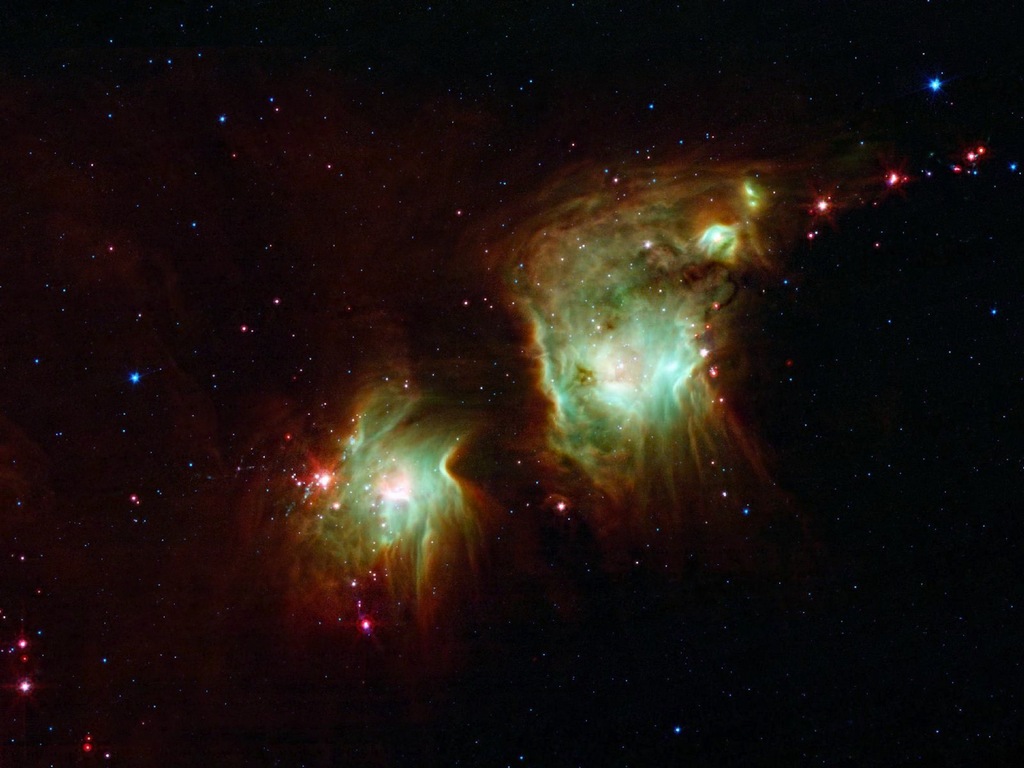
The hydroxylamine molecule is believed to have had a vital role in cooling down the first stars of the universe, and may still play an important part in the formation of current stars. Above, new stars burst into being in the star-forming nebula Messier 78, imaged by NASA’s Spitzer Space Telescope. (Credit:: NASA/JPL-Caltech)
Astronomers have found tentative traces of a precursor chemical to the building blocks of life near a star-forming region about 1,000 light-years from Earth, Space.com reports.
The signal from the molecule, hydroxylamine, which is made up of atoms of nitrogen, hydrogen and oxygen, still needs to be verified. But, if confirmed, it would mean scientists had found a chemical that could potentially seed life on other worlds, and may have played a role in life’s origin on our home planet 3.7 billion years ago.
Some astronomers think that the ingredients for life are formed in cold, gas-, dust- and plasma-filled interstellar clouds. Comets, asteroids and meteors forming in these clouds bear such chemicals, and as they continually bombard planets, they could have deposited the chemicals on Earth or other worlds, said Anthony Remijan, an astrochemist at the National Radio Astronomy Observatory in Charlottesville, Va., who led the research effort.
To test this theory, astronomers look for the chemical fingerprints of simple, inorganic compounds forming in interstellar clouds. These compounds aren’t life or even carbon-based, but they can react with other molecules to form some of the building blocks of life, such as amino acids or the nucleotides that make up DNA.
In recent years, scientists have found several different prebiotic molecules in space, said Brett McGuire, doctoral candidate in chemistry and chemical engineering at the California Institute of Technology.
Comments (6)
by Duane Kuss
The natural flow of the universe lies in the law that all things exist with self actualizing purpose and are unified with other entities in the constant movement toward the creation of even greater complexity.
Reality is purely a moment in time where what you perceive is given a story of meaning and purpose.
by ErikSMeyer
I don’t know, it seems to be that we could do more to sustain actual life we know about here on Earth, since we get so excited about the possibility of alien conditions making life marginally more possible than thought wherever else.
How many animal species stand on the verge of needless extinction because of loss of habitat brought about by human over-expansion?
I care a lot more about lions and elephants than I do about the possibility of coming across some unimaginable and likely highly hostile/toxic extraterrestrial life form.
It seems to me that everyone gets all worked up about the idea of alien contact because they think the aliens will
1. Be more advanced/”superior” to humans, and
2. Have all kinds of wonderful technology that
3. They are eager to share (for reasons that are wholly mysterious to me)
When seems more likely: if alien life exists at all (within meaningful proximity), it will
1. Contain within it microbes against which we have no defense (resulting in mass human death on exposure ), and/or
2. View humans as a threat/target for exploitation, once aware of our existence
If you ever did make “contact” you’d probably just disturb a mass of creatures who hate you and decide they want you dead.
I suppose they might keep copies of some of your machines around, which would be good enough for most of the singulatarians…
by GatorALLin
I guess that I have never been a fan of thinking that comets or meteors could deliver the building blocks of life after being super heated and likely exploding a they hit another planets surface or burn up mostly as they enter a possible atmosphere. I am a bigger fan of having a 3rd Gen star like earth and a rocky planet like earth with all the building blocks already there. I think there are likely a few dozen Goldilocks or more conditions that must be in place (or done in a specific order) and likely takes millions and millions of years to get going…..and then a billion or so more years to develop…. if you lose your sun during that time, or lose your atmosphere or a dozen other bad things happen during those few billion years….. game over.
I always heard the idea that earth was a hot mess during the first few million years, but what if that was not true….what if there was surface water on earth from the very start? see more here http://www.npr.org/blogs/krulwich/2013/01/10/169047159/the-oldest-rock-in-the-world-tells-us-a-story?utm_source=NPR&utm_medium=facebook&utm_campaign=20130111
by GatorALLin
Space seems to be a very sterilizing environment…. if there are meteors that help spark life other places, then where is it? Why nothing on Mars for example that had an atmosphere and had liquid water on the surface likely for billions of years and would have been hit by many of the same meteorites over billions of years. Why no life on any of the moons, or any other planets in our solar system (yeah, I know, we are not done looking). If you are just a bit too close an orbit to the sun you burn up life, if you are just a bit too far away you freeze solid. If your planet size is too big you are a gas like planet. If your planet does not have a liquid core then you likely don’t have a shield for protecting against solar radiation, if you don’t …. (keep doing this for about 30 – 50 more things). I don’t want to come off negative. but I am a firm believer in http://en.wikipedia.org/wiki/Rare_Earth_hypothesis
by Joel C.
We don’t know enough there is to know. We’re still looking and someday we will come across a silver bullet that will tell us exactly what led to life on Earth.
by nfordkrz
There are places on Earth where we never thought life could exist until we found out that it does.