Hidden world: molecules inside cells that grab DNA like rock climbers
October 29, 2012
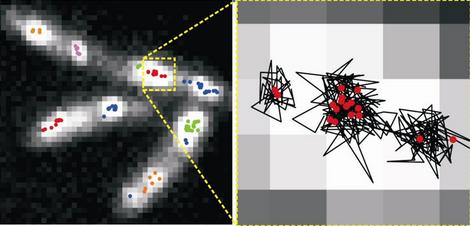
Imaging the molecular machine MukBEF using flourescent tags attached to its component parts. (credit: University of Oxford)
“Each machine functions in much the same way as a rock-climber clinging to a cliff face,” says Mark Leake of Oxford University’s Department of Physics.
“It has one end anchored to a portion of cellular DNA while the other end opens and closes randomly by using chemical energy stored in a ubiquitous bio-molecule called adenosine triphosphate (ATP), the universal molecular fuel for all living cells. …
Using new imaging technology, Oxford University researchers have found how the molecular machines that remodel genetic material inside cells grab onto DNA like a rock climber looking for a handhold.
The experiments use laser light to generate very bright patches close to single cells. When coupled with fluorescent tags this “spotlight” makes it possible to image the inner workings of cells fast enough to see how the molecular machines inside change size, shape, and composition in the presence of DNA.
The molecular machines in question are called Structural Maintenance of Chromosome (SMC) complexes. They remodel the genetic material inside every living cell and work along principles similar to a large family of molecules that act as very small motors performing functions as diverse as trafficking vital material inside cells to allowing muscles to contract.
The researchers studied a particular SMC, MukBEF (which is made from several different protein molecules), inside the bacterium E.coli. David Sheratt and his team found a way to fuse fluorescent proteins directly to the DNA coding for MukBEF, effectively creating a single dye tag for each component of these machines.
Up until now conventional techniques of biological physics or biochemistry have not been sufficiently fast or precise to monitor such tiny machines inside living cells at the level of single molecules.
It is hoped that pioneering biophysics experiments such as this will give fresh insights into the complex processes which are vital to life, and pave the way for a whole new approach to biomedical research at the very tiny length scale for understanding the causes of many diseases in humans, and how to devise new strategies to combat them.