Highest-efficiency flexible thin-film solar cells
January 21, 2013
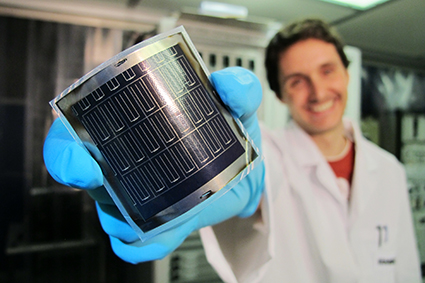
Scientists at Empa, the Swiss Federal Laboratories for Materials Science and Technology, have developed thin-film solar cells on flexible polymer foils with a new record efficiency of 20.4%.
The cells are based on CIGS (copper indium gallium (di)selenide) semiconducting material.
Thin-film, lightweight, flexible high-performance solar modules are attractive for solar farms, roofs and facades of buildings, automobiles, and portable electronics and can be produced using continuous roll-to-roll manufacturing processes that offer further cost reductions compared to standard silicon technologies.
“The next step will be to scale up the roll-to-roll manufacturing process with an industrial partner,” Flisom, says Empa Director Gian-Luca Bona.
The research is supported by the Swiss National Science Foundation (SNSF), the Commission for Technology and Innovation (CTI), the Swiss Federal Office of Energy (SFOE) and the EU Framework Programmes.
UPDATE Jan. 23, 2013: “There are estimates suggesting that high efficiency flexible CIGS solar cells when produced on large scale industrial plants can potentially lead to manufacturing costs below $ 0.60/Watt. However, to achieve this some challenges have to be overcome. — Ayodhya N. Tiwari,Ayodyha N. Tiwari, Empa Laboratory for Thin Film and Photovoltaics team leader

Comments (18)
by Tom Moriarty
They are looking for an industrial partner for the scale up. They can license their process to nanosolar and nanosolar can gain 20% on their existing panels. Nanosolar has had some issues with scale up them selves.
by Bri
I’m happy to see the efficiency increase but I hate hearing about indium or gallium. They are very useful materials that are relatively rare and have very unique attributes. I’d rather see them used for other purposes. My bets are on carbon. It may be a ways of but it will eventually beat the other materials in just about every way. It’s good science though.
by daveb
Nanosolar is already doing this with CIGS on roll-to-roll printers. Their panels are at 17% *MAX*. The issue is that not all panels can reach the theoretical maximum, there are costs related to substrate, building durable panels, and so on. A 20% efficiency milestone is nice, but these folks are a looong way from real world production. I want to know about the substrate, weight of the panels, and so on. I don’t think we will see a true solar breakthrough in the market until the cells can triple in efficiency (through capture of visible+invisible spectrum, capture of heat) and the materials are mundane, such as graphite. This particular product sounds nice, but it is not the gamechanger that quantum dots or nano-engineering will bring.
by Stephen w
Good thin film solar cells would make for great solar powered blimps.
by Matt
How about solar assisted sail boats?
by Derek
Isn’t that how all technology works? First you get to the goal then you go into mass production and then price starts dropping. Until then we just keeping paying the hydro bill.
by GatorALLin
fun solar related project: http://www.kickstarter.com/projects/alex9000/the-solar-pocket-factory-an-invention-adventure?ref=live
by gaoptimize
Major: Agree with your comment. I’ll add this article to the list of at least 5 in 2012 as to why I have yet put solar on my roof. Nowhere in the article to it discuss the $/Watt (installed). I have ~50m2 of south-facing roof. The issue isn’t trying to get 150 watts per square meter (peak). It is getting 5KW for $10K installed. That should be the mantra on the solar industry “5k for 10K”.
by Editor
$/watt not available in Empa materials. I just sent a request for that data.
by Editor
$ 0.60/Watt — see UPDATE
by Major
Price is the problem, not efficiency.
by Gorden Russell
As efficiency increases, you will need fewer cells in your array, which makes them cheaper.
I just did a quick search and found that selenium sells for $65 per pound, indium for $99 per 100 grams and gallium for $77 per 50 grams.
This CIGS compound should be cheap once mass-produced.
by Gorden Russell
Go back and read the paragraph that begins, “Thin-film, lightweight, flexible high-performance solar modules are attractive for…”
They just might be light and flexible enough to be made into part of a common roofing shingle, or even coated onto a roll of tar paper. When any roofer can put them up on your roof, the price will come down.
by asiwel
I know rather little about this but suspect that other weathering and temperature related sustainability factors are involved here. During installation, all of these “panels” or shingles have to be interconnected in various ways, especially so if one fails, the whole roof doesn’t fail. Then there is the electronics needed to “modulate” the electricity produced to be, say, 110 vac, etc. Then more electronics to store, sell, or draw extra power to/from the regular grid, etc. Not too likely yet that “any roofer” will be able to do the job .. so skilled labor is involved. Not to mention cosmesis factors, e.g., the thing needs to be “attractive” looking. All of this and more are part of the $/kw calculation in cost/benefit analysis. Nevertheless, the technology discussed in this article does seem to be quite an advance in efficiency and utility.
by godot
All good points, asiwel, but conceptually all that is required for isolation from “failed shingles” is a diode. And all of the electronics to convert between low voltage DC provided by solar “cells” and 110 VAC and the power grid, etc., has been available as finished closed-box commercial units from Northern California companies for decades. There are really no problems but cost and efficiency.
by asiwel
True. About the wiring and particularly the electronics packages. And “…thin-film solar cells on flexible polymer foils with a new record efficiency of 20.4% …” are pretty darn good, especially if the manufacturing techniques are scalable to continuous roll-to-roll manufacturing. Still, I suspect installation and sustainability are significant cost factors. It will be a good thing when this “home” industry really gets going and these costs come down.
by godot
Touché.
by josdorpjossie
The guy who put the solar panels on my house was not a highly trained specialist. Placing solar panels is not rocket science anymore. Most of the price goes into the panels, and only little into placing them.