How attention helps you remember: the role of astrocytes
October 1, 2012
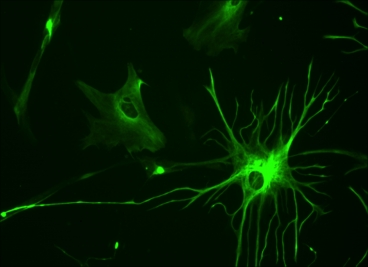
A new study from MIT neuroscientists sheds light on a neural circuit that makes us likelier to remember what we’re seeing when our brains are in a more attentive state.
The team of neuroscientists found that this circuit depends on a type of brain cell long thought to play a supporting role, at most, in neural processing. When the brain is attentive, those cells, called astrocytes, relay messages alerting neurons of the visual cortex that they should respond strongly to whatever visual information they are receiving.
The findings are the latest in a growing body of evidence suggesting that astrocytes are critically important for processing sensory information, says Mriganka Sur, the Paul E. and Lilah Newton Professor of Neuroscience at MIT and senior author of the paper.
Sur’s lab has been studying astrocytes for about five years, as part of a longstanding interest in revealing the functions of different cell types in the cortex. The star-shaped cells were first discovered and named 150 years ago, but since then, “it’s been a mystery what they do,” says Sur, who is a member of MIT’s Picower Institute for Learning and Memory and director of the Simons Center for the Social Brain at MIT.
Attention strengthens response
In this study, the researchers focused on what astrocytes do when the brain is stimulated to pay attention to a specific visual stimulus. When someone is paying close attention to something, the nucleus basalis — a structure located deep within the brain, behind the eyes — floods the brain with a neurotransmitter called acetylcholine. Some of this acetylcholine targets astrocytes in the visual cortex.
To explore how astrocytes react to this stimulation, the researchers measured what happened in the visual cortex as they showed mice several visual patterns composed of parallel lines oriented in different directions. For one of the visual patterns, the researchers also provoked the nucleus basalis to release acetylcholine at the same time. This greatly boosted calcium levels in the astrocytes, indicating high activity.
When the mice were shown the same stimuli a few minutes later, the pattern that had been presented along with acetylcholine stimulation provoked a much stronger response in neurons of the visual cortex than the other patterns.
The researchers then did the same test in genetically engineered mice whose astrocytes were disabled. In those mice, the acetylcholine released by the nucleus basalis did not strengthen neurons’ response to visual stimuli.
“If you are paying attention to something, which causes this release of acetylcholine, that leads to a long-lasting memory of that stimulus. If you remove the astrocytes, that doesn’t happen,” Sur says.
The strengthening effect lasts for tens of minutes, after which the neurons return to their original activity level in response to the selected stimulus.
“More directly than any other study to date, it illustrates the critical role of astrocytes in plasticity,” says Michael Merzenich, a professor emeritus of neuroscience at the University of California at San Francisco, who was not part of the research team. “It’s a crystal-clear demonstration.”
‘Major players in brain disorders’
It is already known that acetylcholine levels drop in the brains of patients with Alzheimer’s disease. In fact, a commonly used treatment that can boost memory in Alzheimer’s patients is a drug that blocks the degradation of acetylcholine. In a follow-up study, the researchers are planning to study how astrocytes are affected in mouse models of Alzheimer’s.
Sur’s lab is also studying the effects of nucleus basalis stimulation on inhibitory neurons. Those effects are thought to be shorter term, lasting seconds or fractions of seconds.
“You cannot understand brain disorders without understanding the basic mechanisms of cortical brain function,” Sur says. “These cell types — astrocytes, inhibitory neurons — are emerging as major players in brain disorders, in unexpected ways.”
The research was funded by the National Institutes of Health and the Simons Foundation.

Comments (12)
by GatorALLin
I am always amazed at how certain smells, tastes or sounds/songs trigger strong memories of a specific place or time for me. For example when I order creame brulee at a resturante (about once a year at most) it always comes with a small piece of fresh green mint leaves to top it off… the smell of the fresh spearmint transports my memory to a place in Kentucky where there is a natural spring coming out of the mountain side and fresh mint would always grow there. I am flooded with childhood memories of this exact spot each time where we would pick and eat this mint (with bare feet in the cold green grass and moss/ferns of that spot, damp with 54 degree cold air that would come out year round). If I close my eyes the memories are all consuming and very vivid with details of other smells and details of that place. The cold spring water on a hot summer day, the sounds of the spring area, the exact trees, location, type, etc. A bit like a time machine… I have since been back to that exact spot a few times just to confirm if my memories are correct. The huge weeping willow tree has since died, but the stump is still there…the mint is still growing, the other details (including natural growing mini strawberries) are still all there. I guess what strikes me odd about it is that just before I bite the fresh mint it has been so long since the last time I have thought about it that I have completely forgotten about it…. the memories come flooding back and catch me off guard each time. A bit of a “safe place” from a better time and place… all good memories…. a welcomed intrusion of sorts during some regular business dinner conversation.
…anyhow this article had me wondering about how smells, tastes or sounds help trigger memories… or if we could somehow use sounds, smells, tastes or other triggers to help better record memories?
http://www.ehow.com/how_8531551_propagate-kentucky-mint.html
by Bri
Smells access a very primal part of the brain. From a time before other senses became more central.
by Marcos Marin
look, Bri! our minds are syncing! we clicked that submit button almost at the same time! I’ve just refreshed the page and your answer was not there before I replied! =)
by Bri
Probably means that we are metronomes, and there is a movable board under us.
by Marcos Marin
makes sense. =) There was a video about it yesterday, right?
by Marcos Marin
That’s simply because odor input goes through one less layer of signal processing, almost directly to the amygdala.
Beautiful words but, wait, aren’t you all doing that already? How impoverished has the post-modern world’s environment become?!
hmmmm.. that explains a lot…
by chrisf
Well, assuming there are 10 times as many astrocytes as neurons, and assuming that they’re doing an equivalent amount of computation, I make that a little over 3 extra doublings. What’s that, an extra 5 years perhaps, in the worst case ?
by Marcos Marin
ahhh.. the fresh aroma of astrocytes in the morning….
so refreshing around here… say, Robin Hood, was that so hard? After all those centuries one should have “transcended” one’s misplaced sense of justice, with or without a singularity, no?
Thank you, Chrisf. =)
by trakk
So all that ” PAY ATTENTION” yelling by our teachers in school and college is responsible for helping us remember what little we still remember :)
by Marcos Marin
Mwahaha, So it’s not JUST those 100 Billion neurons, right Mr. Kurzweil? How many doublings does it pushes AI into the future?
by Robin Hood
Your comment is very ironic. You are responding to an article that is proof of increased understanding of how the human brain functions. In other words, another step closer to reverse engineering the brain. and yet you laugh at and mock Ray Kurzweil as if it proves something. You’re right, it proves that you’re wrong.
by Marcos Marin
All my comments are ironic, I’m the court Jester, dear Robin, only rivaled perhaps by the Green Hood himself!
I’m not mocking Ray! My admiration for him is relatively high, only rivaled perhaps by laughing itself!
I don’t think you’re really interested in discussing epistemology with me, my dear ironic friend, after all, your not alone when misinterpreting my straightforward questions. Therefore I’ll simply focus on your lonely pearl of wisdom: “You’re right, ” And I could not agree more ;-)