How improved batteries will make electric vehicles competitive
November 9, 2012
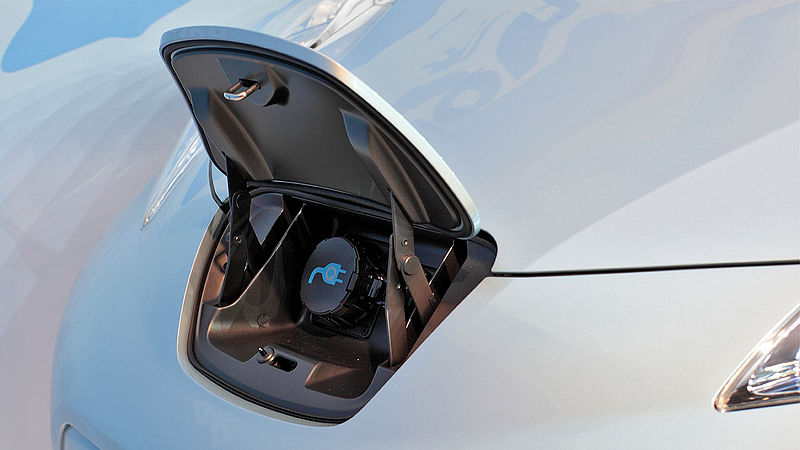
Electric cars like the Nissan Leaf are expensive. Cheaper batteries could eventually change that. (Credit: Tennen-Gas/Wikimedia Commons)
For electric vehicles and plug-in hybrids to compete with gas-powered cars, battery prices need to drop by between 50 and 80 percent, according to recent estimates by the U.S. Department of Energy.
Improvements to the lithium-ion batteries that power the current generation of electric vehicles may be enough, MIT Technology Review reports.
Electric vehicles cost less to operate than gas-powered ones, but that economic advantage largely disappears in the face of expensive batteries. The battery pack for the Chevrolet Volt costs about $8,000. The larger battery in the Nissan Leaf costs about $12,000.
But the cost for the Leaf battery could drop to under $4,000 by 2025, according to a recent study by McKinsey, just by increasing the scale of battery production, forcing down component costs through competition, and approximately doubling the energy density of batteries, which reduces materials costs.
One startup, Envia Systems, has already built prototype lithium-ion battery cells that store about twice that of the best conventional lithium-ion batteries and can be recharged hundreds of times (see “A Big Jump in Battery Capacity” and “Should the Government Support Applied Research?”). And crucially, it’s similar enough to conventional lithium-ion batteries that it can be made on existing manufacturing equipment. The technology still needs work, and could take several years to start appearing in cars, the company says.
Not everyone agrees that lithium-ion batteries can reach the low costs needed for electric vehicles to compete with gas-powered ones (see “A123’s Technology Just Wasn’t Good Enough”). Toyota, for one, is investigating more dramatic changes in battery design. One type it’s developing replaces the liquid electrolyte in a conventional lithium-ion battery with a solid material, something that allows for a number of changes in the battery design that could shrink the system and lower the cost. These solid-state batteries and other technologies could cut the size of a battery pack by 80 percent, according to Toyota. Sakti3, a startup with close ties to GM, is also developing solid-state batteries, and recently started shipping prototype batteries to potential customers for testing, says CEO Ann Marie Sastry (see “Solid-State Batteries”).
24M, an early-stage startup based in Cambridge, Massachusetts, is taking a different approach — rather than an all-solid battery, the company is developing a cross between a battery and a fuel cell in which the battery electrodes are a sludgy liquid that can be pumped around. The energy storage material could be stored in inexpensive tanks, and then pumped into a small device to generate power (see “A Car Battery at Half the Price”).
Despite the novel designs, solid-state batteries and 24M’s technology still operate with a familiar lithium-ion chemistry, which could make them less risky to commercialize than more radical approaches that move beyond the lithium-ion chemistry. But these new batteries have theoretical energy densities several times that of today’s electric car batteries.
Comments (40)
by Aezel
My bet is still on something radically better than anything mentioned here, and well before 2025. Lithium Ion is just not the answer, taken to it’s extreme it will never be enough.
by Brian H
BTW, the Leaf and Volt, etc., are wimpy jokes. Check out Teslamotors.com for real electric cars. The company is currently setting up nation-wide FREE fast-charge stations for its Model S 200+ mile cars for long-distance travel. Free for life, powered (grid power-swaps) by Solar City arrays.
by dbamford
The Prius (model, now line) is the envy of the carmaking world. Toyota is winning, and Ford is scrambling to catch up — others are still chasing and eating dust. Announced today that Ford is tripling-down on hybrid dealerships. http://evworld.com/news.cfm?newsid=29156
Tesla itself is relying on partnerships (and investments from ) Toyota and Daimler to bring production-relevant EVs to the market (not high-priced executive-model “toys”). EVs are the future of consumer cars, it is obvious for anyone not wearing blinders.
by William Collins
This is strange for this board, to hear such un-informed commentary and even some flaming, kids perhaps?
So, has anybody hard of super capacitors? These as well as roads that can provide a light version of inductive current are one viable option, cars can charge as they drive from a variety of methods that have not been considered. Also note that cars, roads, and other forms of transportation and energy utility are grossly inefficient. Even at the moment a Kers type system could be implemented in all cars and together with a hybrid architecture could make all cars run above a 45mpg level. Also note that even if you are a gashole you can surely see that a combustion motor is terribly inefficient, like a tungsten bulb it spends most of its energy on heat, how about two-stroke technology, and when I say this I mean a modern two stroke. Consider the thermal efficiency of a two stroke to a four stroke and you begin to see the picture; these issues are much bigger than a scientific problem, this is a political and socioeconomic issue, the powers in control of the market will not let it go. Would you?
by Katherine MacLean (old science fiction writer and research fan
With cell phone links between office workers less commuting & less car use,& only 2 children per woman and delayed children by banking sperm and eggs away from mutation & with youth extension for the women to choose a full career before having children—In other words, reduce the population and live green. and walk and bycycle. Pollution will go down down.enough .Cars and coal burning &,oil burning factories are not needed..Pollution is not essential to keep the energy rolling.Solar panel tech has been improved, cheaper mass produced sheets of carbon based solar energy collection sheets that roll up and ship easily. Gov can help with subsidies and prizes, and tax smoke for the cost of its consequences. Carrot and stick to speed up the conversion to solar energy. If `poor populations did not have to burn wood to cook their food land and big deserts could grew green cover and trees and level out the climate extremes with shade. America’sr mid country could do with tree belts cooling the heat and dryness of 20 mile squares of only.farm corn and grains.
Sorry! I got off the topic. I want an electric car with lasting batteries and charge it from solar cloth rolls panels on every flat surface..of house and use panals for yard shade in summer. Sail boats can use solar panals for sails. and get power .too. Cruising in the tropics in houseboats, with solar collecting sails and air conditioners . Ahhh!. .
by Brian H
Sufficient to sustain about 1/20 of current population. Reductions urgently required! You first.
by NeoCool
they said that with current technology and just by increasing manufacturing we will have better batteries by 2025. That is not looking exponentially at the problem. by 2025 we will have much better battery tech at a much lower cost.
by piratejoe
Every time there is talk about the wonderful world of electric powered autos, somehow, it is never mentioned that even if there was a magic breakthrough that provided a super battery, the massive recharging that would happen every night would burn millions of tons of fossil fuels, be it oil, coal or natural gas, producing tons and tons of pollution. Where’s the advantage? Nuts!
by Gorden Russell
There was an article posted here just in the past few weeks telling of new carbon photovoltaic cells that can be printed on any surface. Soon cars will be covered with photovoltaics that will recharge during the day while you are at work. Carbon solar cells will be made part of roofing shingles and more and more people will buy them as fuel prices climb from the competition of a growing global market for autos and trucks.
During the day, photovoltaics on your roof will power hydrolysis to split water into hydrogen and oxygen to fuel your hybrid car.
Looking even farther ahead, rooftop wind turbines will also be cheaper when rare earth metals are mined on the Moon and on asteroids. On a windy winter’s night here in Syracuse you will still be able to charge up your car.
by snake0
Such super batteries would also aid renewable energies such as solar wind and geothermal power.
And there’s always nuclear…
by piratejoe
Hey, idiot! The wind may blow at night, but the sun goes down. Together, with millions of solar cells and wind turbines pocked marked all over the countryside, do you think that they will be able to power the recharging of the tens of millions of batteries necessary to power all of the super auto batteries that will be hungry every night in the year 2025? Get real everybody. There is no energy source here or in the foreseeable future, except fossil fuels.
by AZryan
Hey Troll, don’t call someone an idiot who hasn’t said anything idiotic! No kidding the ‘sun goes down’. How idiotic of you to think anyone didn’t know that!?
There are methods of storing solar power to carry-over through the night -which could be used to great efficiency if we made an excess of clean power in the day. But no one is calling for fossil fuels to be halted tomorrow. It’s a well-studied FACT that we could power the entire country with clean energy 24/7 if we wanted to. It wouldn’t even have to be ‘pockmarked’ as you claim.
Plenty of rational people (of which you obviously aren’t one of) simply suggest we move towards this clean energy independence with reasonable haste.
As I wrote further down, the advantage you apparently doubt exists is in causing FAR LOWER levels of pollution even when you charge electric cars from fossil fuel plants vs. gas cars we have now. Moving, of course, to pure clean energy lowers that towards zero when every level of manufacturing draws clean power. Try looking into studies of how much wind and solar power hit the US per day if you have any interest in actually learning something.
by Brian H
Dilute and dispersed energy? Great idea! The exact opposite of what got us out of the caves and the fields!
CO2, btw, has failed every test and prediction as a climate changer. But has been proven to boost agriculture and forests. It obviously must be eliminated.
Yup. Duh. Yup.
by Rb
“It’s a well-studied FACT that we could power the entire country with clean energy 24/7 if we wanted to”. Yea you are totally right, we just don’t feel like it… Actually, we enjoy wasting billions of dollars every year to suppress humankind and accelerate global warming just for kicks. Maybe you are the one who should look into studies and actually learn something.
by AZryan
Enough wind and solar hits the US to EASILY power the nation. FACT.
We already have the technology and ability to make the panels and turbines, etc that could collect what we need. FACT.
Same idea as saying that if we wanted to we could power the nation on nuclear power.
Your pathetic argument is that because we’re not doing what we ‘could be’ doing…that must mean we can’t do it!? I also like how you don’t even attempt to make a case for such stupidity.
Maybe you should learn what FACTS are troll before you tell other people to reexamine the ones they’ve already seen.
by snake0
The tides also continue to move at night. The earth still gives off heat at night. But regardless of that, my argument was that renewable energy would be aided by batteries, which would store the energy produced during the day to be used during periods of low input (such as when the sun sets). Your argument did nothing to contradict my statement. Batteries WILL be able to hold more charge, as the technology improves. That’s not a debate, its a fact.
by Gianluca Bonifazi
I can only tell you: space-based solar power (http://en.wikipedia.org/wiki/Solar_satellite). That’s all we’ll need, for every use you can think of. And about the night’s problem, this issue has been already worked out: Germany is already building hydrogen’s tanks to store the energy produced by photovoltaic cells during the day.
by jonagold
The advantage are 1. Renewable energy can be used. 2. Reduced oil spills. 3. Less dependence on petro-dictatorships, weakening such powers and enabling democratic reforms.
by Brian H
US now produces/pumps most of its own oil and gas. Barely getting started; the GAO estimates the US has as much light “tight” oil recoverable resource (present tech) as the rest of the world COMBINED. Get used to it; the US is an Oil Superpower for the next few centuries.
by Brad
If we use the oil we have in the US for the next century we will create a planet so warm we won’t be able to survive in the US, other than maybe Alaska. We’ve got to leave most of our fossil fuel in the ground or we won’t make it.
by botheredbybees
why wouldn’t people recharge using solar technology during the 8 hours their cars are sitting about while they’re at work?
by Brian H
Cloudy days; winter; expense.
Much better sources at <10% current prices are coming, soon (4-10 yrs.) Ultra-hot, ultra-small, waste-free fusion: LPPhysics.com .
by Brian H
That’s <10% current BEST prices, btw. Below 1¢/kwh. Anywhere and everywhere.
by Jerry
I had to read up on this LPP company, they are just in the test phase with a proof of concept experiment. If you think they can go from proof of concept testing to a commercial application in under 20 years you are really out of touch with reality. I think you’re simply too excited by the possible advances to consider the reality of transitioning from paper to product.
Solar is a massively growing industry and will continue to grow exponentially year over year. We won’t have any fusion for at least 30-50 years if things go according to plan, and more likely based on Tokamak than Focus Fusion.
Large generators “can” be more efficient, but as we’ve seen with the web, peer-2-peer power generation on small scales will be the more likely victor in the future. Especially with the growth of solar. We’ll likely expand our ability to generation and capture energy from a multitude of sources rather than one big huge plant.
by Brian H
The power required is generated anyway, and mostly goes unused. Large generators are/can always be more efficient than millions of little badly maintained (by comparison) putt-putts.
by Bennie Beaver
It’s dizzying to read articles like this one repeating claims I’ve heard before. Someone needs to get together and pick, maybe these three ideas, and let’s create a new Manhattan Project. Let’s get the job done before the environment kills us, or we’re again locked into old hydrocarbons making it even more difficult to change.
I’ve read about new battery ideas that cost less than hydrocarbons to manufacture, and produce enough energy; then they end those claims with, well, it could be many more years before they’re on the market. Give me a break. Someone needs to get together and let’s get the job done. We need a Steve Jobs of the energy development world.
All the talk in the world ain’t worth a spit in a river. Get something done, or shut-up until you got a real plan to conclusion.
I know that may sound a little rough, but that’s the way I feel. How about you?
by piratejoe
What’s the difference — hydrocarbons from exhaust pipes or from smoke stacks? Pollution is pollution.
The only real solution for now is nuclear.
by AZryan
The AMOUNT of pollution is vastly LOWER in using it to power electric cars vs. fossil fuel engines. Even if you charge an electric off of coal-fired power plants, it’s still lower pollution levels. That’s the difference you insulting troll.
by brendan havel
well put, “a new Manhattan Project” same caliber anyway, like you said “before the environment kills us…”
fossil fuels will end we must replace our fuel source before we use up all natural resources of Earth.
by Roger Bullocks
Based on your own argument, I suggest you shut up.
by someday69
It sounds dissapontting…..With such an”ex’cell’erating,future….there time line..for this,,mead’ee’oaker….improvement…six grand difference”-’nice” Oh’you will have to wait..for..let’s see’….18years!!
This is nut’s,,,in eight’teen’freek’in year’s well be”rideing in elctro’magnetic’ flying cars…with’out any’steering wheel’s….(driven bye The System’)
by melajara
Energy production is not reducible to an IT, this is why there is no accelerating returns on that road, although there is progress through nanotech and biotech.
by Christian Gehman
Well, what’s to prevent the current crop of vehicles from air-lifting five or six inches to reduce mechanical friction and drag and steering with vanes except when the wheels touch down for braking?
by Vin
Won’t weather conditions complicate handling, demanding more driver skill and training?
by Brian H
Physics. About which you need to learn something. Pushing on air requires huge velocity of exhaust to move a car’s mass.
by Jerry
Quantum Physics. About which you need to learn something. The GP is likely talking about quantum locking, which is hoped to be put into wide spread use once we find a suitable room temperature superconductor. 18 years is a little too optimistic imo, more like 50.
by snake0
At least we don’t have to wait until the future for talking robots…
by high carbfoods
It is not clear which electric battery as of today is the best to prevent pollution and also save consumer money. It is good to know what is market proven and why details.
by Christian Gehman
Cars don’t have to roll; they could fly — a few inches off the ground at all speeds over 30 mph. With adequate design, the car itself could be a flying wing which only one motive wheel touching the ground.
by Brian H
See above. Observe a hovercraft; you must do real violence to air to move a large mass.