How noise in brain-cell signals affects neuron response time and thinking
August 16, 2012
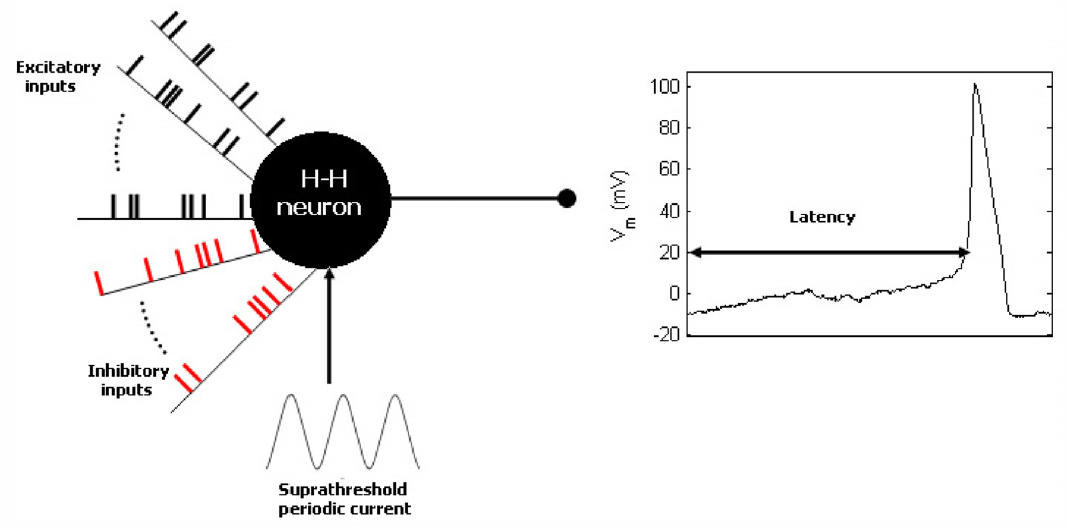
Neural noise sources and resulting spike-latency time (credit: M. Uzuntarla et al./European Physical Journal B)
Biomedical engineer Muhammet Uzuntarla from Bulent Ecevit University, Turkey and colleagues have developed a biologically accurate model of how noise in the nervous system induces a delay in the response of neurons to external stimuli.
A new spike-latency noise model
Information encoding based on spike timing has attracted increasing attention due to the growing evidence for the relation between synchronization in neural networks and higher brain functions, such as memory, attention and cognition. And it has been shown that first-spike latency (arrival time of the first spike associated with information) carries a considerable amount of information, possibly more than other spikes.
The researchers analyzed the presence of noise in the nervous system, detected by changes in first-spike latency (the time it takes for brain cells to first respond to an external stimulus) and jitter (variation in spike timing). The noise is generated by the synaptic bombardment of each neuron by a large number of incoming excitatory and inhibitory spike inputs and because chemical-based signalling does not always work.
Previous attempts at noise modeling used a generic bell-shaped signal, referred to as a Gaussian approximation. The new noise model, published in European Physical Journal B, is closer to biological reality, the engineers suggest.
They showed there is a relation between the noise and delays in spike signal transmission, and identified two factors that could be tuned, thus influencing the noise: the incoming excitatory and inhibitory input signaling regime and the coupling strength between inhibitory and excitatory synapses. Modulating these factors could help neurons encode information more accurately, they found.
Comments (3)
by graham caldwell
dear rob,thanks for your reply i will need to find out more about tinitus and then some. thanks again.graham.
by Rob Hunter
One of the areas I do not see being utilized is the nervous system response during reasearch in neural function. The brain and the body are one. All living organisms have two purposes: Survive and mate. Using the example of danger, evolutionary imperative has determined that in times of extreme danger (extinction events) where the predator already has the “jump ” on you that you not only need a neural decision response (do I fight,flight,freeze) but the body must be ready for that instant physical response. A plan that cannot be executed is no plan at all is it? In survival situations where miloseconds are the difference between life and extinction reacting pysically and cognitively is equally important which is why in times of danger our nervous system is alreading gearing up even before the signal (sensory input) has reached the brain. Thus when researching neural response you cannot get a clear pattern of neural function/firing unless you incorporate the nervous system as well. Simply, you’re missing half of the picture which accounts for confusion and false-positives.
Spike signal transmission influences can better be identified given two factors.
1- What was the cognitive neural function at the instant of new sensory input?
2- What is the “degree” of new sensory input?
For example: I’m walking down the street with a friend talking and talking about the weather (prefrontal neural function) when I see something in a store window that catches my attention. Instant change in cognitive function/ spiking. We stop look and decide we’re not interested which means neural function remains in the prefrontal cortex.
2- This time a man with gun suddenly appears. This new sensory input will instantly (through the amygala) send neural cognitive response into “extinction” mode. Extinction mode causes a shift from dominant neural function to shift from the prefrontal to the hippocampus as my brain begins to search for a response/survival tactic which has two equally important and simulataneous/synchronized responses these being cognitively and spatailly.
What I mean to say is there is increased spiking and supression each time there is new sensory input. What is important is the degree of sensory input.That is another topic.
What I am suggesting is that when attempting to identify spiking in neural function do not forget to look at the nervous system. There is a reason that the Hippocampus is divided into two areas. Memory and spatial.
When not engaged in survival (or mating) the prefrontal rules. An easy test would be to engage a test subject in what I suggested (walking down the street) I garantee that by engaging “extinction” you will see massive spiking in not in just both spheres of the Hippocampus and nervous system but a marked supression in the prefrontal at the same instant.
A simple way to test this theory might be by using the example of two friends walking doen the street.
1- Create a baseline of prefrontal spiking by having them discuss the weather.
2- Have them shift the conversation to sports which they are both passionate and opinionated about. Neural function at its core is emotional (we are what we experince) and there should be a marked shift in not only neural spiking and supression as the topic changes which also will show a marked increase in physical/nervous system baselines: blood pressure, heart rate etc as the argument over who will the upcoming game escalates.
3- When they spot something in a window that catches their interest (say a scantily clothed mannequinn thus keeping with Evolutionary Imperative of surviving long enough to procreate) you should see a dramatic shift from prefrontal neural function to the hippocampus and even more increased nervous system function that might include hastening their pace over to get a better look and changes in blood flow to different parts of the body.
4- Bring in the man with the gun and there should be a definative shift as the prefrontal becomes submissive and both spheres of the Hippocampus take complete control (you might also want to look for an extreme spike in the amygala) and search for a way to respond. That response, or the sucess of that response has everything do with previous experience/memory and is another topic for another day.
I hope this helps.
Rob Hunter
by graham caldwell
could the tuning process help deminish the noise of tinitus.