How sleep deprivation poses risks to physical and mental health
October 17, 2012
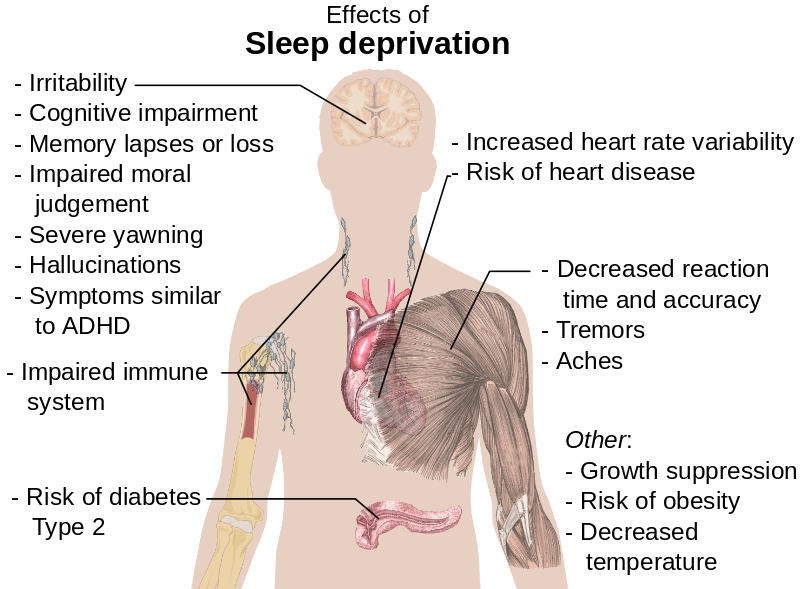
Sleep deprivation effects (credit: Wikipedia)
One in five American adults show signs of chronic sleep deprivation, making the condition a widespread public health problem. Sleeplessness is related to health issues such as obesity, cardiovascular problems, and memory problems.
New findings presented at the annual meeting of the Society for Neuroscience Tuesday report the important role sleep plays, and the brain mechanisms at work as sleep shapes memory, learning, and behavior.
The findings show that:
- Sleepiness disrupts the coordinated activity of an important network of brain regions; the impaired function of this network is also implicated in Alzheimer’s disease.
- Sleeplessness plays havoc with communication between the hippocampus, which is vital for memory, and the brain’s “default mode network”; the changes may weaken event recollection.
- In a mouse model, fearful memories can be intentionally weakened during sleep, indicating new possibilities for treatment of post-traumatic stress disorder.
- Loss of less than half a night’s sleep can impair memory and alter the normal behavior of brain cells.
Other recent findings discussed show:
- How sleep enables the remodeling of memories — including the weakening of irrelevant memories — and the coherent integration of old and new information.
- The common logic behind seemingly contradictory theories of how sleep remodels synapses, aiding cognition and memory consolidation.
“As these research findings show, we cannot underestimate the importance of a good night’s sleep,” said Clifford Saper, PhD, MD, from the Harvard Medical School, an expert on sleep and its deprivation. “Brain imaging and behavioral studies are illuminating the brain pathways that are blocked or contorted by sleep deprivation, and the risks this poses to learning, memory, and mental health.”
This research was supported by national funding agencies such as the National Institutes of Health, as well as private and philanthropic organizations.