How the brain’s stem cells find out when to make new neurons
August 8, 2012
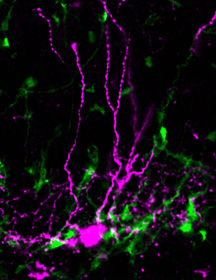
A parvalbumin-expressing interneuron (purple), the type of brain cell that influences neural stem cells (green) (Credit: Gerry Sun)
How do stem cells in the hippocampus — a part of the brain responsible for learning, memory and mood regulation — “decide” to create new brain cells?
Apparently, they “listen in” on the chemical communication among nearby neurons to find out what is stressing the system and when they need to act, says Hongjun Song, Ph.D., professor of neurology and director of the Institute for Cell Engineering’s Stem Cell Program at Johns Hopkins Medicine.
(The stem cells detect chemical messaging fueled by neurotransmitters that leak from neuronal synapses, the structures at the ends of brain cells that facilitate communication.)
The researchers say understanding this process of chemical signaling may shed light on how the brain reacts to its environment and how current antidepressants work, because in animals, these drugs have been shown to increase the number of brain cells (neurogenesis). So does that mean sedatives (like Valium) decrease neurogenesis?
Here’s what the researchers learned:
1. Stem cells can detect GABA neurotransmitter messages
To find out which neurotransmitter brain stem cells can detect, the researchers took mouse brain tissue, attached electrodes to the stem cells and measured any change in electrical charge after the addition of certain neurotransmitters. When they treated the stem cells with the neurotransmitter GABA — a known signal-inhibiting product that the stem cells’ electrical charges changed, suggesting that the stem cells can detect GABA messages.
2. GABA inhibits stem-cell production
To find out what message GABA imparts to brain stem cells, the scientists used a genetic trick to remove the gene for the GABA receptor — the protein on the surface of the cell that detects GABA — only from the brain stem cells. Microscopic observation of brain stem cells lacking the GABA receptor over five days showed these cells replicated themselves, or produced glial cells — support cells for the neurons in the brain. In contrast, brain stem cells with their GABA receptors intact appeared to stay the same, not making more cells.
3. Valium acts like GABA
Next, the team treated normal mice with diazepam (valium), often used as an anti-anxiety drug and known to act like GABA by activating GABA receptors when it comes in contact with them. The scientists checked the mice on the second and seventh day of valium use and counted the number of brain stem cells in untreated mice and mice treated with the GABA activator. They found the treated mice had many more dormant stem cells than the untreated mice.
“GABA communication clearly conveys information about what brain cells experience of the outside world, and, in this case, keeps the brain stem cells in reserve, so if we don’t need them, we don’t use them up,” says Song.
Predictably, treatment with flumazenil (an antidepressant drug that reverses the effects of benzodiazepines like valium and is used by doctors to treat patients who become too drowsy) had the opposite effect, causing stem-cell production.
This work was supported by grants from the National Institute of Neurological Disorders and Stroke (NS047344, NS048271), the National Institute of Child Health and Human Development (HD069184), National Institute of Mental Health (MH089111), the National Institute on Aging (AG040209), the National Alliance for Research on Schizophrenia and Depression, the Adelson Medical Research Foundation, the New York State Stem Cell Science, the Ellison Medical Foundation, the Life Sciences Research Foundation and the Maryland Stem Cell Research Fund.