How to avoid ‘computational irreducibility’: Wolfram
July 2, 2012
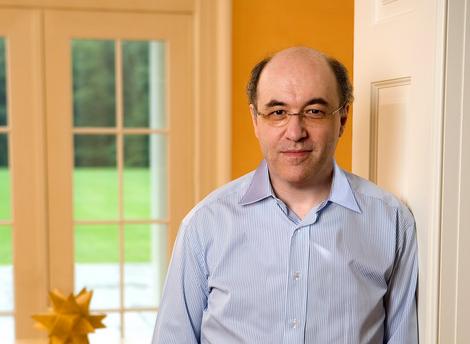
Stephen Wolfram (credit: Stephen Wolfram PR/Stephen Faust/Wikimedia Commons)
“It seems like Nature has some secret that lets it make complicated stuff in an effortless way,” Stephen Wolfram recently told an audience at Oxford University’s Mathematical Institute.
In his talk, that you can now watch online, Wolfram, the scientist behind Mathematica and Wolfram Alpha, explored how advances in computation could benefit mathematics.
One of the key ideas he put forward was “computational irreducibility” — the idea that some computations cannot be sped up by any shortcut, the only way to figure out what is going to happen is to simulate each step.
“People sometimes say that the reason the mathematics that we have is the way it is, is because that’s what we need to describe the natural world, I think that’s just not true,” he commented. He suggested that much of the reason mathematics covers the areas it does is historical, building on work begun by the first mathematicians in ancient Babylon.
Computational irreducibility, he said, is a “junior version of ‘undecidability'” — the idea that when you ask the question of what will ultimately happen the answer is something that is undecidable. While there are more than three million theorems in mathematics, these are all things that turned out to be decidable/provable.
There isn’t much undecidability in mathematics because maths is set up to examine those things its methods can make progress on: “Mathematics has navigated through these kind of narrow paths in which you don’t run into rampant undecidability all over the place.”
Ask mathematical questions at random, he suggested, and you would soon run into undecidability. But perhaps through exploring the space of all possible theorems, using tools such as Wolfram Alpha, you might find new paths.
He described the point of Wolfram Alpha as “to collect as much knowledge as possible and make it computable,” and that this approach could be applied to find out which theorems about a particular structure or system were interesting or powerful.
A pilot study focusing on one particular area of maths, continued fractions, is already showing that the process of organizing theorems in a way that’s systematically computable is leading to new advances, he said.
In a contrast to the days when mathematicians did all of their calculations by hand, the future of mathematical process could be that, by entering some details of a system, within seconds they would automatically see a range of theorems about it.
This would give a window on what he called a “vast ocean of unexplored generalization of mathematics that exists in this computational universe of possible systems.”