How to build a million-qubit quantum computer
December 4, 2012
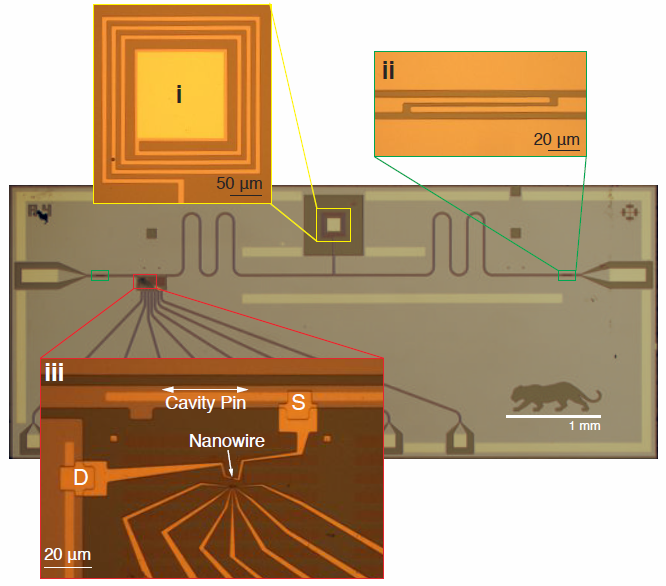
Hybrid dual-quantum dot/superconducting resonator device (credit: K. D. Petersson et al./Nature)
A team led by Princeton‘s Associate Professor of Physics Jason Petta has developed a new method that could eventually allow engineers to build a working quantum computer consisting of millions of quantum bits (qubits).
Quantum computers take advantage of the strange behaviors of subatomic particles like electrons. By harnessing electrons as they spin, scientists could use the particles to form the basis for a new type of computing.
The problem, though, is that these incredibly tiny electrons are hard to control. So far, scientists have only been able to harness extremely small numbers of them.
“The whole game at this point in quantum computing is trying to build a larger system,” said Andrew Houck, an associate professor of electrical engineering at Princeton who is part of the research team.
A cage for trapping electrons
To transfer information Petta’s team used a stream of microwave photons to analyze a pair of electrons trapped in a tiny cage called a quantum dot. The “spin state” of the electrons — information about how they are spinning — serves as the qubit, a basic unit of information. The microwave stream allows the scientists to read that information.
“We create a cavity with mirrors on both ends — but they don’t reflect visible light, they reflect microwave radiation,” Petta said. “Then we send microwaves in one end, and we look at the microwaves as they come out the other end. The microwaves are affected by the spin states of the electrons in the cavity, and we can read that change.”
In an ordinary sense, the distances involved are very small; the entire apparatus operates over a little more than a centimeter. But on the subatomic scale, they are vast. It is like coordinating the motion of a top spinning on the moon with another on the surface of the Earth.
“It’s the most amazing thing,” said Jake Taylor, a physicist at the National Institute of Standards and Technology, who worked on the project with the Princeton team. “You have a single electron almost completely changing the properties of an inch-long electrical system.”
One challenge facing scientists is that the spins of electrons, or any other quantum particles, are incredibly delicate. Any outside influences, whether a wisp of magnetism or glimpse of light, destabilizes the electrons’ spins and introduces errors.
Over the years, scientists have developed techniques to observe spin states without disturbing them. (This year’s Nobel Prize in physics honored two scientists, Serge Haroche and David Wineland, who first demonstrated the direct observation of quantum particles.) But analyzing small numbers of spins is not enough; millions will be required to make a real quantum processor.
Making quantum dots
To make the quantum dots, the team isolated a pair of electrons on a small section of material called a “semiconductor nanowire.” Basically, that means a wire that is so thin that it can hold electrons like soda bubbles in a straw. They then created small “cages” along the wire. The cages are set up so that electrons will settle into a particular cage depending on their energy level.
This is how the Princeton team reads the spin state: electrons of similar spin will repel, while those of different spins will attract. So the team manipulates the electrons to a certain energy level and then reads their position. If they are in the same cage, they are spinning differently; if they are in different cages, the spins are the same.
The second step is to place this quantum dot inside the microwave channel, allowing the team to transfer the information about the pair’s spin state — the qubit.
Petta said the next step is to increase the reliability of the setup for a single electron pair. After that, the team plans to add more quantum dots to create more qubits. Team members are cautiously optimistic. There appear to be no insurmountable problems at this point but, as with any system, increasing complexity could lead to unforeseen difficulties.
“The methods we are using here are scalable, and we would like to use them in a larger system,” Petta said. “But to make use of the scaling, it needs to work a little better. The first step is to make better mirrors for the microwave cavity.”
Support for the research was provided by the National Science Foundation, the Alfred P. Sloan Foundation, the Packard Foundation, the Army Research Office, and the Defense Advanced Research Projects Agency Quantum Entanglement Science and Technology Program.