How to communicate better in virtual worlds
October 13, 2011
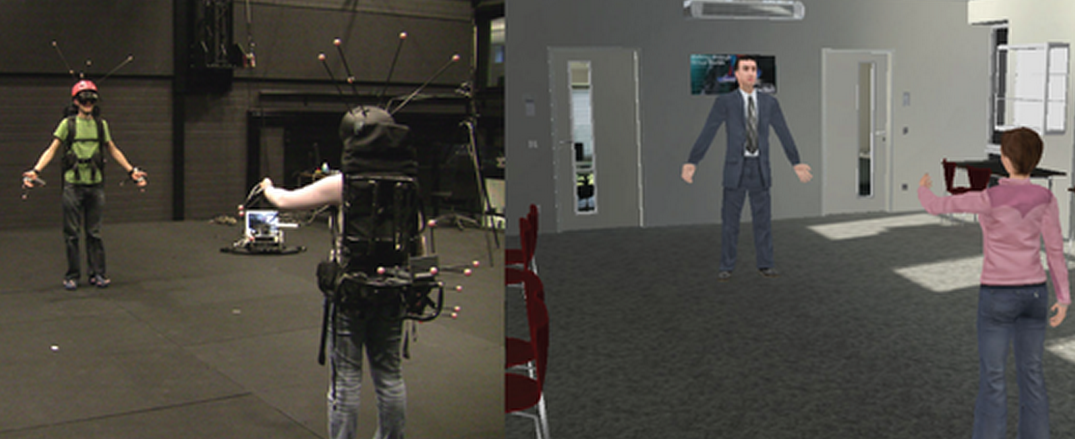
The experimental setup. Left: The participants wore a total of six tracked objects; right: the corresponding virtual environment, showing the avatars in the self-animated third-person perspective. (Credit: Trevor J. Dodds et al./PLoS One)
Mapping real-world motions to “self-animated” virtual avatars, using body tracking to communicate a wide range of gestures, helps people communicate better in virtual worlds like Second Life, says researchers from the Max Planck Institute for Biological Cybernetics and Korea University.
They conducted two experiments to investigate whether head-mounted display virtual reality is useful for researching the influence of body gestures in communication; and whether body gestures are used to help in communicating the meaning of a word. Participants worked in pairs and played a communication game, where one person had to describe the meanings of words to the other.
Ref.: Trevor J. Dodds et al., Talk to the Virtual Hands: Self-Animated Avatars Improve Communication in Head-Mounted Display Virtual Environments, PLoS One, DOI: 10.1371/journal.pone.0025759 (free access)