How to create a startup country
December 23, 2010 by Amara D. Angelica
At Peter Thiel’s invitation-only “Breakthrough Philanthropy” event in San Francisco on December 7, which brought together Silicon Valley’s top entrepreneurs with eight of the most visionary non-profits, Patri Friedman, grandson of legendary economist Milton Friedman, presented one of the most radical, imaginative concepts I’ve heard in some time. Here’s the text of his four-minute talk (video below — other Breakthrough Philanthropy speaker videos here).
— A. Angelica
Every year, our phones get smarter, our cars safer, and our medical treatments more advanced. We all benefit from startups and established companies competing through constant innovation. So why is it that in one of the most advanced countries in the world, we’re still using the legal technology … of 1787? I mean, if you drove a car from 1787, it would be a horse!
Surely some of the advances of the last two centuries have enabled new , better forms of government. For example, America’s founders were brilliant, but they couldn’t design a political system using the Internet, because it didn’t exist then.
“A startup country could be the world’s first trillion dollar business.”
Now for humanity, this is a huge problem, but with our entrepreneur hats on, what a business opportunity! A startup country could be the world’s first trillion dollar business.
But right now, there’s no way for an entrepreneur with a great idea for a startup country to make it happen. Unlike the software industry, where you can get started with just a laptop, to enter the government industry, you need a open space, a physical place that allows political experiments. But there is no such place — every piece of land in the world is claimed.
So there are no startup countries, there’s no channel for innovation of entrepreneurs … no wonder it’s a such a sad industry.
So why don’t we see more innovation in politics? Now, politics is a pretty emotionally charged subject. You’re not supposed to talk about that, or religion. So let’s take a new perspective. Let’s forget about left and right and instead, put on our entrepreneur hats. Let’s think of government as an industry, where countries are firms and citizens are customers.
This is not just any industry. This is the world’s biggest industry. The leading firm had 2009 revenues of 2.5 trillion dollars. Strangely, it’s also an industry legendary for poor performance. That leading firm lost 1.4 trillion. And that’s a top company. The worst companies kill many of their own customers. It’s a pretty sad industry!
The seasteading solution: let a thousand nations bloom
So that’s how we come to seasteading — homesteading the high seas. What we need is a new frontier, an open space for political experiments…and the next frontier is the ocean. With a little technical innovation to make this new frontier accessible, we can unleash enormous political innovation. Let a thousand nations bloom on the high seas, trying diverse political systems — essentially, a startup sector for government.
“Seasteading is the entrepreneurial way to fix government — by competing with it, instead of complaining about it.”
And of course, you don’t have to go out there to benefit. The best discoveries of these startups, like in any industry, will be copied by the market leaders — the countries of today.
So seasteading is the entrepreneurial way to fix government — by competing with it, instead of complaining about it. That’s why every day at The Seasteading Institute, we’re growing our community of pioneers and conducting research into engineering, business models, and international law. Here’s what we expect the progress to look like:
We think seasteading will begin in 3–10 years on ships, repurposed for businesses like medical tourism. In a decade, they’ll progress to innovative designs based on oil rigs, hosting a range of businesses and thousands of residents. And in several decades, they’ll evolve into true floating cities for millions of people, pioneering new ways to live together.
Sounds like science fiction, but as Christine [Peterson] said, after 25 years, science fiction can become fact. It’s an incredible vision, and it’s urgent that we get these experiments started as soon as possible. We can already see that existing political systems are straining to cope with the realities of the 21st century. We need to find the next generation of governance technologies.We need to find banking systems that can handle inevitable financial crises; medical regulations that protect people…without retarding innovation; democracies that ensure our representatives truly represent us.
Humanity needs seasteading…and seasteading needs you. We need experienced entrepreneurs who can join us in bringing the Silicon Valley spirit of innovation to where it’s most sorely needed.
More about Seasteading Institute
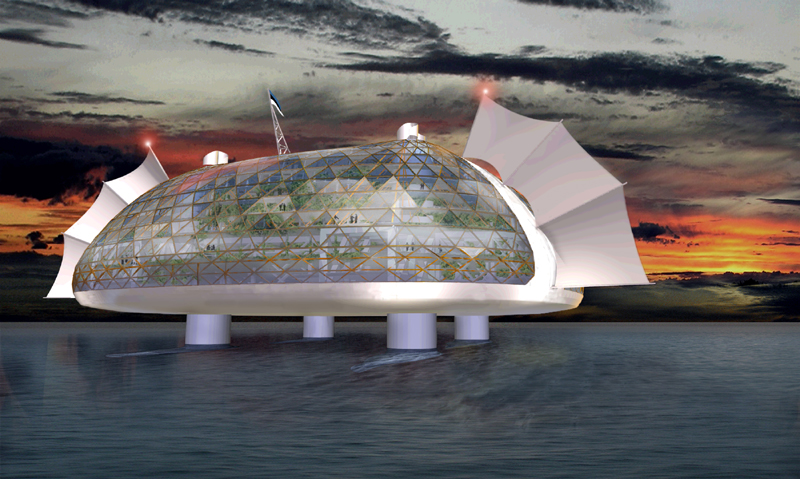
The Seasteading Institute was founded in 2008 by Patri Friedman. The idea, he says, is to “enable seasteading communities — floating cities — that will allow the next generation of pioneers to peacefully test new ideas for government. The most successful can then inspire change in governments around the world.”
As of December 2010, the institute has raised more than $1,000,000, with funding led by Silicon Valley investor Peter Thiel, co-founder of PayPal and first investor in Facebook. The nonprofit institute’s mission is to “further the long-term growth of the seasteading movement.” Its current focus is on “enabling the success of the first seasteads by researching the critical engineering, legal, and business problems, increasing public awareness, and building a core seasteading community.
The institute believes the tipping point for the seasteading movement will be “the existence of a growing market for seastead real estate, which creates an economic incentive for not just residents, but real estate developers to build more and more seasteads.”
“I think seasteading is not just possible, or desirable, but necessary,” said Thiel in his keynote address to the second Seasteading Conference in September 2009 in San Francisco. “Seasteading is one of the few technological frontiers that has the promise to create a new space for human freedom.”
Interested in getting involved? Check out Seasteading Institute jobs and internships (“We’re looking for brilliant young students who are passionate about seasteading, fun to work with, and have a stellar track record of independence and accomplishment, and who are excited at the idea of taking on a high degree of ownership and responsibility. Our internships are custom-designed to meet each individual’s interests and skill set.”). You can keep up with the latest seasteading news via numerous online channels or contribute through the Membership Program.


Comments (9)
by Monolithic
I disagree. As scientists we cannot let the politicians have the land while we take the sea. HE WHO CONTROLS THE LAND CONTROLS THE SEA. Your biosphere is dying, species are fading, YOU ARE DESTROYING YOUR WORLD. Stop arguing about baloney and face the real political and scientific climate.
by matt@wronkiewicz.net
Yes! We’ll invade the sea in three massive floating cities. For purposes of discussion we’ll call them ‘A’, ‘B’, and ‘C’. City A will hold all the brilliant leaders, the scientists, and the artists. City C will hold all the people who do the actual work. And then city B will house all the middlemen. City B will begin the grand adventure, with cities A and C to follow later.
by willtruth
Isn’t there a risk that these new countries could be parasites to a certain degree on the old ones? What I mean is that, when they start off, it will probably only be young, healthy productive, intelligent people who migrate to them. That will give them an advantage over th old countries, which must pay for people who are disabled, or old, or get cancer and need healthcare etc. The new country will have none of these costs, so their taxes will be lower or non-existent. But then, if any of their residents get sick, presumably they will head back to the old country for treatment or support. Doesn’t seem very fair to me..
by Jake_Witmer
I’m amazed at the lack of innovation in the libertarian movement. I mean, Hayek had the answers how many years ago, and the libertarians are still conflating philosophical knowledge with knowledge of strategy and tactics?
The ruling elite don’t want progress. They don’t want change. That’s what the political theater is there for.
Most libertarians don’t even know what they want. They can’t quantify what would be a step in the right direction.
I can. I’ve talked with thousands and thousands of people. And I’ve defeated rigged courts and rigged juries. I know my history.
What libertarians want is simply a society whereby economic calculations take into account predictable individual rights: they want to be able to keep what they own, and use it fully. They expect that they own their own bodies, and that the areas where goverment claims ownership in these areas, they are wrong.
This is not a difference of opinion, anymore than it is a difference of opinion that one owns one’s own wallet, yet a totally illegitimate theif also believes he owns it. The morons here claiming a right to other people’s money for “research” are not even at the gradeschool level of the libertarians –they don’t even have the philosophy worked out.
So what does someone who wants a free country do?
One makes the freest country freer, and one makes the least free country freer (damage control).
How?
Well, we were much more free and innovative in the USA before we lost proper jury trials. This is noticeable change, in the direction of tyranny.
I haven’t met 30% of the population that agrees with consistent liberty (libertarianism). But I have met 30% of the population who can comprehend jury trials, and why they are important. As soon as I show people the history, they agree with me. If I had even a few dozen paid employees, I could take over 1 state for libertarianism-in-effect, by taking on the court system of that state.
This won’t happen. Because everyone has a stupid, poorly-thought-out reason why it won’t work, and I’m too poor to do it myself. The people pursuing this strategy are the best the libertarian movement has to offer, but they’re also doing everything wrong, because they seem to lack a basic understanding of human psychology.
Maybe this dooms us to tyranny.
Prediction: Seasteading efforts will be raided and destroyed by governments, resulting in death of all or most involved. You see, the illegitimate parasites want what you’ve created, and they want it for free. They want to steal it, and they have the power to do so. The average cop is vastly less intelligent and vastly more violent than the average KAI visitor or ‘seateader’.
However, I CAN think of a way seasteading will work. If the libertarians are all rich, and this becomes a club for the rich, while the poor languish in oppression in the mainland. If that happens, the governments will LOVE the people who set it all up. After all: it will “prove” to their tyrannized subjects that they are free, (without offering them the possibility of actual freedom). Basically: if the seastead is open to all, and threatens governments with a loss of their slaves, then governments will shut it down. If not, it will be the same thing we have right now: nominally more freedom for the rich, no freedom at all for the middle class and poor.
Do you really want freedom? Build strong freedom movements in the western states and NH around jury rights. Pay educators to do the hard, difficulty, crappy work of handing out jury rights pamphlets in front of courthouses. But hurry up and figure out what I already know: you don’t have much time.
In IL, MA, and MD, it is now illegal to video record government agents in public. That’s literally the law in those states! And the sentence for gathering evidence of police brutality, or governmental crime and lawbreaking? It’s equal to that for rape (at least in IL).
Still, if the freedom movement cared to do what works, has worked, and will always work (talk to people using the right memes), they could achieve very, very, very rapid success.
I doubt it will happen, but it’s a nice idea.
And better than getting nuked at sea for being smarter than a sociopathic monkey named Joe Biden or Barack Obama.
Here’s to hoping the libertarian movement gets grounded in reality: ASAP.
by Theo
I have trouble seeing seasteading as a driver of innovation in government. Seasteads may come up with some good ideas, and conventional governments will remain resistant to change. The recent U.S. health care debate is a great example of how examples of better policies in other nations may be ignored: I mean, seriously, health care for everyone, that’s just so French.
That being said seasteads or some equivalent may be necessary to drive technological innovation in the GNR fields. The success of religious fundamentalists in the U.S. of cutting public funding for stem cell research they felt was morally questionable makes me worry about the future of scientific research in general. As advances mount in technologies which can fundamentally alter what it means to be human, opposition movements will organize to block even private research efforts. Seasteadings may offer a refuge for cutting edge research which would otherwise be banned by most conventional nations.
by Evil
An amazing idea – and the snide comments here are about pirates, the weather and sewage.
by geekette
It could be that this project is like putting a man on the moon. Figuring it out will give us solutions to some of our most pressing OTHER problems. Such as recycling sewage. Currently, with all of the rain, many of our cities and beaches are experiencing contamination by sewage. As they say in the army – don’t crap in your own mess kit. These floating cities would certainly have to come up with a great solution for that mess.
by geekette
I think the concept is excellent. Its the execution I’m worried about. Having crossed the pacific ocean 4 times (from LA-Sydney and Brisbane-Seattle) – and travelled through the panama canal 2 times (LA – Miami, Miamai-San Diego), as well as having owned 2 boats in the San Francisco bay area, I feel I am somewhat qualified to say, WHAT ABOUT THE WEATHER? Unlike being on land, the sea tosses you about like a tiny little cork. I guess the idea is that the floating city can travel. There is this problem of schedules for picking up supplies however, and for docking in various ports. Details, details. Its still an idea worth pursuing.
by Foozinator
An interesting idea, but how to keep anything with any value safe from pirates?