How to generate ‘superluminal’ pulses
May 4, 2012
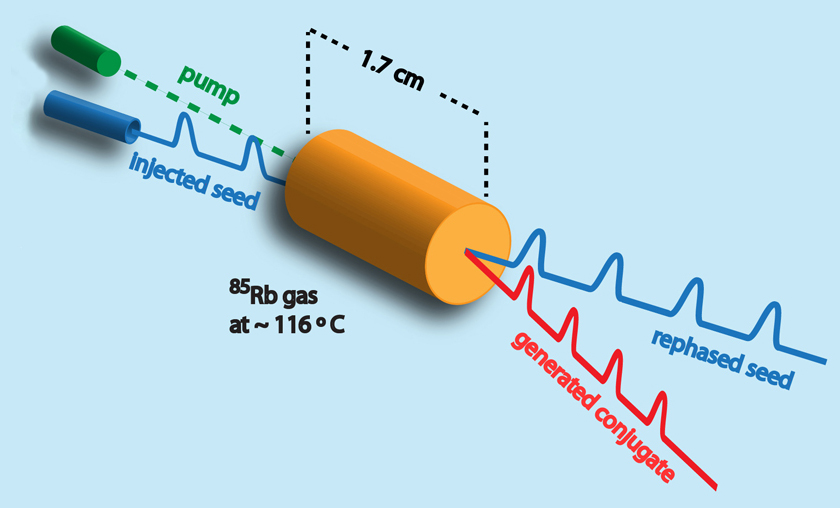
In four-wave mixing, researchers send "seed" pulses of laser light into a heated cell containing atomic rubidium vapor along with a separate "pump" beam at a different frequency. The vapor amplifies the seed pulse and shifts its peak forward, making it superluminal. At the same time, photons from the inserted beams interact with the vapor to generate a second pulse called the "conjugate." Its peak, too, can travel faster or slower depending on how the laser is tuned and the conditions inside the gain medium. (Credit: NIST)
National Institute of Standards and Technology (NIST) researchers have developed a novel way of producing light pulses that are “superluminal” — in one sense — because part of the pulses travel faster than the speed of light.
The technique, called four-wave mixing, reshapes parts of light pulses and advances them ahead of where they would have been, had they been left to travel unaltered through a vacuum. The new method could be used to improve the timing of communications signals and to investigate the propagation of quantum correlations.
According to Einstein’s special theory of relativity, light traveling in a vacuum is the universal speed limit. No information can travel faster than light.
A short burst of light arrives as a sort of (usually) symmetric curve like a bell curve in statistics. The leading edge of that curve can’t exceed the speed of light, but the main hump, the peak of the pulse, can be skewed forward or backward, arriving sooner or later than it normally would.
Recent experiments have generated “uninformed” faster-than-light pulses by amplifying the leading edge of the pulse and attenuating, or cutting off, the back end. The method introduces a great deal of noise with no great increase in the apparent speed. Four-wave mixing produces cleaner, less noisy pulses with a greater increase in speed by “re-phasing” or rearranging the light waves that make up the pulse.
In four-wave mixing, researchers send 200-nanosecond-long “seed” pulses of laser light into a heated cell containing atomic rubidium vapor along with a separate “pump” beam at a different frequency from the seed pulses. The vapor amplifies the seed pulse and shifts its peak forward so that it becomes superluminal. At the same time, photons from the inserted beams interact with the vapor to generate a second pulse, called the “conjugate” because of its mathematical relationship to the seed. Its peak, too, can travel faster or slower depending on how the laser is tuned and the conditions inside the laser.
In the experiment, the pulses’ peaks (but not the leading edge) arrived 50 nanoseconds faster than for light traveling through a vacuum.
One immediate application that the group would like to explore for this system is “quantum discord.” Quantum discord mathematically defines the quantum information shared between two correlated systems — in this case, the seed and conjugate pulses. By performing measurements of quantum discord (information) between fast beams and reference beams, the group hopes to determine how useful this fast light could be for the transmission and processing of quantum information.
Ref.: Ryan T. Glasser, Ulrich Vogl, and Paul D. Lett, Stimulated Generation of Superluminal Light Pulses via Four-Wave Mixing, Physical Review Letters, 2012, DOI: 10.1103/PhysRevLett.108.173902
Ref.: Ryan T. Glasser, Ulrich Vogl, and Paul D. Lett, Stimulated generation of superluminal light pulses via four-wave mixing, arXiv:1204.0810v1