How to kill lymphoma cancer cells without chemotherapy
January 23, 2013
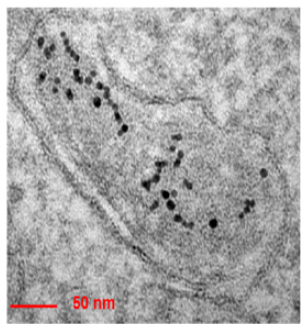
Transmission electron micrographs of HDL-mimicking nanoparticles in lymphoma cells 24 hours after treatment (credit: Shuo Yanga et al./PNAS)
Northwestern Medicine researchers have developed a nanoparticle that attacks a cancerous lymphoma cell by mimicking HDL.(high-density lipoprotein) cholesterol, an essential nutrient for the cell.
The nanoparticle tricks the cell by blocking cholesterol from entering the cell. Deprived of an essential nutrient, the cell eventually dies.
The new study by C. Shad Thaxton, M.D., and Leo I. Gordon, M.D. shows that these synthetic HDL nanoparticles killed B-cell lymphoma, the most common form of the disease, in cultured human cells, and inhibited human B-cell lymphoma tumor growth in mice.
“This has the potential to eventually become a nontoxic treatment for B-cell lymphoma which does not involve chemotherapy,” said Gordon. “It’s an exciting preliminary finding.”
Recent studies have shown that B-cell lymphoma is dependent on the uptake of natural HDL, from which it derives fat content, such as cholesterol.
One-two punch
The nanoparticle closely mimics the size, shape and surface chemistry of natural HDL particles. But it has one key difference: a five nanometer gold particle at its core.
When the nanoparticle is incubated with human B-cell lymphoma cells or used to treat a mouse with the human tumor, the gold particle’s spongy surface sucks out its cholesterol. Meanwhile, the gold core prevents the cell from absorbing more cholesterol typically carried in the core of natural HDL particles.
The National Cancer Institutes reports that in 2012 there were about 70,000 new cases of non-Hodgkin lymphoma in the U.S. with nearly 19,000 deaths. About 90 percent of those new cases were B-cell lymphoma. Non-Hodgkin lymphoma is a cancer that starts in cells called lymphocytes, which are part of the body’s immune system.
Gordon is a professor of medicine in hematology/oncology and Thaxton is an assistant professor of urology, both at Northwestern University Feinberg School of Medicine.
Gordon also is co-director of the hematologic malignancy program at the Robert H. Lurie Comprehensive Cancer Center of Northwestern University and a physician at Northwestern Memorial Hospital. Thaxton is also a member of the Lurie Cancer Center.
The research was supported by The Howard Hughes Medical Institute and the Schwartz Foundation. Thaxton is a co-founder of AuraSense, LLC a start-up biotech company that holds the license to the HDL nanoparticles used in the study.