How to optimize light sources for vision
November 20, 2012
Fluorescent lamps (credit: Wikipedia)
Vision researchers at Barrow Neurological Institute have made a groundbreaking discovery into the optimization of light sources to human vision. By tuning lighting devices to work more efficiently with the human brain, the researchers believe billions of dollars in energy costs could be saved.
The research, conducted by Stephen Macknik, PhD, of Barrow’s Laboratory of Behavioral Neurophysiology, and Susana Martinez-Conde, PhD, of Barrow’s Laboratory of Visual Neuroscience, is believed to be the first attempt to tune light-emitting devices to the optimal temporal dynamics of the human visual system.
The discovery concerns the way humans perceive temporal modulations of light. For example, most light-emitting devices, such as light bulbs, video monitors and televisions, flicker. Faster flicker rates result in reduced perception of flicker, which is more comfortable to viewers. In studying this phenomenon in the brain, the researchers discovered that there is a range of flicker dynamics of light that optimizes the perceived brightness of the light without increasing power.
“We found a temporal sweet spot in visual perception that can be exploited to obtain significant savings by redesigning light emitting devices to flicker with optimal dynamics to activate visual system neurons in the human brain,” says Dr. Macknik.
The researchers estimate that if every light-emitting device in the U.S. — from light bulbs to cell phones — operated at optimal efficiency for the human visual system, it could result in billions of dollars of savings in electricity and power.
To come to their conclusion, the researchers conducted experiments into two contradictory theories of temporal visual perception, or how bright a light appears:
- Bloch’s Law states that the perceived contrast of a visual stimulus increases with its duration, but eventually plateaus at approximately 100 milliseconds. For example, a 5-millisecond flash will appear half as bright as a 10-millisecond flash, but a 200-millisecond flash will be just as bright as one of 400 milliseconds.
- The Broca-Sulzer Effect, on the other hand, states that perceived contrast increases with duration initially, but then peaks and falls again.
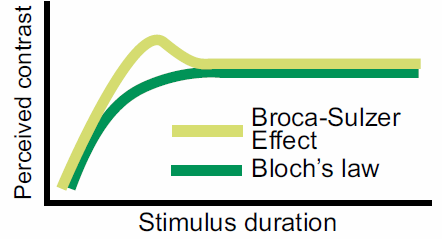
Contradictory theories of temporal visual perception (credit: Hector Rieiro et al./PNAS)
The researchers discovered that the discrepancy between Bloch’s Law and the Broca-Sulzer Effect is caused by an intrinsic bias among experiment subjects, leading to dramatically skewed data.
By improving their experimental design to overcome this bias, something that has never been before reported or intentionally controlled for, the results demonstrated that temporal vision actually follows the Broca-Sulzer Effect.
“Researchers have been studying temporal vision for more than 125 years, but because ours is the first experiment of its kind to control for all known forms of criteria, it is the first to accurately measure the role of temporal dynamics in brightness perception,” says Dr. Macknik. “Thus, the power savings are ripe for the picking because we can adjust our lighting to flicker to take advantage of this peak in perception.”
Comments (7)
by dbamford
Please just hasten the death of fluorescent/halogen/incandescent lighting, already! I am remodeling my house and finally getting to choose some LED-friendly fixtures. I actually cannot believe how much 80-90% of the lighting market is still tied to Halogen. WTF
by seeker
It seems like NEUROERGONOMICS – this approach going to be very fruitful in the future :-)
We’ll optimize other elements of our environment as well.
In late future we could seen personalized version of Neuroergonomics – textbooks written for you by machines, all sorts of visual interfaces optimized for nour needs/brain, education optimized for your brain/mental hardware/specification, games, music etc. it goes to infinity.
by jimrandomh
The unlabeled x-axis on the graph conceals the fact that this story leads off with bullshit. If you check the abstract of the actual study, you will find that “that perceived contrast peaks at durations of 50–100 ms”. Whereas this article leads off with “billions of dollars in energy costs could be saved”. Save energy on lighting by using an effect that only exists from 10-20Hz? Anything much below 60Hz causes headaches, so no, that’s not going to fly.
Please sanity-check press releases before posting them.
by Bob Vasquez
Don’t forget that the eyes of 20 to 40 year olds differ greatly from those 65 and above. Too often standards of all kinds are established for a younger crowd or what is presumed to be the dominate population.
by Clay P.
Much better explanation than what the article had, now I understand it. And yes, some down time is needed.
by gaoptimize
The perception of flicker is partially determined by the light level in the environment (why 24 fps is tollerable in a dark movie theater and torturous at work). It is due to the decay rate of the response of the retina: faster in bright light, slower in dim. Also, if the are measuring “perception” in some quantitative way, they may be missing the more subtle mood efgfects of various amounts and colors of light. I simply don’t need or want to be at the top of my visual/mental game all the time. The last thing we need is science like this to fuel over-reaching Government lighting standards.
The best analysts where I work leave their flourescents off and use incandescent desk or torcher lamps instead. What Dr. Macknik may have failed to have recognized is that non-continuous light source frequencies “beat” against eachother. How does he intend to control for that is a multi-source environment?
by GatorALLin
…wondering myself on what happens if your overhead lights are the old type and ad a poor flicker rate…but your new monitor is upgraded…. I would guess you need both lights in harmony with the same flicker rates or it could produce some form of lowest common denominator. I would also think that screen hertz or flicker rates could be much more easily adjusted in software vs. you have to buy all new monitors. I would guess however the overhead lights do need to be purchased new to upgrade.
I have in the past seen dental offices that switched out the standard overhead lights for new blue ones that mimic outside light better and it create a dramatic positive affect when you switch from one to the other. Especially when they also add in the plastic ceiling tiles of clouds or some outside like scene of tree tops and clear blue sky to be a mood changer. See pic here http://www.fluorescentgallery.com/page/skies
One other comment is that it is interesting to see the difference from LED type light to things like a standard flashlight bulb. The 2 different lights don’t work well together as one washes out the other. For example if you go caving and one guy has very bright LED lights and another guy has regular lights, they don’t compliment each other… one of the 2 lights becomes useless and your eyes can’t adjust. It appears as if the LED drops to about 1/5 the brightness… if everyone in the group has same LED lights then works great. Wondering if your overhead lights at work are all florescent tubes and your monitor you stare at all day long is different light type then it must force your eye to switch or let only one of the 2 work at its best.
Anyhow… glad they are taking a fresh look at how this all works and how to save energy in the process…