How to reinforce learning while you sleep
June 27, 2012
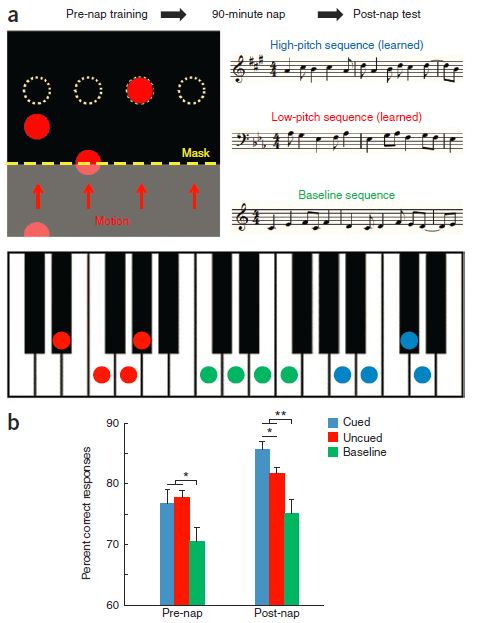
(a) Subjects learned to play melodies with four fingers of the left hand while watching circles that indicated which key to press when. After initial learning trials, the amount of advance information was reduced using an opaque mask (shown here as transparent). Two melodies were repeatedly practiced (red and blue). Baseline melodies (green) were played during testing periods before and after the nap. Either the high melody (eight subjects) or the low melody (eight subjects) was presented covertly (cued) during sleep. (b) Accuracy scores (percent correct responses) were computed according to whether the correct key was pressed at the proper time. (Credit: James W Antony, Eric W Gobel, Justin K O'Hare, Paul J Reber, Ken A Paller/Nature Neuroscience)
Memories can be reactivated during sleep and strengthened in the process, Northwestern University research suggests.
In the Northwestern study, research participants learned how to play two artificially generated musical tunes with well-timed key presses. Then while the participants took a 90-minute nap, the researchers presented one of the tunes that had been practiced, but not the other.
“Our results extend prior research by showing that external stimulation during sleep can influence a complex skill,” said Ken A. Paller, professor of psychology in the Weinberg College of Arts and Sciences at Northwestern and senior author of the study.
By using EEG methods to record the brain’s electrical activity, the researchers ensured that the soft musical cues were presented during slow-wave sleep (deep sleep, not REM sleep, or dreaming), a stage of sleep previously linked to cementing memories. Participants made fewer errors when pressing the keys to produce a melody that had been presented while they slept, compared to the melody not presented.
“We also found that electrophysiological signals during sleep correlated with the extent to which memory improved,” said lead author James Antony of the Interdepartmental Neuroscience Program at Northwestern. “These signals may thus be measuring the brain events that produce memory improvement during sleep.”
Sleep-learning new material?
The age-old myth that you can learn a foreign language while you sleep is sure to come to mind, said Paul J. Reber, associate professor of psychology at Northwestern and a co-author of the study.
“The critical difference is that our research shows that memory is strengthened for something you’ve already learned,” Reber said. “Rather than learning something new in your sleep, we’re talking about enhancing an existing memory by re-activating information recently acquired.”
The researchers, he said, are now thinking about how their findings could apply to many other types of learning.
“If you were learning how to speak in a foreign language during the day, for example, and then tried to reactivate those memories during sleep, perhaps you might enhance your learning.”
Paller said he hopes the study will help them learn more about the basic brain mechanisms that transpire during sleep to help preserve memory storage.
“These same mechanisms may not only allow an abundance of memories to be maintained throughout a lifetime, but they may also allow memory storage to be enriched through the generation of novel connections among memories,” he said.
The study opens the door for future studies of sleep-based memory processing for many different types of motor skills, habits and behavioral dispositions, Paller said.
James W Antony, Eric W Gobel, Justin K O’Hare, Paul J Reber, Ken A Paller, Cued Memory Reactivation During Sleep Influences Skill Learning, Nature Neuroscience, 2012, DOI: 10.1038/nn.3152