How to see quantum images and survive (I hope)
March 1, 2012 by Amara D. Angelica
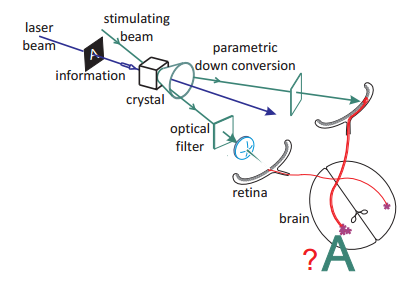
Sketch of a setup to recover the information imprinted on a laser beam (a letter A, in this example) by visualization of a high-order image (credit: Geraldo Barbosa)
Physicists have designed several wild experiments to see if humans can see quantum images.
The latest, just described in the Physics arXiv Blog: Geraldo Barbosa at Northwestern University plans to use a laser beam shaped into an image, such as the letter A.
This laser beam hits a non-linear crystal, generating entangled pairs of photons that retain this image shape and are detected by human eyeballs.
(Hmm, I wonder if this could lead to a new display concept for quantum computers? What about a crystal for each pixel…?)
Anyway, the quantum images are created by sending entangled photons towards a pair of detectors. Use one of the detectors to receive just one half of the entangled photons and the result is a blur, smeared by the process of randomness.
But use two detectors to receive both sets of photons and the uncertainties disappear, because of the quantum correlation between the entangled pairs. Damn cool. (Ref.: Geraldo A. Barbosa, Can humans see beyond intensity images?)
Entangled humans: the oops factor

Sensing spooky-action-at-a-distance (credit: Nicolas Gisin et al.)
But Barbosa wasn’t the first to conceive this. In 2008, Nicolas Gisin and colleagues at the University of Geneva calculated that a human eye ought to be able to detect entangled photons, and a year later, took it a step further, saying that the human eye could be used in a Bell type experiment to sense spooky-action-at-a-distance. Now that’s an experiment.
Slight problem: these experiments would mean that the humans involved would become entangled themselves, if only for an instant. Shades of The Fly and the Philadelphia Experiment! (OK, that was a hoax, but still….)
The Stellerator: try this at home (if you dare)

Nick Herbert (credit: Nick Herbert)
Meanwhile, edge physicist Nick Herbert — chronicled in the book How the hippies saved physics — came up with a simpler (and safer) way to view entangled photons: just two people looking at a star, as he explained to me in 2006.
“Visible stars possess a ‘radius of coherence’ of several feet or larger so that when you and your partner look up at a star (and are close together), you are standing inside that star’s coherence radius,” he explained in his January 2010 Quantum Tantra blog. “But you are also standing inside lots of other star’s coherence discs.”
To solve that, he invented the Stellerator — simply a hollow tube that allows you and your partner’s retinas to be excited by light from the target star and no others.
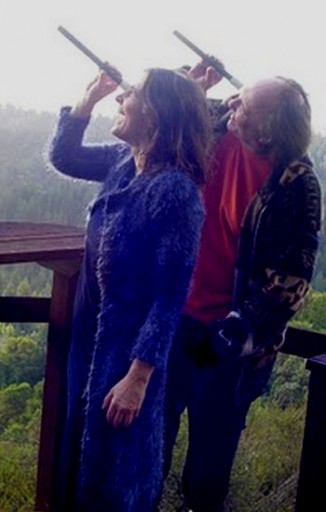
Sun and Allan test out the Stellerator (credit: Nick Herbert)
“The Stellerator was first tested by a gang of happy amateurs immersed in an Esalen hot tub on the edge of a cliff overlooking the Pacific Ocean under the starlit sky,” he said. “No huge increase was observed in our already high level of conviviality.”
The Lunarator: physics violation?
But what about trying something closer? So Herbert conceived the Lunarator, which depends on the smaller coherence radius of moonlight. “The coherence discs from the Moon are small enough to fit inside the light-adapted pupil of the human eye.
In the Lunarator, moonlight is split by a half-silvered mirror so that half goes into his eye and the other half goes into hers. There is a sense in which you two are both competing for the same photons.”
Herbert (perhaps wisely) hasn’t built one of these things yet. He pointed out a conceptual problem: “even if the Lunarator only induces a common mood (no signaling), it is easy to show that the presence or absence of such a mood could be used for signaling, and that signaling could, in principle, be superluminal.”
And you know all about that uproar with the CERN Opera experiment.
Hey, I have no problem with that. I’m going to build one and try it! I’ll report back — if I survive the entanglement.