How unconscious processing improves decision-making
February 15, 2013
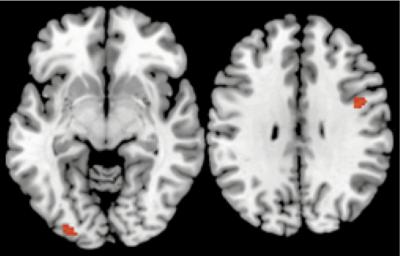
New brain imaging research from Carnegie Mellon University found that the brain regions responsible for making decisions continue to be active even when the conscious brain is distracted with a different task. This image shows unconscious activity in two parts of the brain, the left visual cortex and right prefrontal cortex. (Credit: Carnegie Mellon University)
New brain imaging research from Carnegie Mellon University finds that the brain regions responsible for making decisions continue to be active even when the conscious brain is distracted with a different task.
The research provides some of the first evidence showing how the brain unconsciously processes decision information in ways that lead to improved decision-making.
“This research begins to chip away at the mystery of our unconscious brains and decision-making,” said J. David Creswell, assistant professor of psychology in CMU’s Dietrich College of Humanities and Social Sciences and director of the Health and Human Performance Laboratory.
“It shows that brain regions important for decision-making remain active even while our brains may be simultaneously engaged in unrelated tasks, such as thinking about a math problem. What’s most intriguing about this finding is that participants did not have any awareness that their brains were still working on the decision problem while they were engaged in an unrelated task.”
For the study, the researchers presented 27 healthy adults with information about cars and other items while undergoing neuroimaging. Then, before being asked to make decisions about the items, the participants had to complete a difficult distractor task — memorizing sequences of numbers — to prevent them from consciously thinking about the decision information.
The results included three main findings. First, the team confirmed previous research demonstrating that a brief period of distraction — in this case two minutes — produced higher quality decisions about the cars and other items.
But did this effect occur because the distraction period provided an opportunity for the brain to take a break from decision-making and then return to the problem with a fresh look? Or alternatively, does the brain continue to unconsciously process decision information during this distraction period? This research supports the latter unconscious processing explanation.
When the participants were initially learning information about the cars and other items, the neuroimaging results showed activation in the visual and prefrontal cortices, regions that are known to be responsible for learning and decision-making. Additionally, during the distractor task, both the visual and prefrontal cortices continued to be active — or reactivated — even though the brain was consciously focused on number memorization.
Third, the results showed that the amount of reactivation within the visual and prefrontal cortices during the distractor task predicted the degree to which participants made better decisions, such as picking the best car in the set.
“We all face difficult problems we need to solve on a regular basis,” Creswell said. “This study provides some of the first clues for how our brains process this information for effective problem-solving and decision-making.”
The Pittsburgh Life Sciences Greenhouse Opportunity Fund supported this research.
Comments (21)
by Brain Molecule Marketing
There is little evidence for conscious/verbal processing of any brain processes, let alone those causing behavior. Emotions don’t seem to matter either.
by Brain Molecule Marketing
In fact, it appears there is no such thing as “decision making” as humans imagine. For example, other animals get along just fine without this. So do plants. It is likely all behavior is unconscious and happens in 150 milliseconds.
by trakk
which parts of the brain are primarily involved in memorising sequences of numbers? anyone?
by trakk
See….this is why we need more brain research projects :-)
by Ralph Dratman
I do find it surprising that two minutes would be much help, especially if the time is filled with distractions from the earlier thinking session. On the other hand, when we watch a politician “stalling for time” before answering a tough question, the amount of time gained is usually a few tens of seconds, not even as long as the two-minute distraction task described in this article.
by Peter Kinnon
The involvement of de novo students with research provides a good model for conversion of the current trend of rote-learning/empty qualification factories that is so prevalent in today’s educational system.
Firstly, this approach can greatly increase motivation in those with “the right stuff”. Those who do not respond to such motivation are really wasting their time at university anyway.
Secondly, the natural learning mode of our species (and others for that matter) is interactive.
My daughter took a chemistry degree and was hardly allowed to interact with reagents due to health and safety regulations.
There was almost no hands-on involvement for instrumental methods, either.
Like the majority of her peers, she passed her exams, got her degree, and retains very little understanding of Chemistry apart from specifics she has picked up subsequently in industry.
Passive learning is inefficient, superficial and temporary.
by Bri
Peter it’s always good to see your posts. I agree whole heartedly with your assessment of the educational system. Where as your points are well taken I’m not shure of the connection to unconscious mental processing in relation to decision making.
by humanitarian
Whether the decision making helps common good or selfish interests is something to consider. For example, many meditatators, of diverse faiths, have found yielding rich results, including profound scientific truths. So, this study does confirm the validity of ancient meditation technique.
by Bri
My understanding of meditation is different than what you postulate. There was an excellent article here awhile back that illuminated the profound effects of meditation on the brain. It’s more of a house cleaning, recslibration and connectivity promoting activity. If your brain is processing information and unconsciously making decisions then I don’t think you are doing it right. It should unclog your mind, fostering interconnectivity of different brain regions. Rwy describes a related technique that he uses to problem solve. Before sleeping he presents information related to whatever issues he wants to address. Then clearly states the problem. This prompts the brain to process it unconsciously as he sleeps. It’s a powerful technique that many people use. In reality it’s pretty close to the opposite of meditation.
by Bri
This article descibes a process that is similiar to how I address information. I think it’s relativel universal. I read the article. At first I have thoughts and impressions, but I’ll read other articles or do other things. The information will represent itself in my mind from time to time. When I reread or go to post an idea it’s had a chance to develope subconsciously.
by MMC2100704
I’m a firm beliver of innate wisdom , another (unconsious?) discriptive of this study. The, “old wives tales,” have merit in that the “tales” are rooted in age old experience, such as “sleep on a decision.” Some are as a result of ignorance but many are surprisingly spot on. There is no doubt that the unconsiousness continues to delve on a problem. It is as basic and as simplistic as your own exdperiences if you stop to think about it.
I was hoping toi find an intellectual discourse of Kurzweilai newsletter material — well — not on this subject anyway.
by MMC2100704
experiences
by WLGJR
“sleep on a decision.”
Bruce Lee was once asked: “Do you believe in God?”
He answered: “I believe in sleeping.” – From Wikipedia
by WLGJR
I believe there is the possibility that some government groups and corporations monitor (or even influence) their employees’ subconscious mental processes via devices enbedded in the uniforms, desks and other locations.
by MvB
But there is also the possibility that transdimensional nazi-communist-cyborg-zombies from hell are manipulating our conscious mental processes directly via ether.
by WLGJR
Well, what I said is more doable now than, let’s say, a few years ago.
You remind me of the meme of “This Man” which was featured on Wired.com a few years ago (the Man in the story does not manipulate consciousness, but is equally creepy)
http://www.thisman.org
by Ian
That’s EXACTLY what happened to me!
by Gorden Russell
You’ve met them too, MvB? A trans-dimensional nazi-communist-cyborg-zombie from hell moved in down the street from me last March and boy is he paranoid. He runs out of his house in his purple evening gown accusing me of letting my dog go on his lawn and claims to have found plastic bags of dog poo on his lawn, even though I’ve stopped walking down his side of the street and keep pointing out to him that my stool sample is right there on the end of my garden spade. Not even dog poo can be in two places at the same time.
But he is intransigent and continues to promise that he will get some bath salts and then bite my 105 pound German shepherd right in the middle of his forehead.
This is not only a crazy thing to say, it is stupid. Just where does he think the dog’s teeth will be while he is busy gnawing between the dog’s ears? That is just crazy-stupid.
by Bri
Actually German Shepards were bred for just such a siduatiin. Let us know how it works out.
by MvB
So, it seems, they really are everywhere. Beware!
by Sherrie
I do hope you are being sarcastic. People change according to the fully public behaviors, teachings and experiences everyone knows about. why would anyone make this type of secret effort knowing before they start that people do not ever react to any stimulus in the same way?