Huge Mars colony eyed by SpaceX founder Elon Musk
November 25, 2012
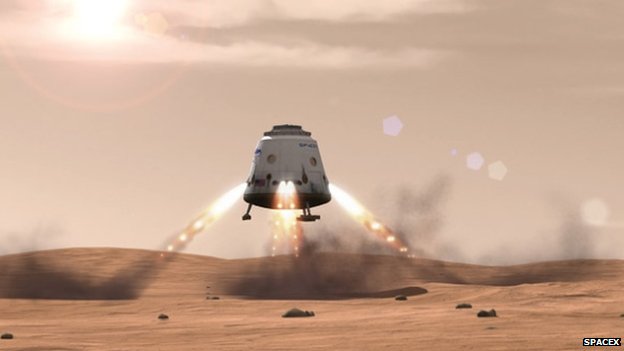
(Credit: SpaceX)
Elon Musk, the billionaire founder and CEO of the private spaceflight company SpaceX, wants to help establish a Mars colony of up to 80,000 people by ferrying explorers there for perhaps $500,000 a trip, Space.com reports.
In Musk’s vision, the ambitious Mars settlement program would start with a pioneering group of fewer than 10 people.
Accompanying the founders of the new Mars colony would be large amounts of equipment, including machines to produce fertilizer, methane and oxygen from Mars’ atmospheric nitrogen and carbon dioxide and the planet’s subsurface water ice; and construction materials to build transparent domes, which when pressurized with Mars’ atmospheric CO2 could grow Earth crops in Martian soil.
Musk figures the colony program — which he wants to be a collaboration between government and private enterprise — would end up costing about $36 billion.
Comments (43)
by james braselton
hi there yeah i know every thing about the universe i found ufo have back up species sooo they have infant livese they reverse death reverse ageing faster then light speed
by Christian Gehman
Get more Musk!
by James Goggin
Musk is a visionary. He is very impressive. We need more like him.
by GAUSS
Agreed!
by GAUSS
36 Billion… so, about a year’s worth of one of the USA’s ridiculous wars. Piece of cake.
by Bruce Wright
The initial settlers would cost a whole lot more than $500k each to put onto Mars – you need to get lots of infrastructure in place (the space ships to go there, the habitats on the ground, etc) before you send even the first person. Near as I can tell, the $500k figure must be either his anticipated average cost amortized over 80,000 colonists, or the anticipated marginal cost of each additional colonist once you got the first 1000 or 10,000 up there. My guess is that the seed money needed to get this going is probably more in the $50-100 Billion range at minimum, and even that’s given the technology we’ll have in 10 or 20 years. Somebody’s going to want to get that investment back (wars, unfortunately, can often be profitable ….).
by GAUSS
Quite true.
by omran al-kandari
Please take me to mars with you :( ! I want to be a martian :D
by Ted Rodosovich
Just divert all the resources being wasted on useless activity like religion … plenty of $$$ …
by GFreeman
Living under a reduced gravity is still an unansered question, Life expectancy in zero gravity is about 4 years while is it more than 70 years at 1 g. On the moon it’s 1/6 g and on Mars it’s 1/3 g. No one knows what the life expectancy will be there.
by Roo
Funny that Carl Sagan wrote in his book Contact that living in 0 g actually give you longivity. At least that is what I remember. Please correct me if I am wrong.
by pt
Why not just have rotating physical activity areas to simulate 1g+?
by GatorALLin
…reply to GFreeman….. Yeah, have to admit that problem seems like a big one… lets hope if we can crack this DNA coding a lot more in the next 10 years or so, that we can improve our longevity and fix problems like that as well. There must be a dozen or so challenges like this that will come up and maybe only become obvious once we live there for a bit to find out all things we don’t yet know/appreciate.
I remember hearing a few “what if” theories about the moon landing that came up. What if the surface was covered in 10-20 feet of dust or very find sand, making it impossible to walk on the surface or almost impossible to land a craft safely? Luckily that was not the case, but questions of radiation or other non-earth like environments must be on the “what if” list.
btw..this will be interesting. http://mars-one.com/en/
by Bruce Wright
As I recall most of the problem with low-gravity environments isn’t that they directly reduce life expectency, but that the resulting muscular atrophy and loss of bone density makes it difficult or even impossible to return to Earth-normal gravity. The surface gravity on the Moon is so low – about 1/6 g, as you note – that it’s likely to have a similar effect. The surface gravity on Mars is actually 38% of Earth’s rather than 33%, and may be large enough minimize those effects; a 150 lb person would weigh about 57 lb on Mars. The effect of someone travelling from Mars to Earth would be similar to a 150 lb person suddenly weighing about 395 lb – which would be enough of a change to have a large effect on their mobility, but probably one to which they could adapt given time.
It is of course still an open question what will happen biologically, since we haven’t had any possibility of observing anyone living under those conditions; the only thing we’ve been able to observe is the effect of zero gravity, which almost certainly won’t be the same.
by Glen Lincoln
Why go to Mars? Why DO anything, we should just all stay in bed. Life! Who needs it?!
by Bruce Wright
… Except that when you’re talking about spending $80 Billion or more to do it, you’d kinda like to get some kind of return on that investment. There are plenty of things I can think of to spend that kind of money on right here on Earth – exploring the deep ocean, building a national high-speed rail network, funding basic biomedical research on diseases like cancer, heart disease, and Alzheimer’s, etc. Just because it’s an exciting project with lots of sweet technology doesn’t mean that it’s a good way to spend that much money.
by tedhowardnz
Put the $80 Billion into developing self building, self repairing production systems, and creating an age of abundance, where everyone on earth has all their survival needs guaranteed.
With abundance achieved, money becomes meaningless (as money is a measure of market value, and market value has a scarcity function, and anything abundant {with zero scarcity} therefore has zero monetary value).
With abundance, and security, and technical production capacity, we can cooperate to achieve whatever we want.
Creating artificial G inside large rotating habitats is relatively easy.
The moon is a great source of mass. Taking just 1% of the Moon’s radius, and processing it to create large spinning hollow tarraformed cylinders gives us enough mass to construct 50 time to land area of the earth, in near earth orbit.
Enough for quite a bit of expansion.
Relatively easy to do if we put enough self replicating robotic systems to work.
Once we produce a system of machines that can duplicate themselves in two weeks, then within two years, all of this becomes possible.
Once we start to think and act beyond economics and scarcity, and start to envisage what we can do with abundant production, and abundant energy from the sun, most of the problems we have now go away very quickly.
Most people are trapped by thinking in terms of money.
Money has been a useful myth, but is rapidly outliving its utility for humanity.
Time to start thinking beyond money, to start creating systems that unleash and empower the productive capacities of every human mind.
And I doubt anyone has any real idea what will result.
I am confident that the result would be far more fun for almost everyone than the reality that most live in today.
What could we achieve with one final grand challenge for money – to be the tool of its own demise.
by Bruce Wright
I’m quite sure something like this could be done, but the question I can’t find answered anywhere is why? Unless you can do something there that can’t be done on Earth, there’s no economic incentive. It doesn’t appear to be likely that mining for export will be practical, unless the materials mined are extremely valuable (even just launching an unmanned return rocket from Mars would be expensive since you’re at the bottom of that gravity well …). Anything that requires the zero gravity or high vacuum conditions of deep space is obviously impossible. Solar energy facilities would be too far away to be practical. The only thing I can think of is that it might make a somewhat better support facility for exploiting the asteroids than trying to do that directly from Earth (it’s a lot closer to the asteroid belt, and the gravity well isn’t as deep) – but that brings up a whole different set of issues that aren’t mentioned anywhere that I can find.
I’d have to agree with those who are saying that the Moon and L4/L5 would be better short-term investments. The Moon is actually very attractive in a number of ways: very low gravity and no appreciable atmosphere, so it’s easy to launch things out of its gravity well, plus it’s reasonably close. If we could establish a mining and manufacturing presence on the Moon, the large amount of materials needed for large L4/L5 habitats become much easier to achieve. The main downside is that the Moon is never likely to make an ideal habitat for permanent human occupation (very low gravity, 28-day night/day cycle, etc), so any human workers will likely have to be cycled on/off fairly regularly. But if industrialization on the Moon is successful, it makes things like Mars colonies a much easier step since much of the big initial infrastructure can be manufactured there, likely cheaper than making it on Earth and launching it into space – at least until and unless a space elevator ever becomes practical.
by Matt
Why go to Mars? Because it’s the ultimate escape to build a colony of 1% without the gene’s of the Wal-Mart crowd. :-)
by Bruce Wright
LOL. But there are much cheaper (and more picturesque) ways of doing exactly that without leaving the Earth.
by GAUSS
500,000 per trip is cheap compared to what the actual cost of the trip is. I’m surprised he doesn’t estimate more. It costs that just to get a crummy bungalow in a major US city these days. :P
by pt
Asteroid belt operations and creation of new real estate are the main reasons I see. Mars is easily terraformable. All CO2 plus tectonic activity. Just have to get the atmosphere mix right and you have a nice balmy planet. Production of various types of space equipment in a lower gravity environment has its benefits, although an in-orbit station would likely serve all of those needs more efficiently.
by RB
Musk has stated previously that he believes humanity needs to become a multi-planetary species; that’s our next step. If we can do it successfully, it may ensure the survival of the species if any sort of cataclysmic event were to occur (natural or man made). Imagine an asteroid impact on Earth. With a thriving colony on Mars, or on asteroids, or further afield, we can continue.
by GatorALLin
…with the sun slowly expanding….. do we only have 600 million years left before we have to solve problems like the oceans evaporating due to earth heating up? (yeah, maybe we solve all problems in the next 200 years and becomes a non threat)
by Bruce Wright
I understand that, but in the cosmic scheme of things it probably really won’t matter that much if we establish a colony on Mars in 2025 or 2125. Given our current space infrastructure (small), it’s a huge undertaking, while there are more immediately achievable goals (establishing a Moon colony, for example) that would provide much more immediate and direct benefits while still providing for some of that “insurance policy” that you mention.
If we don’t manage to kill ourselves first, a Mars colony will happen eventually – but it’s probably not one of the first things we need to be doing in space.
by RB
I never understand this kind of thinking. First, we won’t “kill ourselves first”. Second, why isn’t it “one of the first things we need to be doing in space”? Says who? You? The inevitability of mankind becoming a multi-planetary species is irrespective of any short term “insurance policy” rationale. That you think we should wait (as if there was a “proper” order to our advancement) is an opinion, no more valid than Musk’s. My money’s on him, and on those with grand vision, for they are the drivers that fulfill the human potential.
by Bruce Wright
The problem with it is that it just gets us from the bottom of one gravity well to the bottom of another gravity well, and one with many fewer resources (Any biosphere that we would find useful for the colony would have to be constructed and brought over by us). Granted, the gravity well isn’t as deep as the one we’re in, but getting there does little to exploit the resources of the solar system – and in fact drains resources that could be used elsewhere. If you’re going to try to sell this to any government or group of private investors, they’re going to want to know what kind of payoff they’ll get for their money. If you’re not, then good luck finding enough money to accomplish it.
The first thing we need to be doing to start exploiting the resources in the solar system is to work on technology that can be used to extract useful materials from the Moon and the asteroids – which can be used to build spacecraft and space habitats that don’t require the large energy expenditure of energy to lift them out of our own gravity well. Certainly a space elevator would help in that regard, but it’s still a ways off even if it does eventually become practical.
I’d very much like to see a human presence on Mars, and I think we’ll establish a colony there eventually – but right now it’s a major distraction. IMHO, of course, but so far I haven’t heard anyone (including either you or Musk) give even one cogent reason why this is an important thing to be working on before we have any of the other infrastructure in place.
by Dr.Pratt
Now THAT is exciting!!
by Laura C.
We could have done this years ago, e.g., the Mars-Direct plan – see “The Case for Mars: The Plan to Settle the Red Planet and Why We Must” (recently updated). But that was put together for a period before major medical breakthroughs, and if RK is right, these coming breakthroughs (that could protect human tissue from radiation, lack of gravity, perhaps even lack of oxygen – e.g., oxygen-carrying blood-bots – and so forth!) may come in time for the projected Musk-to-Mars plan, meaning it will be easier and less risky, and so even cheaper, than it now appears. And of course there’ll be all sorts of breakthroughs in materials science that should enable both the space-faring hardware and the protective materials available for the space-farers to overcome what now appear to be very, very difficult obstacles. Let’s go!
by bernard
Perhaps is the projected timeframe space elevator technology will become practical and the cost of getting all that equipment up there for transport to Mars will fall to affordable levels.
by giorgio gaviraghi
I believe that a cost of 500K $ per person on Mars is quite reasonable considering existing launch costs , only for LEO they range from 5 to 10K perr Kg.
To achieve such capability needs a major effort and breakthrough in several technologies, strting from the need a of a fully reusable Earth. Mars transportation system,to propulsion systems, to underground Terraforming on Mars , power generation, food production, life support systems etc.
A cruiser-feeder system as transportation should be considered as well as advanced techniques ,( Bini shells ?) or others (3d printing ?) to obtain construction materials on Mars and other type of products.
The real key for its success is a profitable business model that could produce benefits immediately, with th e few individuals that will organize the initial base. Also the possibility for the settlers to return to Earth, Mars One plans to leave them there in a one -way only trip. More details of the above in the ebook” How to develop the solar system and beyond ” on Amazon
by Longwise
There is a kind of Natural Selection when you make the price $500,000. That will limit the people going in at least two ways: Means and will. Genetics is more convoluted than this model would filter for, but certainly it would limit the initial group to an able and aggressive bunch for the most part. I find that prospect interesting in and of itself.
by Bill Clayton
The wealthy will need a working class. They’ll import the talented — an perhaps no-so-talented — to do the labor. They might send representatives ahead of them. Organizations might fund trips for their representatives. Means and will will be part of the equation but no all.
by Tomas
But surface of Mars ( soil ) is higly contaminated by radiation, isn`t it ? I`m not sure who`ll eat that crop.
by Rick Thurman
What would be wrong with a more conservative approach? Say, establishing ecologically and economically sustainable operations in Earth orbit, the L-spots, and the Lunar surface? Closer to home, easier to support, more likely to provide useful exports back to Earth to create a full-sectored space economy. No need to create interplanetary-travel capable drives. I’m sorry, I just find obsessing over colonizing Mars when we can’t yet make long-term human life in our local terralunar system viable — ecologically, financially, politically — a distraction from the very real challenges to space colonization that are already staring us right in the face. Of course you want to get there eventually, but to leap past some obvious local resource opportunities, compound our current settlement challenges with an even further trip — how much money (that we don’t necessarily have, at least not now) would this suck out of these other, more practical space settlement endeavors?
by Jake
I’d like to point out that large amount of raw material are needed to build habitats (rotating habs perhaps?) in the 5 L points.
by melajara
You have a point for a Lunar colony but for the Lagrange spots, you’ll have to cater for a rapid rotation of the teams in charge as the absence of gravity is unsustainable in the long run for the human organism.
Of course, you can have artificial gravity through e.g. centrifugal force, but then this complicates the infrastructure.
But I like very much the idea of a Mars colony. In the long run, this is inescapable and if we are doing it now, we’ll regain ground on the terrible lack of any progress for the past 40 years in human space exploration.
If Musk thinks this is achievable, I believe him: this man is not a daydreamer but one of the best entrepreneur I know.
by Bri
I agree, the money should be spent on near earth activities, then liner.
by Longwise
Musk seems to like Escapism. The further you are from the messed up politics and ethics of Earth, the easier it is to redesign a governmental system that might work. None of the systems we have here adequately take into account the nature of man. We have some that err on the side of man being too perverse, and some that err on the side of man being basically good. Neither model works, so all the governments are broken and without adequate ground rules, sustained growth is unlikely. A close colony is more easily sucked in to Earths almost certain fall than a remote one. Musk thinks of the colony as Noah’s Ark. Remnants anyone?
by John
My thoughts exactly.
by GAUSS
I don’t blame him.
by Ed
80,000X500,000=40 billion with an over head of 100% the totle is 80 billion dollars. Still a great deal. I love this guy.
by GAUSS
That’s what I said!!