Human brains share a consistent genetic blueprint and possess enormous biochemical complexity
September 20, 2012
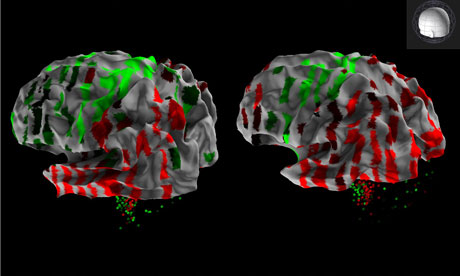
3D rendering from the Allen Human Brain Atlas (credit: Allen Institute for Brain Science)
The same basic functional elements are used throughout the cortex and understanding how one area works in detail will uncover fundamentals that apply to the other areas as well, scientists at the Allen Institute for Brain Science reported in the latest issue of the journal Nature.
Human brains share a consistent genetic blueprint, and possess enormous biochemical complexity, they said, based on the first deep and large-scale analysis of the vast data set publicly available in the Allen Human Brain Atlas.
The results of this study are based on extensive analysis of the Allen Human Brain Atlas, specifically, the detailed all-genes, all-structures survey of genes at work throughout the human brain. This dataset profiles 400 to 500 distinct brain areas per hemisphere using microarray technology and comprises more than 100 million gene expression measurements covering three individual human brains to date.
Among other findings, these data show that 84% of all genes are expressed somewhere in the human brain and in patterns that are substantially similar from one brain to the next.
“This study demonstrates the value of a global analysis of gene expression throughout the entire brain and has implications for understanding brain function, development, evolution and disease,” said Ed Lein, Ph.D., Associate Investigator at the Allen Institute for Brain Science and co-lead author on the paper. “These results only scratch the surface of what can be learned from this immense data set. We look forward to seeing what others will discover.”
Key Findings
The results of this study show that, despite the myriad personalities and cognitive talents seen across the human population, our brains are more similar to one another than different. Individual human brains share the same basic molecular blueprint, and deeper analysis of this shared architecture reveals several further findings:
- Neighboring regions of the brain’s cortex are more biochemically similar to one another than to more distant brain regions, which has implications for understanding the development of the human brain, both during the lifespan and throughout evolution.
- The right and left hemispheres show no significant differences in molecular architecture. This suggests that functions such as language, which are generally handled by one side of the brain, likely result from more subtle differences between hemispheres or structural variation in size or circuitry, but not from a deeper molecular basis.
- Despite controlling a diversity of functions, ranging from visual perception to planning and problem-solving, the cortex is highly homogeneous relative to other brain regions. This suggests that the same basic functional elements are used throughout the cortex and that understanding how one area works in detail will uncover fundamentals that apply to the other areas, as well.
In addition to such global findings, the study provides new insights into the detailed inner workings of the brain at the molecular level – the level at which diseases unfold and therapeutic drugs take action.
- 84% of all genes are expressed, or turned on, somewhere in the human brain.
- Many previously uncharacterized genes are turned on in specific brain regions and localize with known functional groups of genes, suggesting they play roles in particular brain functions.
- Synapse-associated genes—those related to cell-to-cell communication machinery in the brain—are deployed in complex combinations throughout the brain, revealing a great diversity of synapse types and remarkable regional variation that likely underlies functional distinctions between brain regions.
“The tremendous variety of synapses we see in the human brain is quite striking,” said Seth Grant, FRSE, Professor of Molecular Neuroscience at the University of Edinburgh and collaborating author on the study. “Mutations in synaptic genes are associated with numerous brain-related disorders, and thus understanding synapse diversity and organization in the brain is a key step toward understanding these diseases and developing specific and effective therapeutics to treat them.”
Fully integrating several different kinds of data across different scales of brain exploration, the Allen Human Brain Atlas is an open, public online resource that details genes at work throughout the human brain. Data incorporated into the Atlas include magnetic resonance imaging (MRI), diffusion tensor imaging (DTI), as well as histology and gene expression data derived from both microarray and in situ hybridization (ISH) approaches.
Users of the Allen Human Brain Atlas comprise a diverse array of biomedical researchers — primarily neuroscientists — throughout the world. They include scientists who study the human brain itself, as well as those working in model systems, providing a rare and important opportunity for them to probe the relevance of the findings to humans. Currently, more than 5,000 unique visitors access the Atlas each month.
The Allen Human Brain Atlas is used in small and large-scale applications to examine diseases and disorders, such as epilepsy, Parkinson’s disease, autism, schizophrenia, and Alzheimer’s disease — as well as to understand how the healthy brain works. The data also allow comparisons between the brains of humans and other animals, with particular relevance for studies of human disease. The Allen Human Brain Atlas is available via the Allen Brain Atlas data portal at www.brain-map.org.