Humanoid robot learns language like a baby [updated 6/15/2012]
June 14, 2012
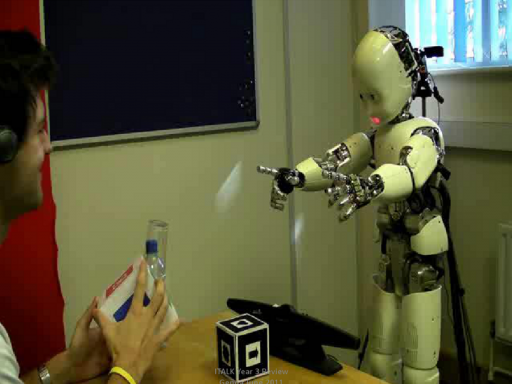
The scenario for the human-robot dialogue (credit: Caroline Lyon, Chrystopher L. Nehaniv, Joe Saunders/PLoS ONE)
With the help of human instructors, a robot has learned to talk like a human infant, learning the names of simple shapes and colors, reports Wired Science.
“Our work focuses on early stages analogous to some characteristics of a human child of about 6 to 14 months, the transition from babbling to first word forms,” wrote computer scientists led by Caroline Lyon of the University of Hertfordshire.
Named DeeChee, the robot is an iCub, a three-foot-tall open source humanoid machine designed to resemble a baby. The similarity isn’t merely aesthetic, but has a functional purpose: many researchers think certain cognitive processes are shaped by the bodies in which they occur. A brain in a vat would think and learn very differently than a brain in a body.
This field of study is called embodied cognition and in DeeChee’s case applies to learning the building blocks of language, a process that in humans is shaped by an exquisite sensitivity to the frequency of sounds.
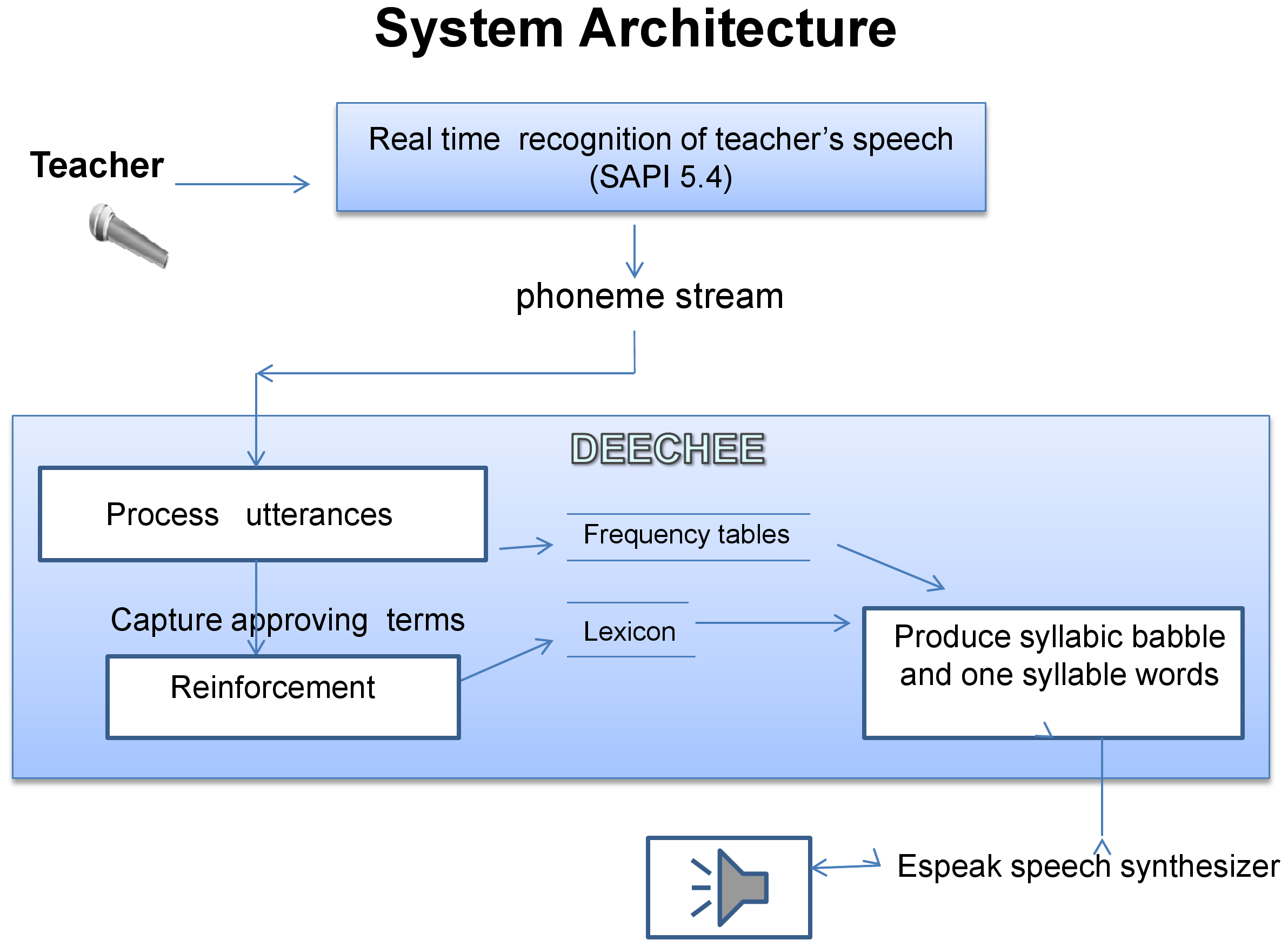
Overview of the system architecture (credit: Caroline Lyon, Chrystopher L. Nehaniv, Joe Saunders/PLoS ONE)
Using DeeChee also allowed the researchers to quantify the transition from babble to recognizable word forms in detail, drawing statistical links between sound frequencies and the robot’s performance that might eventually inform research on human learning.
“This paper fascinated me because I’m a big fan of Tomasello’s constructivist theory of language acquisition, which is one of the key inspirations they cite for their work,” artificial general intelligence expert Dr. Ben Goertzel told KurzweilAI. “I think that having machines learn language in an embodied and social context is the right thing to do. So, I do think this work is going in a great direction, broadly speaking.
“However, the limitations of the particular techniques and results reported here are also worth carefully noting….. What the AI is learning here is, basically, to recognize individual words in streams of sounds. This is interesting and valuable, but obviously, in itself, it doesn’t get you very far toward general language learning. They’ve done this using statistical reinforcement learning methods — using well-known methods that seem pretty obviously capable of doing this sort of thing. So there’s nothing really revolutionary here scientifically, though of course it’s wonderful to see that they’ve gotten this working.
“Obviously, one key question is whether the methods they’ve used to do this will be extensible in future to more advanced aspects of language learning. According to my own scientific intuition, they probably will not be thus extensible. I think very different methods will be needed to make more advanced language learning work, within the embodied social language learning context that these researchers have (IMO correctly) chosen. But the researchers involved may have a different intuition about the potential of their particular methods.”
Ref.: Caroline Lyon, Chrystopher L. Nehaniv, Joe Saunders, Interactive Language Learning by Robots: The Transition from Babbling to Word Forms, PLoS One, 2012, DOI: 10.1371/journal.pone.0038236 (open access)
Update 6/15/2012: Comments by iCub developer Jürgen Schmidhuber, Director of the Swiss Artificial Intelligence Lab IDSIA and artificial general intelligence expert Ben Goertzel added
Comments (19)
by anthrobotic
There’s no denying that rebuilding something from the ground up is one of the best ways to truly understand it (or copy it, right China?).
Now, a creepy little plastic face is a creepy little plastic face, to be sure, but this an important step in ramping up the software for androids that already appear very, very real.
“Leaping Across Mori’s Uncanny Valley: Androids Probably Won’t Creep Us Out” http://goo.gl/2THZG
by Peter Simmons
So men invent machines to ‘discover’ how baby humans acquire language. They could have saved some time and money and asked a woman who has children. It’s already established how we acquire language… go read Chomsky. ‘Inform research on human learning’ indeed … justify another ‘research’ grant more like.
by qwerty_jones
Research like this is done not to “‘discover’ how baby humans acquire language.”, but to figure out how to create efficient self-learning algorithms for machine-learning.
by Editor
Comments by artificial general intelligence expert Ben Goertzel added
by Bri
Human beings are mammals. We came from creatures that have very specific desires. The NEED to eat, to reproduce, to relate socially. I came up with a thought experiment in high school. Imagine allthe things you like doing. Now think that no one else ever existed, or ever will. We really don’t do things for our selves, we NEED other people. It will be a long time before an A I will NEEd to get seek revenge for some insult or ‘ belief’. You’re just anthropomorphesizing a relatively simple execution of code. Nothing anywhere near as NEEDY as say a dogs NEED to be an alpha male. Hopefully we won’t make robots that go through th terrible twos, or teenage angst.
by Bri
Let me continue this thought in relation to sky net. If we continue to let DARPA be the strongest developer of A I then we are defined by actions as a war mongering species. There robots will have cognition in relation to aggression. It then is the same as the people who want to shoot down the drones. Lash out, attack all invaders. This is a survival mechanism from our aboriginal days. Xenophobia emanates from this perspective. It was wise, for survival to don this perspective. Most things in the aboriginal world were trying to eat you. Most other human social groups were trying to dominate you. For evolution, this made us learn, or grow faster as we compete with other hominid groups. Like Russia, Iran, china, etc. So it’s ‘ wise’ to be Leary of outsiders, and to quickly make judgements, and eradicate threats. This is a deeply ingrained social ‘ program’, that constantly runs in the background of our unconscious minds. We view everything in relation to it’s threats to us. Believe me, robots aren’t even close to this. If we continue to define our world in this way, as Ray say’s, A I is an extention of our selves. DARPA is making an A I that defines the world in terms of threat, and so can concieveably make a sky net type A I. Then A I might “see” humans as a threat. In a micro second, our fate could be determined, only if it had access to enough macro center control. That in it’s own is a tall order. Otherwise we would crush it. Don’t let your fears rule your life. There is more to be gained by learning, and understanding, than by restriction and ignore , ignorance. Our lives are full of desires. A I doesn’t even understand desire, or NEED to overthrow humanity.
by Marcos Marin
Who’s Leary?
… This wise outsider you speak of…?
by Bri
That’s the famous O’Leary’s. They had a cow, like your having. I’ve always been bad at spelling. It’s from social influences when I was a child. Hard to break the habit. I haven’t written anything in thirty years. Its painful to me, to see. I appreciate any discussion of my thoughts. Whether you agree or not. Just trying to instigate a conversation.
by Marcos Marin
No problem Bri =) I actually agree with some of what you say.
How do you guys get notified of replies? only by registering? =/
by Mr.x
@Marcos Marin: I just drop in from time to time.
@Bri. Bad social influence sounds like an excuse (don’t say I can’t know how it is…. you don’t know whether I know).But I do think you are doing fine, so there should be no need to excuse yourself.Hm, but don’t take my word for it, maybe I am even worse- who knows!?
For example I did not get the cow reference.
@Peter: It is not as if Chomskies views are uncontroversial.They are just mainstream in some parts of the world.Anyway I agree with qwerty’s comment.
by GatorALLin
ahh….baby skynet…. so cute. Please don’t nuke us baby skynet.
by Mr.x
People who think that hollywood movie references are a serious argument are…. funny.Must be a cultural thing. I also think you did not read the article because the simmilarity between this robot and something like “skynet” is rather abstract.
I hope it is allowed to post some links concerning this:
http://www.overcomingbias.com/2007/04/overcoming_fict.html
http://lesswrong.com/lw/bda/fictional_bias/
have a nice day.
by Marcos Marin
she/he COULD be joking… =)
by Mr.x
@Marcis Marin: I COULD be joking too =)
There are a lot of people whose sole reaction is sth like this movie reference.Anyway, it is not the kind of humour I think funny, so I apologize if anyone feels offended.
@Bri
http://en.wikipedia.org/wiki/Evolution
Evolution seems to be the thing most people believe to understand without doing so.The first time I came across this statement I took a superficial look into the subject matter found out that I belonged to those who only thought they understand evolution.The kind of notions people develop about things based on superficial appearence are called “naive theories”.One has to be weary of these overly simple and intuitive explanations if s/he wants to align his/her understanding with the way things are.
Most of what you describe does not stem from evolution but the accumulation of culture.Concerning the “survival mechanism of aboriginal days”- it is much much older- older than the human race itself. About the creation of strong AI: Traits representive for the general population don’t necessarely have to be present in a smaller population (e.g designers of AI) to such an extent that they inavoidably find a way into something they create.If this were not true we would probably not have such notions as high/lowbrow culture etc.
Of course people should try to understand each other but there are situations in which being too friendly can lead you to suffer considerably.There are people, ideologies etc out there which make it necessary to act in order to preserve oneself/ves.
by Marcos Marin
Man! calling a “joke” a “serious argument” is a serious offense! =)
by David Luzar
Mr. x, you are aware that the fictional bias you reference was actually an april’s fool -) .. but it applies non the less, so I guess you’re right.
by Mr.x
@David: No, I just googled to find something that would explain my point without having to write lengthy explanations about why I think this is true- I would feel like a religious person trying to convert someone: hard work, little to no payoff. Lazyness on my part, sorry. The post I actually should have refered to was this one: http://lesswrong.com/lw/k9/the_logical_fallacy_of_generalization_from/
In short: We consume fiction and adjust our expectation of what is likely to happen or possible on the basis of something that someone just conjured up.It is like a kind of fake experience–> in general wrong premises are more likely to lead to wrong conclusions than right premises.
@Bri: We are really d’accord on most things.You were the one who claimed that we should change so that ‘the simple execution of code’ suits us.Think about it, maybe human emotions are nothing else but the result of the execution of algorithms based on perceived information through the medium of physics, and its subcategory chemistry (one could abstractly view physical things as material pattern).If the evolution of a species/being follows some mathematical pattern/rules which is enforced through the physical “laws” (as they are, not as we know them, the way the universe is), then our adaptions (aformentioned algorithms and so on) are partly arbitrary in relation to any goals we may formulate (they are not aligned), as are those goals themselves because they are the output of the product of this/these process/es.This leaves us with the option to choose as we see fit within the scope of the “free will” that is left (if any).This view is partly simmiliar to reductionism and the computational theory of mind.I think these two approaches to their respective fields fit nicely to some prescriptive models of thinking.I mean I know these are oversimplifications, but in my view stuff has not to be right, but right enough to do achieve ones goals.I hope I am not making a fool out of myself again ;).Otherwise I need to strengthen my Google Fu.
Have a nice day.
by Mr.x
I forgot to say why I mentioned the choise aspect.I wanted to say I think it smart create stuff that has only more or less specific applications.E.g you don’t have to build in real feelings in a robot that serves to entertain someone.No real feelings, no drive, no undesired actions.I mean, we can’t look into the heads of others, and sometimes it feels as if they are not thinking either ;). With regard to practical applications (not some “strange” desires) it makes no difference if we just have some kind of intelligence, ai, able to do something, or true artificial consciousness.The people who build those things have the choice what they implement, given their ability to do so.
by Editor
Links are OK here as long as they do not lead to spam websites (resulting in a user ban) and have URLs that are relevant (but users are advised to mouse over the link text to confirm that it matches the actual URL)