IBM ships Watson system to RPI researchers to develop new markets
January 31, 2013
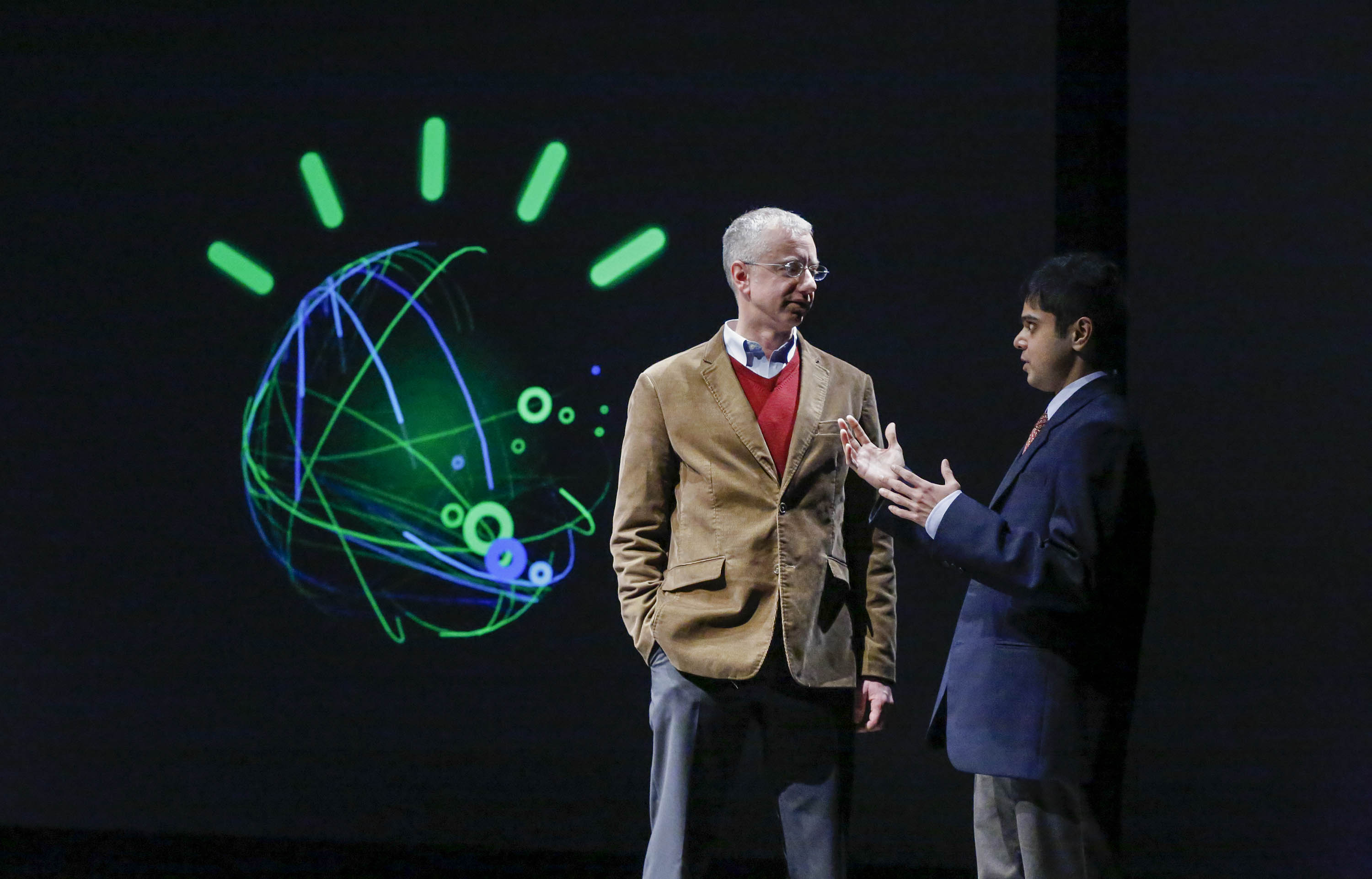
IBM Research Scientist Dr. Chris Welty (left) and Rensselaer Polytechnic Institute student Naveen Sundar discuss potential new ways the famous computer could be used. (Credit: Philip Kamrass/Feature Photo Service for IBM)
IBM announced Wednesday that it will provide a modified version of an IBM Watson system to Rensselaer Polytechnic Institute, making it the first university to receive such a system.
The Watson system will enable upstate New York-based RPI to find new uses for Watson and deepen the systems’ cognitive capabilities, IBM says.
Watson has a unique ability to understand the subtle nuances of human language, sift through vast amounts of data, and provide evidence-based answers to its human users’ questions.
RPI will extend Watson’s reasoning and cognitive abilities to finance, information technology, business analytics, and other areas, IBM says. Until now, IBM has focused Watson mainly on healthcare and finance.
Watson as enabler of 2 million future jobs?
The Watson system at Rensselaer will have 15 terabytes of hard disk storage*, roughly the same amount of information as its Jeopardy! predecessor, and will allow 20 users to access the system at once.
“Access to the Watson system will enable new research in cognitive computing as it relates to a diverse range of scientific and engineering fields, and the experience of working on Watson will give our students an advantage as they compete for the best jobs in Big Data, analytics, and cognitive computing,” said Rensselaer President Shirley Ann Jackson.
Gartner, Inc. estimates that 1.9 million Big Data jobs will be created in the U.S. by 2015. This workforce — which is in high demand today — will require professionals who understand how to develop and harness data-crunching technologies such as Watson, and put them to use for solving the most pressing of business and societal needs.
As part of a Shared University Research (SUR) Award granted by IBM Research, IBM will provide Rensselaer with Watson hardware, software and training. The ability to use Watson to answer complex questions posed in natural language with speed, accuracy and confidence has enormous potential to help improve decision making across a variety of industries from health care, to retail, telecommunications and financial services, IBM says.
Several key members of IBM’s Watson project team are graduates of RPI, which was one of eight universities that worked with IBM in 2011 on the development of open architecture that enabled researchers to collaborate on the underlying QA capabilities that help to power Watson.
IBM is also a key partner of the Rensselaer supercomputing center, the Computational Center for Nanotechnology Innovations, where the Watson hardware will be located.
UPDATE: Feb. 2, 2013: * The original Watson cluster for Jeopardy! had “a total of 16 Terabytes of RAM” and “the file system containing all of Watson’s data [was] on 4 Terabytes of disk,” according to IBM Systems Magazine, Feb. 2011 (or “15TB of total RAM and 1 Terabyte of stored data,” according to Inside System Storage — by Tony Pearson (Master Inventor and Senior Managing Consultant for the IBM System Storage product line) on the IBM Developer Works website), neither of which is “roughly the same amount of information as its Jeopardy! predecessor.” I’ve asked IBM for a clarification and detailed specs. — Editor (H/T to melajara)
Comments (40)
by Bri
I for one am very happy that Watson is being used in conduction with the financial system. As time goes by Watson will be able to take the hype out of financial theory. Too much is at risk if we keep guessing what is actually happening and allow political policy to adversely impact millions if not billions of people.
by DeBee Corley
Is tomorrow going to be much the same as today? Well, no. I just started doing my income taxes. Because of “computer programming” and new tax law, it is going to be “waaaaay” more difficult.
Watson is going to create an ungodly amount of work.
Question Watson: Analyze the structural defects on the Brooklyn Bridge.
Question Watson: Who is stealing money from the pension fund?
Question Watson: What is DeBee thinking? (Hey, wait a second….)
by WLGJR
Eventually this results in what is called a “Oracle AI”.
Read Anders Sandberg, Nick Bostrom and Stuart Armstrong’s paper on this (you can find it on Google).
by melajara
@Editor
“The Watson system at Rensselaer will have 15 terabytes of hard disk storage”. 14TB HD is not impressive, given the mandatory bandwidth, I think it’s rather 14TB RAM!
To support this interpretation, look e.g. here https://www.ibm.com/developerworks/mydeveloperworks/blogs/InsideSystemStorage/entry/ibm_watson_what_s_in_that_1tb3?lang=en
by melajara
Ahem, 15TB RAM ;-)
by Editor
See UPDATE: Feb. 2, 2013 at bottom of article
by DrDubious
Watson and “Big Data’ may help create a couple million jobs but they will simultaneously help eliminate tens of millions and drive down income in the process.
Society needs to, sooner rather than later, figure out how to support and entertain a growing population who will have no productive purpose.
The Ruling Class already have their plan.
(Hint: We’re not included)
by Charlie
Previous industrial revolutions have involved changes from one form of manual labor, farming, to another form of manual labor, namely factory work. Artificial intelligence and robotics threaten to eliminate virtually all manual labor jobs. For example, self driving cars trucks and buses will probably eliminate all driving jobs within the next 20 years. Will the several million such drivers put out of work be able to find new jobs in the knowledge industry? Seems highly doubtful. Since modern economies are consumer driven, if artificial intelligence and robotic’s eliminate millions and millions of jobs, where will the consumers come from? Will corporations be willing to pay people not to work But still be consumers, through taxes or whatever? It is going to be and interesting transition and I wonder if any of us are really ready for it.
by Thrillhouse
>where will the consumers come from? Will corporations be willing to pay people not to work But still be consumers, through taxes or whatever?
Nobody says there have to be a *lot* of consumers for a lot of money to be spent consuming.
From the infamous citibank plutonomy memos:
>In a plutonomy there is no such animal as “the U.S. consumer” or “the UK consumer”, or indeed the “Russian consumer”. There are rich consumers, few in number, but disproportionate in the gigantic slice of income and consumption they take.
>(Then?) There are the rest, the “non-rich”, the multitudinous many, but only accounting for surprisingly small bites of the national pie.
http://politicalgates.blogspot.ca/2011/12/citigroup-plutonomy-memos-two-bombshell.html
by WLGJR
The ideal scenario is that we the non rulers also benefit from exponential growth. Ultimately through cyborgization.
If the ruling class think differently from we do, then we will have to do that bravely and carefully. “Citizen cyborgization” would be a good name for the new activism.
by IIChron714
“We are the Borg. You will be assimilated. Resistance is futile.” – Star Trek
Be careful what you wish for…
by WLGJR
Assimilation is better than annihilation. I for one can accept that.
by trakk
it will be guys like you who will rat out the resistance.
Just kidding:-)
by ErikSMeyer
Does 1.9 Million strike anybody else as, I don’t know, on the high side for jobs to be created in Big Data in the next two years? Jobs doing what, specifically? I’m not saying there’s nothing to do there, but 1.9 Million?
by thomas
Watsons performance on the Jeopardy show eliminated 2 jobs. I have the sense that down the road Watson will eliminate more jobs than Watson creates.l
by Joseph
I agree… I don’t understand all these tech “cornucopians” that think that accelerating technology is going to create jobs. I personally think that society is hooped.
by Bri
I think they make these job predictions to quell the fears of job loss. In the short term it might create some jobs but I think further AI and robotic development will eliminate any new ones created.
by Dr. Eddward Josef
Oh you dont understand? It is because you are misinformed, and base your reasoning on sc-fi films. These tech “conucopians” base their reasoning from historical data. Every technological advancement has (yes eliminated some jobs, but created many more). I can give you a good example of how accelerating technologies create jobs: The smartphone app market, an industry with employment of 0, to 600,000 strong, and growing, in less than 6 years. The auto industry may have eliminated the demand for horse drawn carriage manufacturers, but created millions of jobs in the sector, and even more in related sectors (i.e. auto accessories, auto insurers, body shops, garages, technical schools that were started to train individuals in mechanics, creating technicians, and spurring growth in the industry,etc —– I count about 10 million right there. I’ve got more examples if you want: look at how many jobs were created with the advancement of the computer, the internet. Just ask and I can school you some more.
by Aaron
It may be true that jobs are indeed created after technological advancements (many, in fact), however, the coming loss of jobs will surely overwhelm the amount created. Before, when new jobs were created as a result of tech advancements, the advancements themselves were relatively easy to adjust to (especially for jobs that didn’t involve creative thinking or working the mind too hard–basically labor jobs), thus it wasn’t extremely difficult to work off of those innovations and find jobs that were created as a result.
The coming age of advanced automated processes (from self driving cars all the way to 3D printers) will simply render millions of such jobs obsolete; manufacturing jobs, driving jobs, and many more will no longer require a human in virtually any capacity. It may be true that more jobs will be created, but they will likely be technical jobs that require extensive training and/or education. I know that at least in America, the majority of people are not particularly inclined towards highly technical jobs that require large amounts of training and/or education. The majority will therefore be left with no jobs, because adjusting to the changes brought on by the coming technological advancements will be too difficult and time consuming to deal with. All of those who lost their jobs (there will be many millions, at least in time) will either have to go back to school and find a way to sustain themsleves for the years it will take to learn a new skill (because most low skill jobs will no longer be available) and hopefully find a job eventually after they complete their education, or they will be left behind as yet another burden upon society that the rest of us will have to carry. We can only handle so much until the strain finally breaks us.
That is why it is imperative to find a way to fix these coming problems before they become too much to handle. If we don’t, the transition will be far from easy and there will be radical changes in the economy and governement as a result. We may not agree or like some of those changes, which is why we should try to make policies and changes that we can all agree upon in a controlled and organized process.
by Michael
I agree also that there will be a lot of problems with job loss but I’m more of the opinion that it will be a short term problem rather than a long term one. The idea of us “carrying” the jobless as you suggest will gradually get easier as there will be less to carry. For example robots will take a lot of the jobs but they will also do a lot of work meaning that more can get done for less. Depending on how far into the future you want to look it should get easier and easier eventually to the point where you won’t need a job because you will have everything you need already at a small cost. This is a simplified viewpoint but in general I think it will play out. One day (possibly not as far away as you might think) we’ll be growing food in factories and eventually doing this out of raw materials that possibly don’t even start out as food. i.e 3d printer for everything. if you can just print your food and everything else for that matter then as long as you have somewhere to stay why do you need a job? you’ll be able to get by while you study for the jobs that are left.
by IIChron714
I believe it’s time we seriously think about colonizing Mars and then make an Albucierre drive to get humanity to other star systems. If we all stay on Earth we will stagnate. Yes, establishing a colony and then a new branch of human civilization on another planet is a lot of hard work, but that’s exactly my point. New frontiers will open up new types of jobs and opportunities for those willing to make the trip, just as immigration to North America has done for millions of immigrants over the past few centuries. Let’s get out there and build new worlds!
by Michael
People are. Have a look at this as an example: http://mars-one.com/en/
by PirateRo
Good for you! I agree completely! We need more, much more.
by Cybernettr
Yeah, the problem is that the low-IQ jobs will be replaced by the high-IQ jobs. Until we figure out how to give people an IQ transplant, the average person will not be able to fill the new jobs. Look at a list of the top new jobs. They all require considerable training and most of all, smarts.
by de Broglie
Dr. Eddward, I do generally agree with you, and your examples are valid. A person always has a comparative advantage somewhere and technology will make goods cheaper. Thus wealth will increase. I am only a soft-believer in this Singularity paradigm, and I am highly skeptical of many of the comments made on this site; however, I think that the fears expressed over job losses are highly valid. The industrial revolution allowed society to harness energy to complete physical work. Less human labor needed to go into each manufactured output. For example, a stamped metal product had far less labor input in an industrial plant than in a blacksmith shop. The current information technology revolution currently allows for reduced mental input for each unit of output. For example, current science, engineering, and mathematics students use calculators and computer programs to manipulate data (Mathematica, Matlab, etc.). Prior to ubiquitous computing, tables were needed and many problems that take seconds now would take hours. Manufacturing plants are not fully automated in a lot of instances because human processing power is still superior to machine power on a comparable cost basis. Currently, humans have much better vision than machines. Thus little things like picking up bolts out of a pile and noticing details are relegated to people. However, as machines improve and become less expensive the processing advantage is rapidly shrinking. Ironically China is inadvertently unwittingly financing capital expenditures in the developed world with their high savings rate leading to a lower interest rates. After braun and brains, what do people have left? The horse mainly had braun and very few brains. The horse was an integral part of the economy at one time, so what happened to the principle of comparative advantage? In the short-run is everyone capable of being an engineer, programmer, marketer, or person that can put together the site we are reading? I highly doubt it. In the long run you may be correct. I think it will be a painful economic transition. As Charles Dickens taught us, economic transitions are not pleasant.
by Chrispium
The left side of the bell curve will loose their jobs.
by de Broglie
Probably. That is the honest answer.
by Michael Tefsfaye
98% of apps don’t make money and are given out free.
by WLGJR
You are right. People are spoiled.
BTW are the 2% of apps that charges fees any special?
by PirateRo
Seriously, what is your degree in? Is it dentistry? This is a ridiculous assertion. The implied assumption is that tomorrow will be like yesterday and this is a foolish and insubstantial position to take.
This generalization and application of intelligence is unlike ANY previous technology obsolescing earlier technology. In the cases you site, physical labor was still required; it was just of a different type. Now, we are introducing software into the picture and not just any software, but software that can learn at a rudimentary level.
Given our knack to continually refine our tools, I will wager dollars to beans that this will improve logarithmically along with our computing base. And if that software can learn about things outside itself, it can certainly learn about itself and it can certainly begin a process of change.
Attacking a concept by insisting that tomorrow will be like yesterday attempts to alter the discussion that must occur. The discussion that moves humanity from the role of producer through physical labor to the role of producer through ideas via the role of the consumer must begin today. We are in the early part of a transitional economy and we are past the beginning of this transition where we had off a large part of what we do and how we do it to machines.
The question is not if the jobs of tomorrow will require more education or less, whether they will pay more or less. The question is if the core idea of the job has any real bearing in a tomorrow where physical labor is ended. What might people do instead? Certainly, the “struggle for existence” never ends but these devices have certainly reframed it. And at this point, it makes no sense at all to have people scraping together money for rent, food, medical care or education. It makes no sense to tell people to live within their means or save for tomorrow.
We need every mind on the planet active and contributing. We must have this discussion, not hide from it or try to reframe it in the vain hope to hold on to yesterday. Change is upon us and we must decide what to do next and how.
7.2B people and their children need us to make the right choice. And we all need to do the right thing. The answer is not found in yesterday.
by WLGJR
Champion is a title, not a job.
This technology ultimately manifest into something resemble the “Guide” in Hitchhiker’s guide to the Galaxy. This should do great help to human beings (jobless will no longer be an issue) before cyborgization and before pure AIs achieve common sense (prerequisite for survive in the real world).
by WLGJR
Sooner or later (end of this decade I guess) we will have a computer similar to Watson installed at every primary schools and public libraries.
Then on our smartphones, by about early-mid 2020s (by then best smartphones of today are probably available in dollar stores, because of exponential growth).
by Joseph
Interesting timeline. I wonder how much capability will be on a personal device and how much will be in the cloud… or if it will even matter for most applications.
by WLGJR
People don’t need that much (technology, bandwidth, hard drive and RAM size and CPU clockspeed), but they will WANT that much.
People will always take high technology for granted.
E.g. Digital camera, WiFi, and even more.
by PirateRo
I don’t agree. I think people not only want it, they need it and desperately! Right now!
by Gorden Russell
Even sooner, WLGJR. Did you hear that our man, Ray Kurzweil, has gone to work with Google? With him there they will have a Ramona on your phone that will be better than Watson, and maybe only in a few years. Just wait and see.
by melajara
Ask Ramona what is 2 + 2, you’ll be surprised by her answers (or lack of) LOL
by Bri
I don’t think she graduated grade school let alone high school. Like most people she just talks without thinking about what she is saying.
by melajara
Much worse, IMHO, it is just a refinement along the venerable Weizenbaum’s Eliza chat bot.
by Qwerty Jones
Enabling chat-bots to answer math questions is not trivial, but still doable. Check out Personality Forge bots. I recommend the green dragon – the winner of several competitions or Brother Jerome.
I wrote this Javascript as an example.
// -- math section -------
if (input.match(/plus|minus|devide|times|multiply|\+/) ){
input=input.replace(/plus/i, "+");
input=input.replace(/munus/i, "-");
input=input.replace(/devide|devided/i, "/");
input=input.replace(/times|multipy|multiplied/i, "*");
input=input.replace(/zero|nill|null/gi, "0");
input=input.replace(/one/gi, "1");
input=input.replace(/two/gi, "2");
input=input.replace(/three/gi, "3");
input=input.replace(/four/gi, "4");
// etc for all possible digits
//alert(input);
}
patt1=new RegExp( "(\\d+)\\s*([\+\-\/\*])\\s*(\\d+)" );
if ( input.match(patt1) ){
var reply = eval( RegExp.$1+RegExp.$2+RegExp.$3 );
//alert(reply);
if ( reply ){ return "The answer is: "+reply; }
}