iRobot files patent application for autonomous all-in-one 3D printing, milling, drilling and finishing robot
January 28, 2013
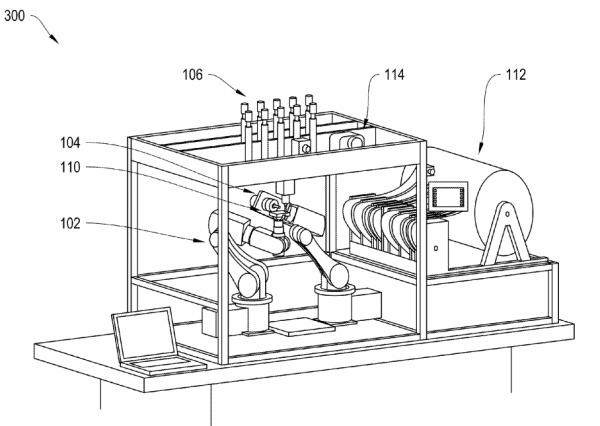
Robotic Fabricator (credit: iRobot)
Well, just when you thought 3D printing was finally putting you back in charge of creating your own stuff, along comes iRobot Corporation with a U.S. patent application for a “Robotic Fabricator.”
It’s conceived as a completely autonomous all-in-one product fabrication robot that handles manufacturing (including 3D printing) and all the post-printing work, from seed component to mature product, 3Ders reports.
A Robotic Fabricator would automate manufacturing and assembly processes to reduce the need for human labor, decrease manufacturing costs, and improve product quality.
Product fabrication is centered around a six-axis industrial robotic manipulator that handles the product from seed component to mature product. The primary manipulator positions the product for manufacturing operations such as additive and subtractive manufacturing (3D printing, milling and drilling). A secondary manipulator handles component pick-and-place and secondary manufacturing operations such as wire placement and hardware testing.
The system may include one or more sensors that can measure parameters and characteristics of the product being manufactured while the process is taking place. For example, the system can include a precision visual scanning device that will generate precise measurements of the product being fabricated. Information collected by the sensor may be used by the fabrication machine to adjust subsequent steps in the manufacturing process. The sensors can also be used for detecting electrical anomalies in wiring to add wires or cables to a product etc.
The fabrication machine also uses a pick-and-place manufacturing method with the added capability of operating in six degrees of freedom, allowing for the placement of components in arbitrary locations on the product assembly.
Comments (16)
by David
Should be easy to print semi-automatic or automatic weapons one day.
by Whittaker
Weapons are not dangerous, it is the intelligence that is using the weapons that is dangerous (and is responsible for the consequences).
by Michael
Perhaps you need to re-learn the definition of dangerous. hint: “Able or likely to cause harm or injury”. Given that the sole purpose of a weapon is to cause harm or injury I would suggest that weapons are in deed dangerous.
by Bri
Dick Cheney would agree.
by jm
The sole purpose of a firearm is to launch a projectile accurately to a target.
by PCMcGee
I can’t imagine much that doesn’t fit that description. Do we need to ban it all to quench the fear?
by Bri
And for what purpose are you hitting a target? Oscar Pistorias used a cricket bat. Should they be banned? The problem is people, morsels and ethics. How do you instill a sense of right and wrong?
by MikeB
hmmm … since the same thing exists in a larger box ie. a factory, does the reduction in volume constitute something novel? BUT if you actually read the patent claim then you see what they’re getting at. At the moment 3D printers deposit in 3D, building an object vertically; overhangs, for instance, are impossible without installing a temporary support. THIS machine would rotate the object so deposition could occur without a temporary support. Is that new or novel?
by cosmowrench
Depends on what printer principle you use. With the extrusion deposition method, overhangs are not possible. The granular materials binding method, like electron beam melting and selective laser sintering does allow for overhangs. Electron beam melting makes milling and drilling totally unnecessary.
by adrian
I’m curious as to the novel part of this. Surely merely placing several machines in one box is not sufficient to make something patentable ? Machines where this is done (such as combination woodworking machines) typically patent specific features that are only required in order to re-use parts, such as special joints or clamps.
by Gorden Russell
Well, whatever you have to say about the novelty of the design, or the patentability, this could be the gadgetron to put out the robot that turns around and prints out another printer. Once there are a few robots to keep pouring seed component into the bin and march back and forth to the loading dock to bring in more seed component, this will allow them to keep doubling their numbers until it will be like the “Sorcerer’s Apprentice” segment of the Disney film, “Fantasia.”
When the “Robotic Fabricator” gets to the point where it can duplicate itself and the robot that feeds and unloads it in one day, then in 30 days of reproducing like bacteria, there will be over a billion fabricators and robots. The iRobot company will need to set up in one of those giant, old, abandoned assembly plants in the Rust Belt to approach these numbers…but they can certainly make a lot of these machines.
by Phillipe Cantin
I really hope this is not going to stall or stop the DIY 3D-printer maker movement. As recently proven by Apple, patents can be use in evil ways.
by GatorALLin
…agreed… Note that even if they get a patent, you as an individual can make one for your own use (you can not make them to sell of course). So a patent would give some detailed instructions on what they claim and so just maybe this would help you build one.
by Whittaker
Do you no about China’s incredible bourgeoning “Shanzhai” (pirate, imitation products) industry?
They have shanzhai cars, shanzhai Iphones (which work just as well as the Apple’s iphone, and anyways the Apple’s assembly plants are in China).
I personally consider people in the Chinese shanzhai industry as heroes, liberators of poor.If more people in the world can do similar works, we will enter Singularity faster.
by Tom
Or patent litigation will just ruin the singularity entirely.
http://www.youtube.com/watch?v=IFe9wiDfb0E
by GatorALLin
http://www.cnn.com/2013/01/15/tech/inventor-advice-market/index.html