Key genes for schizophrenia identified
May 16, 2012
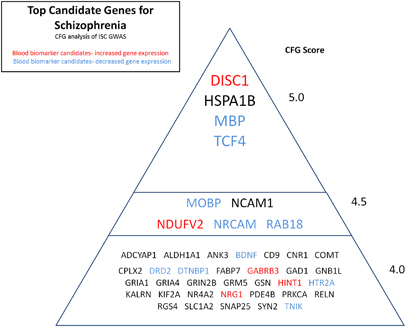
Top candidate genes for schizophrenia. CFG, convergent functional genomics; GWAS, genome-wide association study; ISC, International Schizophrenia Consortium. (Credit: M Ayalew et al./Molecular Psychiatry)
An Indiana University-led research team and collaborators have identified and prioritized a comprehensive group of genes most associated with schizophrenia and that can generate a score indicating whether an individual is at higher or lower risk of developing the disease.
They used a convergent functional genomics approach that incorporates a variety of experimental techniques.
The scientists also were able to apply a panel of their top genes to data from other studies of schizophrenia and successfully identify which patients had been diagnosed with schizophrenia and which had not.
Evaluating the biological pathways in which the genes are active, the researchers also proposed a model of schizophrenia as a disease emerging from a mix of genetic variations affecting brain development and neuronal connections along with environmental factors, particularly stress.
“At its core, schizophrenia is a disease of decreased cellular connectivity in the brain, precipitated by environmental stress during brain development, among those with genetic vulnerability,” said principal investigator Alexander B. Niculescu III, M.D., Ph.D., associate professor of psychiatry and medical neuroscience at the IU School of Medicine and director of the Laboratory of Neurophenomics at the Institute of Psychiatric Research at the IU School of Medicine.
“For first time we have a comprehensive list of the genes that have the best evidence for involvement in schizophrenia,” said Niculescu, who is also staff psychiatrist and investigator at the Richard L. Roudebush Veterans Affairs Medical Center.
Schizophrenia is a relatively widespread psychiatric disease, affecting about 1 percent of the population, often with devastating impact. People with schizophrenia can have difficulty thinking logically and telling the difference between real and unreal experiences, and may engage in bizarre behavior.
When the test estimating the risk for schizophrenia is refined, it could provide guidance to caregivers and health care professionals about young people in families with a history of the disease, prompting early intervention and treatment when behavioral symptoms of schizophrenia occurred among those at higher risk, Dr. Niculescu said.
He stressed that a score indicating a higher risk of schizophrenia “doesn’t determine your destiny. It just means that your neuronal connectivity is different, which could make you more creative, or more prone to illness.”
“It’s all on a continuum; these genetic variants are present throughout the population. If you have too many of them, in the wrong combination, in an environment where you are exposed to stress, alcohol and drugs, and so on, that can lead to the development of the clinical illness,” he said.
The prototype test was able to predict whether a person was at a higher or lower risk of schizophrenia in about two-thirds of cases.
Convergent functional genomics
To identify and prioritize the genes reported Tuesday, the researchers combined data from several different types of studies. These included genome-wide association studies, gene expression data derived from human tissue samples, genetic linkage studies, genetic evidence from animal models, and other work. This approach, called convergent functional genomics, has been pioneered by Niculescu and colleagues, and relies on multiple independent lines of evidence to implicate genes in clinical disorders.
The authors noted that the results were stronger when analyses were performed using gene-level data, rather than analyses based on individual mutations — called single nucleotide polymorphisms, or SNPs — in those genes. Multiple different SNPs can spark a particular gene’s role in the development of schizophrenia, so evidence for the genes, and the biological mechanisms in which they play a role, was much stronger from study to study than was the evidence for individual SNPs.
“Finally now, by better understanding the genetic and biological basis of the illness, we can develop better tests for it, as well as better treatments. The future of medicine is not just treatment but prevention, so we hope this work will move things in the right direction.”
Ref.: M Ayalew et al., Convergent functional genomics of schizophrenia: from comprehensive understanding to genetic risk prediction, Molecular Psychiatry, 2012, DOI: 10.1038/mp.2012.37 (open access)