Kinect-based system dramatically cuts cost of telemedicine
February 15, 2013

Microsoft Kinect (credit: Microsoft Corp.)
A Kinect game controller and Microsoft software couldĀ cut the U.S. healthcare bill by up to $30 billion by allowing physicians and other medics to interact with patients remotely, reducing the number of hospital visits and the associated risk of infection.
It could also bring medical services to underserved areas around the world.
Janet Bailey of the University of Arkansas at Little Rock and Bradley Jensen of Microsoft have developed the Collaboration and Annotation of Medical Images (CAMI) system, which can make the knowledge and skills of healthcare workers available remotely to where they are needed, they say.
This could cut patient transport costs for those who live considerable distances from suitable hospitals and health centers and would also lower the risk of hospital-acquired infections.
For a few hundred dollars, CAMI could replace or augment existing telemedicine systems that cost tens of thousands of dollars, the researchers say.
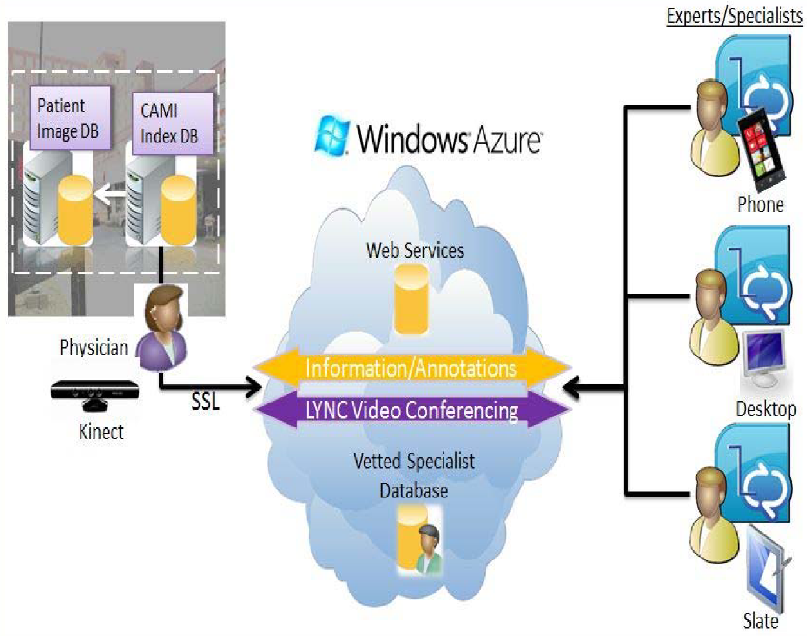
CAMI uses a laptop, Kinect, Microsoft Azure connection, and Office 365 (credit: James Taylor)
The Kinect also allows doctors to “control the system without breaking the sterile field via hand gestures and voice commands, with a goal of reducing the direct cost of healthcare-associated infections to hospitals and patients,” the team says.
In many regions, there is a shortage of specialists at a time when they are needed most, due to growing populations and increasing numbers of individuals suffering from the diseases of old age. The issue of access to expert healthcare is particularly acute in remote parts of the developing world and even in many rural communities removed from U.S. cities in the West.
The team has demonstrated that the system works even where only low-bandwidth and unreliable connectivity is available.
Comments (11)
by Allan Carson
Living in a “Third World” county where any form of proper medical consultation is only within the reach of those people who live in surburbia and / or have the means to afford it; telemedicine opens up new hope for the vast majority who have no access to primary let alone specialist treatment. Kinect is just one of the technologies that is striving to bridge the gap and like all new technology it will (has to) come with a price tag. However; competition and consumerism will bring similar and more affordable (free?) options to the table. The network of open source gurus have been working on this for quite sometime and the idea is certainly not new (nor is it Microsoft’s to own or take the glory for). It’s just a matter of time before the doctors and experts contributing to the “pay” databases open their services to the open source communities and many of them already contribute time and expertise generously to those who can’t afford it. Ultimately the need will outweigh the cost and telemedicine will be the norm and not the exception. We can already supply this kind of technology using smart phones and other mobile platforms, the only thing slowing the momentum is restrictive Government legislation and drug manufacturers (cartels?) hanging on to thir well established income channels, but these will also have to change because people REALLY need smarter, faster and more affordable medical treatment.
by Bri
Those cartels are going to develope Watson based experts systems. For those people who would rather interact with humans they will fabricate realistic humanoid robots or highly realistic chat bot style simulations.. This will make health care much less expensive. ( and the skater pulls their arms in closer causing them to spin faster.)
by MikeB
Hoax?
It won’t reduce costs. The hint? ” … _augment_ or replace … “.
As well, why was this vague summary (taken from the vague abstract) provided here? The article is behind a paywall so there is no way of knowing what the benefit of ‘Kinect’ is over say, the even cheaper webcam/skyype solution. The only reason seems to be that this is a Microsoft spawned study. Notice the solution (as illustrated here) is MS Windows, Windows Azure, and MS Kinect?
by WLGJR
Can some wealthy and very generous person pay for the rest of us?
So that the paywall-protected information can be emancipated and available to us.
Thanks.
by Walter Baltzley
Contact your representatives in congress about this…scientific and engineering knowledge needs to be freely available to the public. DOWN with the paywalls!
by Editor
According to the study, “Doctors and specialists join the system, being pre-vetted and having accounts setup in SQL Azure. Using the Lync feature of Office 365, CAMI allows the doctor with patient to search the database for a particular doctor or all doctors with a particular specialisation. Only those doctors who are available and approved by the hospital appear.
“Early evaluation by an AR Saves technician is that CAMI shows extreme promise for replacing their current complex system and that with the incorporation of a larger database of doctors (i.e., a national database), time could be reduced even further than it currently is (Hogbin, 2012).”
I can’t evaluate the value of those features, but the marginal incremental cost of the Microsoft software doesn’t seem high, and the Microsoft name make the system easier to sell to hospitals.
Re Skype, yes, we discussed that in comments to a related post:
http://www.kurzweilai.net/fda-clears-first-autonomous-telemedicine-robot-for-hospitals/.
by WLGJR
Great news. Let’s hope Wii can be used for similar benevolent purposes.
How should the US spend to $30 billion?
Pay the debts, or more research on this type of technology?
by WLGJR
“to $30 billion?” Should be *the* $30 billion.
by Ian Clarke
Free or heavily subsidised healthcare for those unable to afford it?
by Walter Baltzley
The Government needs to INVEST the $30 Billion in infrastructure and technology to make the economy more productive. It needs to bring down the cost of energy and transportation, and encourage innovation.
I recommend the establishment of a number of “X-Prize” type contests…open to the public…for solutions to the major problems or bottlenecks hindering us on the road to abundance.
Of course, I am partial to technological solutions…like my DIGITAL MATTER-NET idea…but a LOT of problems are of a social and political nature. In many cases government can’t solve the problem…government IS the problem.
by Tom Armstrong
As Americans, citizens of the wealthiest, best resourced country in the history of the world, we ought to be ashamed of ourselves that primary healthcare, on demand, in whatever form, is denied to millions of us. Every other developed country have systems which provide for all, at less capita cost than here. Surely we must be the laughing stock of the world.