Law and order: Blame it on the brain
July 13, 2012 | Source: BBC Future
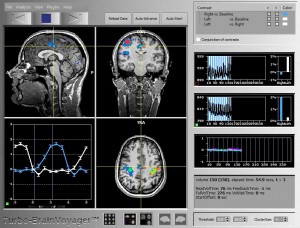
fMRI images showing brain activity (credit: AVL)
Advances in neuroscience could transform our criminal justice systems. But the jury is out as to whether “my brain made me do it” will ever be accepted in court.
A jury in Miami voted against the death sentence for Grady Nelson murder crimes. The defense attorneys argued that Nelson had major brain defects that could explain his behavior.
To show this, they submitted as evidence brain activity measurements from a method known as a quantitative EEG (Q-EEG), in which a computer analyzes the EEG data and identifies brain regions of unusual activity.
A brain scan called functional magnetic resonance imaging (fMRI) appeals to lawyers and legal scholars because it seems to show a shortcut to the truth. Humans may lie and cheat, but their brain scans reveal the facts, goes the reasoning.
For example, fMRI has been proposed as a way of telling whether someone seeking compensation for an injury actually experiences chronic pain. U.S. lawyers have already tried to introduce this evidence into the courtroom, but it hasn’t managed to gain any traction yet.
In 2008, Sean Mackey, a neurologist and director of Stanford University’s Division of Pain Management, dismissed one of the first attempts, in which fMRI evidence supposedly showed heightened activity in the “pain matrix” of a chemical burns victim seeking compensation from his employer.
Our brains are highly susceptible to the power of suggestion. Imagining past or future events can affect how we feel right now. During an fMRI scan parts of the brain may light up in response to thoughts as well as action or recalled actions, which means that simply remembering a bout of severe pain could elicit the same effect as feeling the pain. We’re also highly capable of self-deception.
“A parent who has shaken and killed their baby may be so horrified by their actions that they convince themselves they were innocent,” says Nicholas Mackintosh, at the department of experimental psychology at the University of Cambridge and chair of a 2011 UK Royal Society report on neuroscience and the law.
This can skew fMRI-type lie-detection techniques, which can’t distinguish between people who are telling the truth and those who are guilty but believe they are telling the truth.
Though some are eager to embrace the new techniques in court, others in the legal system are highly skeptical. “The error rates are not very well known,” says Owen Jones, director of the MacArthur Foundation Research Network on Law and Neuroscience, at Vanderbilt University Law School, in Nashville.
Studies are beginning to highlight potential differences in the brain structures of some criminals. For example, research shows that psychopaths and murderers have physical abnormalities in the amygdala, a part of the brain that mediates feelings like fear and anxiety, and in the prefrontal cortex, which regulates emotions like empathy and guilt.
In one small study, Adrian Raine, a criminal psychologist at University of Pennsylvania in the US, showed that the amygdalae of psychopaths are 18% smaller, on average, than non-psychopaths. It is a finding backed up by several other studies.
Research also seems to suggest that some of these differences may start in early childhood. In another study, Raine and his colleagues investigated if children who weren’t afraid of punishment would be predisposed to criminal activity as adults. Other studies have shown that people with underperforming amygdalae don’t fear punishment as much as the average person.
To look for answers, Raine used data from a large study of fear conditioning in three year olds born in 1969 and 1970. When the group reached the age of 23, the scientists searched the court records for serious offences, and found that 137 of them (out of 1,795 in total) had been listed as criminal offenders. When Raine compared the offenders with a group of non-offenders, he found that the kids with poor fear conditioning were much more likely to become criminals as adults.
This kind of insight raises the possibility of personalized sentencing, taking into account things like brain abnormalities. A proponent of this approach is David Eagleman, who runs the Initiative on Neuroscience and Law at Baylor University’s College of Medicine in Houston.
He dismisses the idea that sentencing criminals based on their brain biology is akin to letting them off the hook. Instead, he argues, “we should be thinking, given that your brain is like this, what can we do to help?”
One of the biggest factors that should be taken into account, he argues, is the age of the accused. The hard cut-offs societies use to determine the age of responsibility for crimes may not be rooted in science but research now shows that certain parts of the brain develop at very different rates.
For example, recent studies of the maturation of the prefrontal cortex, which is involved in decision-making processes, suggest that it does not reach full maturity until the late 20s or early 30s. It is a finding that suggests a more subtle way of categorising offenders may be needed; for example biological maturity, a measure of the brain’s plasticity — or how easily it can be modified.
Children’s brains are more plastic than adults, which is why they are able to learn more quickly. Eagleman says neuroscience might one day be able to provide a way to measure the specific plasticity of an individual brain. “If at 20 years of age, someone commits a crime and they have a shrunken frontal lobe and are never going to learn the rules — they might have to be put away for longer.” Mo Costandi, a neurobiologist and science writer based in London, says the new research “will eventually lead to us rethinking the way we punish adolescents.”
But not everyone is enthusiastic about the prospect of personalized sentencing. “Individualised justice and determination of responsibility are much more costly to society,” says Vanderbildt’s Jones, compared to a one size fits all approach. But Eagleman has heard this argument often.
“The numbers work out,” he says. In 2008, for instance, the US government spent nearly $75 billion on correction, most of it on incarceration. “It costs so much to put people in jail and we know it has very low utility — you’ve broken their social circles, their employment opportunities — so they’ll come right back round through that revolving door.”
The changes open up the possibility of other factors being taken into consideration sentencing. For example, roughly a third of U.S. prisoners have a mental illness. Some also have drug addictions. Both are poorly tackled by the criminal justice system, says Eagleman who argues the prison system has become the “de facto mental health system”.
Eagleman and his colleagues are using real-time neuroimaging feedback to strengthen people’s short-term capacity to resist impulses. He places someone with a drug addiction in an fMRI scanner and shows her a picture of whatever it is she is trying to resist; cocaine, for example. At first, he asks her to allow the craving to proceed, and he measures her brain activity. On a screen inside the scanner, the volunteer watches a bar that represents her craving level.
Then Eagleman asks her to try to force the bar to go down. “By squelching that craving, you are strengthening the frontal lobes, which allow you to override impulses,” says Eagleman. “Practicing this over and over means you then know how, even if you don’t quite understand it, to make that bar go down.”