Liquid solar cells that can be printed onto surfaces
April 27, 2012
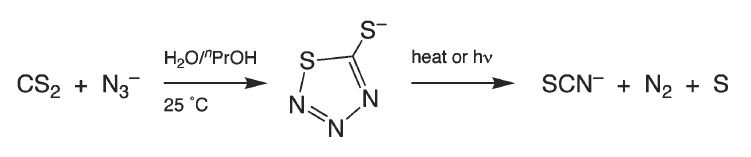
The formation and decomposition of 1,2,3,4-thiatriazole-5- thiolate. It is not known whether the thiocyanate product is derived from the exo- or endocyclic sulfur, or a mixture of both. (Credit: avid H. Webber and Richard L. Brutchey/Dalton Transactions)
USC scientists have developed a potential pathway to cheap, stable solar cells made from nanocrystals so small they can exist as a liquid ink and can be painted or printed onto clear surfaces.
The solar nanocrystals are about four nanometers in size and float them in a liquid solution, so “like you print a newspaper, you can print solar cells,” said Richard L. Brutchey, assistant professor of chemistry at the USC Dornsife College of Letters, Arts and Sciences.
Brutchey and USC postdoctoral researcher David H. Webber developed a new surface coating for the nanocrystals, which are made of the semiconductor cadmium selenide.
Liquid nanocrystal solar cells are cheaper to fabricate than available single-crystal silicon wafer solar cells but are not nearly as efficient at converting sunlight to electricity. Brutchey and Webber solved one of the key problems of liquid solar cells: how to create a stable liquid that also conducts electricity.
In the past, organic ligand molecules were attached to the nanocrystals to keep them stable and to prevent them from sticking together. These molecules also insulated the crystals, making the whole thing terrible at conducting electricity.
Brutchey and Webber discovered a synthetic ligand that not only works well at stabilizing nanocrystals, but actually builds tiny bridges connecting the nanocrystals to help transmit current.
With a relatively low-temperature process, the researchers’ method also allows for the possibility that solar cells can be printed onto plastic instead of glass without any issues with melting – resulting in a flexible solar panel that can be shaped to fit anywhere.
As they continue their research, Brutchey said he plans to work on nanocrystals built from materials other than cadmium, which is restricted in commercial applications due to toxicity.
“While the commercialization of this technology is still years away, we see a clear path forward toward integrating this into the next generation of solar cell technologies,” Brutchey said.
This research was funded by the National Science Foundation and USC Dornsife.
Ref.: David H. Webber and Richard L. Brutchey, Nanocrystal ligand exchange with 1,2,3,4-thiatriazole-5-thiolate and its facile in situ conversion to thiocyanate, Dalton Transactions, 2012 [DOI: 10.1039/C2DT30197K] (open access)