Machines will achieve human-level intelligence in the 2028 to 2150 range: poll
April 26, 2011
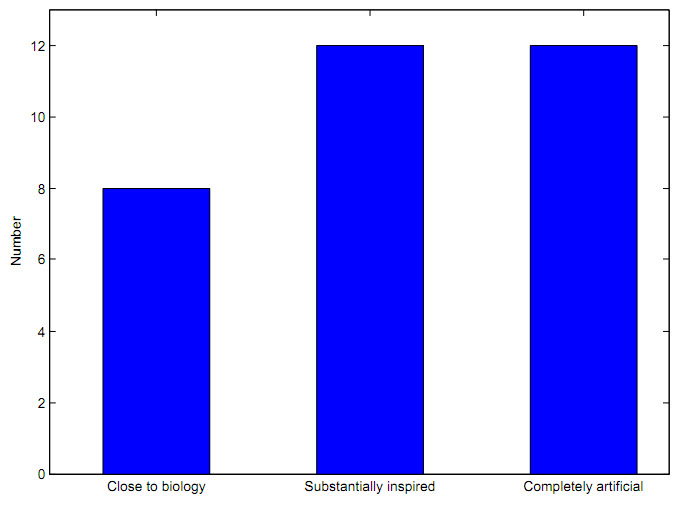
How similar will machine intelligence be to human intelligence? (credit: A. Sandberg & N. Bostrom/Future of Humanity Institute)
Machines will achieve human-level intelligence by 2028 (median estimate: 10% chance), by 2050 (median estimate: 50% chance), or by 2150 (median estimate: 90% chance), according to an informal poll at the Future of Humanity Institute (FHI) Winter Intelligence conference on machine intelligence in January.
“Human‐level machine intelligence, whether due to a de novo AGI (artificial general intelligence) or biologically inspired/emulated systems, has a macroscopic probability to occurring mid‐century,” the report authors, Dr. Anders Sandberg and Dr. Nick Bostrom, both researchers at FHI, found.
“This development is more likely to occur from a large organization than as a smaller project. The consequences might be potentially catastrophic, but there is great disagreement and uncertainty about this — radically positive outcomes are also possible.”
Other findings:
- Industry, academia and the military are the types of organizations most likely to first develop a human‐level machine intelligence.
- The response to “How positive or negative are the ultimate consequences of the creation of a human‐level (and beyond human‐level) machine intelligence likely to be?” were bimodal, with more weight given to extremely good and extremely bad outcomes.
- Of the 32 responses to “How similar will the first human‐level machine intelligence be to the human brain?,” 8 thought “very biologically inspired machine intelligence” the most likely, 12 thought “brain‐inspired AGI” and 12 thought “entirely de novo AGI” was the most likely.
- Most participants were only mildly confident of an eventual win by IBM’s Watson over human contestants in the “Jeopardy!” contest.
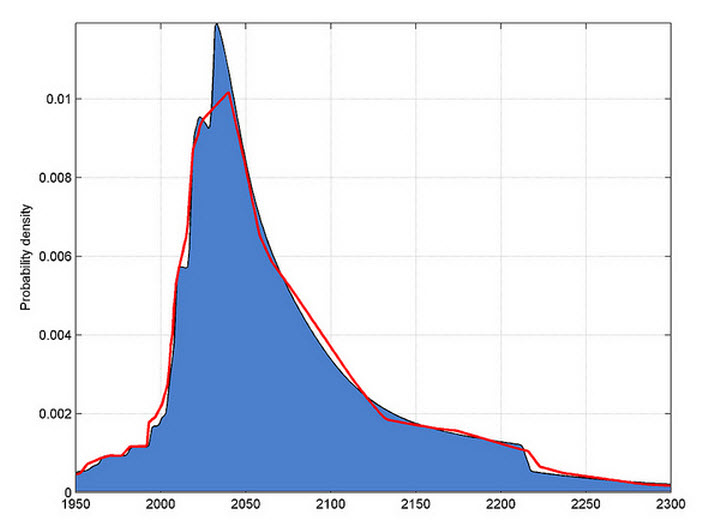
Probability density of human-level AI by date -- the blue represents skew Gaussian fits, the red represents triangular fits; previous dates are artifacts (credit: Anders Sandberg)
“This survey was merely an informal polling of an already self‐selected group, so the results should be taken with a large grain of salt,” the authors advise. “The small number of responses, the presence of visiting groups with presumably correlated views, the simple survey design and the limitations of the questionnaire all contribute to make this of limited reliability and validity.”
“While the validity is questionable, the results are consistent with earlier surveys,” Sandberg told KurzweilAI. “The kind of people who respond to this tend to think mid-century human-level AI is fairly plausible, with a tail towards the far future.Opinions on the overall effect were not divided but bimodal — it will likely be really good or really bad, not something in between.”
Brent Allsop, a Senior Software Engineer at 3M, has started a “Human Level AI Milestone?” Canonizer (consensus building open survey system) to encourage public participation in this interesting question in the survey: “Can you think of any milestone such that if it were ever reached you would expect human‐level machine intelligence to be developed within five years thereafter?”
Ref.: Sandberg, A. and Bostrom, N. (2011): Machine Intelligence Survey, Technical Report
#2011‐1, Future of Humanity Institute, Oxford University: pp. 1‐12. URL: www.fhi.ox.ac.uk/reports/2011‐1.pdf
Comments (10)
by egore
Anything we can think of has probably all ready happened.
by dirk.bruere
Far too pessimistic in my opinion, given that exascale machines will be available by 2020, and that they will likely exceed Human brain processing capacity by some considerable margin. Presumably the report is focusing on s/w only. As for orgs likely to develop strong AI, look to the NSA – it is *exactly* the tech they need, and the funding they have
by cesium62
I’m amazed that self-proclaimed experts in the field are so pessimisstic and produce these sorts of responses.
(1) Watson and various aspects of Google Instant Search clearly suggest that AGI will not be modeled on human intelligence. We currently are taking huge databases with billions to trillions of data points to provide results that look intelligent to a human: e.g. to perform good language translation or to suggest to a user of google search what kinds of similar questions others have recently asked.
(2) Many of the responses for “what sort of result would suggest AGI will be achieved within 5 years” seem to actually answer the question “how will we tell when AGI has been achieved”. To a certain extent, we keep moving the bar on what is AI. It used to be: play chess well. Then: play Jeopardy well. Natural language translation is probably the next milestone, and the suggested “when a computer writes the world’s best chess playing program” would be a strong result.
(3) Industry is clearly the leader for where AGI will most likely arise. Dell, HP, Microsoft, Amazon, Google, IBM, … are each putting together mutli-billion dollar grids of computers for cloud computing. The amount of money industry can spend on the problem dwarfs what academia can spend. The NSA and DOD could outspend industry with a concerted effort, but isn’t likely to.
(4) Maybe the responses for when AGI will be achieved are in terms of the commonly referenced $1,000 computer. However, the poll doesn’t specify a price range. Watson is nearly a cluster-sized computer and has about the right amount of hardware to compete with a human brain. A Google-sized grid of computers certainly has plenty of raw hardware. Give us another 10 years, and the software ecosystem running in the cloud should be rich enough that most observers will feel we essentially have AGI.
@matsbeem: Moravec makes the best argument I’ve seen for how much hardware is needed to compete with a human brain and came up with a figure of about 100 TeraFlops. Cluster sized computers of 1K to 10K processors each of about 10 Gigaflops (based on memory bus bandwidth) provide 10 to 100 PetaFlops of compute capability. A google-sized grid would contain on the order of 100 clusters. All computer power in the world dwarfs a google-sized grid.
by cesium62
Argh, typo. A cluster would have on the order of 10 to 100 *Tera*Flops of compute capability.
by matsbeem
A recent statement was, that all the computer power in the world equals roughly one human brain today. If Moore’s law will be true for ever, it will take about 50 ears before an average computer will equal the processing power of 1 brain.
by MysticMonkeyGuru
The Human Genome Project is one thing, but Strong AI is another. I put the coming of strong AI between 2100 and 2150.
by RobinSongs
Indeed. Once upon a time, people said there was a very low percent chance of sequencing the entire human genome within 15 years.
by Arenamontanus
A slightly updated diagram (taking the skewness of people’s estimates into account) can be found here: http://www.flickr.com/photos/arenamontanus/5657887546/in/set-72157626583204714
For some more thoughts about the statistics, see my blog post on it, http://www.aleph.se/andart/archives/2011/04/ai_overlords_and_their_deciles.html
by Singme
Clearly they are thinking linearly and not exponentially!
by Natasha
Are surveys a reliable? I think Sandberg was spot on when he said information pooling should be taken with a “grain of salt.” I value this work, but I have to say that I’d like to see Sandberg do more neuroscience. We have plenty of theorists on the future and transhumanism, but not enough practitioners.