Makerbot Replicator 2 review
September 20, 2012
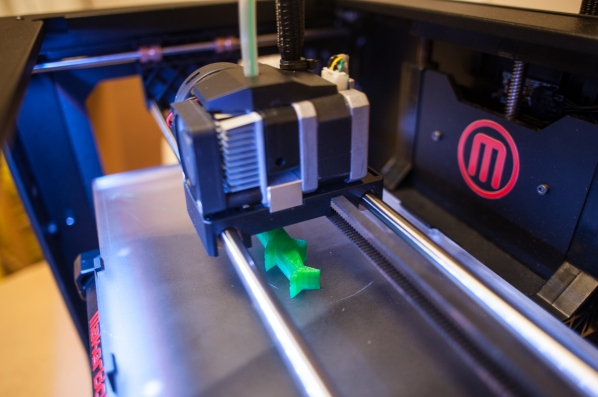
The Makerbot Replicator 2, a second generation of MakerBot’s wildly popular Replicator 3D printer, is now faster, quieter, and more rigid than the original, Make reports.
The Replicator now sports a sleek modern look with an all-black sheet metal frame and PVC side panels that are removable, customizable, and allow for easy cleaning of any excess material.
A larger, more responsive LCD panel on the front right corner allows for easy control and monitoring of the machine. A highlight of the new controls is a “Cold Pause” feature that pauses the print, cools the extruder, and waits for you to resume where you left off.
The new software has a cleaner and more intuitive user interface. Scale, rotate, and arrange multiple .STL models on the build platform with ease. Slicing is now performed by Miracle Grue. The sliced model is loaded onto an SD card (included), inserted into the Replicator 2, and by simply hitting print, you can sit back and watch (or not).
The build area of the Replicator 2 is now inhabited by a quick release, frosted acrylic bed specifically made for use with PLA. PLA, or Polylactic acid, is a corn-based biodegradable and sustainable medium for 3D printing that does not require a heated bed and is known for its lower melting point, and more consistent printing in varied temperatures and environments.
The improvements make the machine more dependable, sturdier, and consistent, with a larger build size, faster start to finish print times, and quieter operation, Make concluded.
The Replicator 2 single extruder model will sell for $2,199 and the soon to be released dual extruder 2X model for $2,799.
Make: Ultimate Guide to 3D Printing will be out in mid-November.

Comments (13)
by David Headrick
One short coming of the Replicator 2 is the filament extruder design. There are many replacement options available on the thingyverse but they all degrade over time. There is an Aluminum/PEEK upgrade currently being offered which improves the reliability greatly.
https://groups.google.com/forum/#!starred/makerbot-buy-sell-trade/HHTABSG09pk
BTW, the Makerbot Opertator Group on Google is full of very helpful people and a great source of troubleshooting info and tips.
by Fabien
Why do I see only little crap listed on thingiverse?
by Bill Wilkes
The most useful items at this point are prototype models. Use the plastic to show form, fit and function, then, after you get the funding, buy a real 3D printer and make your parts using laser sintering.
by Bri
I’m aware of the other printers that are in development. I am interested in models like the one in the article. Like Ray said, the first models tend to be flawed, next generation models get better, after awhile they come down in price and are more reliable. I was being sarcastic because they showed tiny little toys being fabricated, that would never justify 2,000$ investment. I was wondering of anyone out there actually uses one of these machines and what they make with it. I have many ideas of what I would make in relation to my business, but I’m leery of the investment at this time.
by Hoss
Bri, I don’t know what kind of shop you have, but Jay Leno has the best setup I’ve seen yet for 3D printing rare replacement parts for his car collection. YouTube Jay Leno’s Garage, 3D printing.
by Conrad Green
printing clothes and shoes would be a plus. Then people can truly dress uniquely. Also, I reckoning printing houses and other architecture is on blueprints somewhere.
by blue_jack
No for example there are companies like Shapeways that have 3d printers where you send a 3D design to and they print and send back your part. They show products that people are making and it is all toys and jewelry. When people talk about 3d printing they say it can print in many materials including metal. But when you look into it the metal is Alumide heavy and not strong. They cannot make anything with an aluminum alloy yet.
by kw
Not true. You can print in aluminum, titanium, steel, even inconel.
Most printers deal with plastics of course, and they are useful for a huge array of things, mostly prototyping. To prototype a very complex part can be -extremely- expensive.. to do a multi directional injection mold prototype might cost you thousands. You can also prototype things that are eventually going to be metal in order to check mechanical design function or various other variables.. creating proof of concept parts in metal could again cost thousands.
Lots of toys and jewelry sure, but you aren’t seeing the massive industry use.. why? because they aren’t going around showing off their prototypes.
by anthrobotic
Ooops, link for anyone interested in “Geodesic Japanorama & iPhone-Based 3D Modeling Should Totally Blow Our Minds” http://goo.gl/tW3fZ
by anthrobotic
Excerpt from:
Geodesic Japanorama & iPhone-Based 3D Modeling Should Totally Blow Our Minds
“You gotta love the smell of re-domesticated manufacturing in the morning. This is some serious technology. What will individuals and, more massively, manufacturers be doing with this technology in 5 years? 10? Combine precision robotic manufacturing and assembly (see yesterday’s Baxter announcement here at Kurzweil AI), cost/performance that exceeds contemporary shipping and handling across the Pacific, and you begin to sense a global economic upheaval. What happens next is that when the world needs useless (though fun and profitable) plastic crap, we just kinda forget China’s phone number and head out to the garage or over to the community replicator. 3D modeling and printing is the future of fab, yo – and it’s not just for plastic junk: 3D-printed titanium prosthetic jawbone, anyone (http://goo.gl/o9P45)?”
Oh, and the iPhone can now perform 3D object scanning – with free software.
-Reno at Anthrobotic.com
by Gorden Russell
Well Bri, in 10 years these machines will take cultured beef cells and print out a sirloin steak. It’ll be low-fat, too.
by Bri
Two grand to make a toy? Does anyone out there make useful items with this?
by Walter Baltzley
Hop in your time machine and go back to 1976 when the first Apple computer rolled off the assembly line…it wasn’t all that impressive either…NOW look at what an iPad can do 36 years later.
That is where we are with 3D Printing technology folks, its 1976 all over again…this is a whole new industry and it s up for grabs. If you missed the boat last time, this is your second chance…DON’T MISS IT!