Making the Kinect ‘finger-precise’
October 3, 2012
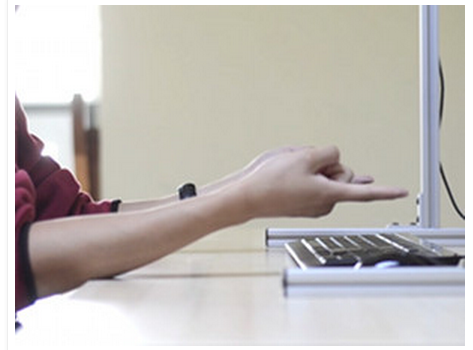
A precise pointing interface (credit: 3Gear Systems)
3Gear Systems has announced a software development kit for adding gestures to applications, using your entire hand (fingers, thumbs, wrists and all) for user interaction.
“This is especially useful when you’re doing something 3D, say assembling 3D parts in Computer Aided Design (CAD), flying through a medical 3D MRI scan, or playing 3D games.
“With the rise of 3D printing and the Maker community, we’re especially interested in making it easier to create in 3D.”
3Gear Systems is using 3D camera hardware (e.g., the Microsoft Kinect) to make this possible.
Kinect limitations
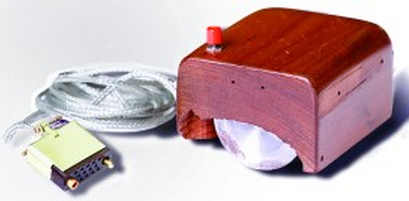
First pointing system, invented by Doug Englebart, 1967 (credit: SRI International)
However, existing Kinect software only works on large, full-body motions.
So they’ve developed software that creates a finger-precise representation of what your hands are doing, capturing tiny motions of your index finger and subtle movements of the wrist.
This means your applications can use small, comfortable gestures such as pinching and pointing rather than sweeping arm motions, as with the standard Kinect software.
They developed new computer graphics algorithms for reconstructing the precise pose of the user’s hands from 3D cameras.
A key component of the algorithm is to use a database of pre-computed 3D images corresponding to each possible hand configuration in the workspace.
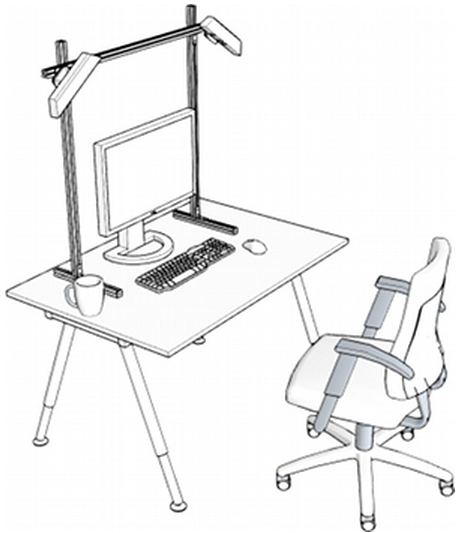
The input system uses two Kinect cameras and an aluminum frame for mounting the cameras (credit: 3Gear Systems)
The 3D image database is efficiently sampled and indexed to enable extremely fast searches. At run-time, the images from the 3D cameras are used to “look up” the pose of the hand using the database.
This way, the user’s hand pose can be determined within milliseconds — fast enough for interactive applications and a short enough time to avoid the effects of “lag” or high latency.
“Today, we’re releasing a “public beta” version of a software development kit (SDK) that allows you to quickly incorporate 3Gear’s technology into your applications or invent new uses of gestural user interfaces,” 3Gear said.
Here’s what it can do:
- Intuitive 3D manipulation. 1-to-1 3D control of virtual objects. Users can grab objects and move them around in 3D with their hands.
- Touchless (aseptic) control. Precise control of computer systems for dirty jobs.
- Runs on commodity hardware. Uses two Kinect cameras and an aluminum frame for mounting the cameras. All of the components are available off-the-shelf right now.
“Our software is free for both non-commercial and commercial applications until the end of the beta period (November 30, 2012), 3Gear said. “After the beta period, we will continue to offer a free version of the software for researchers, hobbyists, and small commercial entities (i.e., annual turnover of US$100,000 or less).
Comments (7)
by Rok
How to know the leap is not fake?
by manicmoose
Mirroring the other comments – as far as I can tell, the Leap does at least a good a job (if not better) at tracking hand motion for a fraction of the cost. This is still cool though.
by GatorALLin
Pre-ordered a few of the the Leap product… also on the developer’s list from Leap, but they are not ready yet, or at least I have not received anything. https://leapmotion.com/
Love that there is more than 1 way to do this hands free touching of comptuers, but for the moment I think the idea Leapmotion is using is better than mounting 2 cameras up so high. Maybe this competition will get Leapmotion to hurry up! Maybe 3Gear can find a way to mount dual cameras only to top of your corner of your screen and avoid the hassle of other mounting efforts needed up high as they show in demo…..?
Note the value of these systems is for Medical data entry where you can NOT touch computers screens without then having to glove up again. Imagine any time you have gloves on, but need to touch a computer in the past. Voice data entry can work, but often voice can not manipulate an object on the screen. You could use this at a food prep place where gloves are needed to touch food and you touch the air to enter info that allows you not to break the asepsis barrier that keyboards, touchscreens or other data entry systems for computers have. This is a big/new idea…will be fun to see how it changes the daily world that affects us. I see medical chart entry in hospitals and also food prep in fast food restaurants being two of the first areas to be used (beyond video games and other cool/fun stuff).
Software developers will want to add touch screen like buttons so that you can plug these air touch devices and just use them right away.
….anyone else get bothered by Subway guy that has gloves on, then touches the money drawer to run an order…then forgets to change his gloves for the next person (hey silly, the gloves are to protect my food, not to protect your hands). With so many customers buying with credit cards and not needing paper receipts, I see future transactions even at subway where an air touch screen could allow they to ring your order up and never touch anything (stay gloved up). Maybe we all keep a bit more germ free in the future? Next up the bedside table with your Hospital chart (they say Hospitals are some of the best places to go to get sick and die, maybe that could change if all data entered from air keyboards). All cool stuff.
by Bri
We’ve seen this type stuff in many movies. Now it’s coming into our daily lives
by Simon Anderson
I wonder how the two systems compare in real-world use. Even if it’s not quite as good, Leap at $70 and the size of a thumb drive is really compelling. Also, Kinect 2 could really shake things up.
by Aaron
Hmm… Two Kinects mounted on a large aluminum frame, or a single pocket-sized Leap?
by mihai
my thoughts exactly