Microscopic 3D printing
February 11, 2013
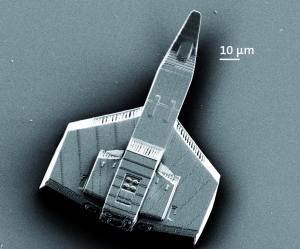
Printing or a miniaturized object like a spaceship model is reduced to less than one minute without loss of quality (credit: Nanoscribe)
Nanoscribe GmbH, a spin-off of Karlsruhe Institute of Technology (KIT), has developed the world’s fastest 3D printer of micro- and nanostructures, the German company claims.
With this printer, three-dimensional objects, often smaller than the diameter of a human hair, can be manufactured with minimum time consumption and maximum resolution. The printer is based on a novel laser lithography method.
Nanoscribe systems are used to print polymer waveguides reaching data transfer rates of more than 5 terabits per second.
Using the new laser lithography method, printing speed is increased by factor of about 100. This increase in speed results from the use of a special “galvo” mirror system, a technology that is also applied in laser show devices or scanning units of CD and DVD drives.
Reflecting a laser beam off the rotating galvo mirrors facilitates rapid and precise laser focus positioning. “We are revolutionizing 3D printing on the micrometer scale. Precision and speed are achieved by the industrially established galvo technology,” says Martin Hermatschweiler, the managing director of Nanoscribe GmbH.
The direct laser writing technique underlying the 3D printing method is based on two-photon polymerization. Just as paper ignites when exposed to sunlight focused through a magnifying glass, ultra-short laser pulses polymerize (fuse into large molecules) photosensitive materials in the laser focus. Depending on the photosensitive material chosen, only the exposed or unexposed volume is dissolved. After a developer bath, these written areas remain as self-supporting micro- and nanostructures.
This allow three-dimensional micro- and nanostructures to be printed rapidly and on large areas. At highest resolution, however, the scanning field is limited physically to a few 100 microns due to the optical properties of the focusing objective.
Comments (7)
by Bri
Although this tech is still a photonic polymer reaction and not a nano assembler, it still paves the way for manipulating atoms on a nano scale. Let’s face it, if you are looking build anything by manipulating atoms, it’s going to take a very fast printing process to make anything of any substantial size. It’s going to take a lot more research and development to get to that level of proficiency.
by Bri
Now that I think of it, this tech might be amenable to that photonic tractor beam research.. It wouldn’t be able to manipulate individual atoms but it might maneuver molecular sub assemblies. Then we might move further away from plastics and sintered materials. Drexler said that at the atomic scale, things tend to bond together, often times releasing energy. I know that with nanocellulose both a Velcro type physical attachment happens ,and also the atomic Van der walls( think that’s the term, I’m not a wikipedia type of guy) forces bond things together. Then we would be a lot closer to a 3D printer that could fabricate things as complex, and of such varied materials as a robot.
by Atmic
Fantastic, the most building pieces we have in place, the easier it will be to develop the nanotech we need
by Gorden Russell
A microscopic 3-D printer just might be the thing to print out perfect cables of carbon nanotubes for the space elevators that will carry millions of people up to where waiting spacecraft can take them throughout the solar system.
Just park carbonaceous asteroids in geosynchronous orbit and lower the cables from there.
by Niclas
Holy shit that’s a hell cat V from wing commander :D
by Gorden Russell
So, are any of these photosensitive materials semi-conductors? Will they be printing up 3-D processors?
If they are semi-conductors and can print up processors, they will be used for von Neumann machines to replicate themselves.
Will the developer bath need an atmosphere and gravity to process the written areas? If so, then the asteroid-mining spacecraft will need a heated and pressurized centrifuge to start printing out robots in space. This makes things a bit more complicated and expensive, maybe putting these robotic mining craft even another 18 months into the future.
But on the other hand, setting up a robot-reproducing plant out in the desert near Hoover Dam will make the mass unemployment of humans expected to be caused by the robot-apocalypse happen another 18 months sooner.
by WLGJR
Minimize the size of individual robots, so that the pressurized, heated volume can also be minimized.