Microsoft tech to control computers with a flex of a finger
July 31, 2012
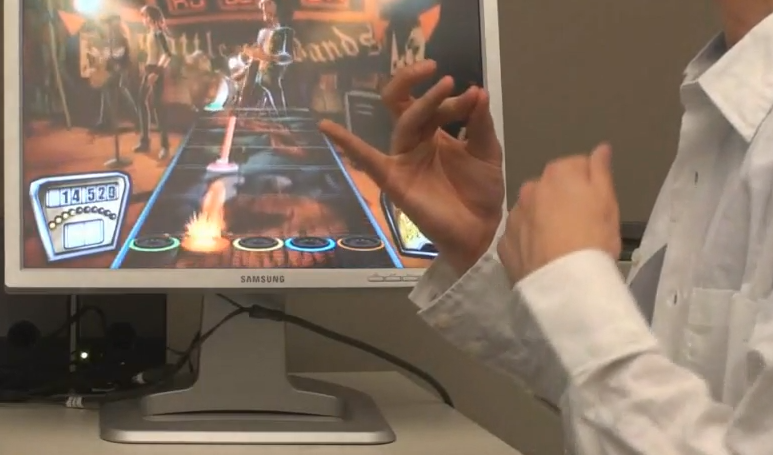
In the future, Microsoft apparently believes, people may simply twitch their fingers or arms to control a computer, game console or mobile device, ReadWriteWeb reports.
Microsoft applied for a patent on electromyography (EMG) controlled computing on Thursday, suggesting that a future smart wristwatch or armband might simply detect a user’s muscle movements and interpret them as gestures or commands.
The “Wearable Electromyography-Based Controller” could also use a network of small sensors attached to the body, all communicating wirelessly with a central hub.
Microsoft also showed off a prototype of an EMG controller in 2010, and has filed complementary EMG controller patents as well as a patent covering the gestures used to control them.
But EMG-based computing does imply several interesting possibilities: the ability to type without a keyboard; wiggling a finger, rather than an arm, to provide fine-grained Kinect controls; or new ways to control “waldos” and other robotic appendages. Microsoft even suggests that a glove-based version of the EMG controller might be used to automatically translate American Sign Language into written or spoken English or other languages. That’s pretty cool.
Microsoft’s patent application claims that an EMG sensor is a “universal” method of controlling any computing device, such as a television or light sensor. That may be true, although something like voice commands could also control just about anything. However, it does offer some sneaky, secret-agent possibilities:

Comments (8)
by Steve Engard
Applying for a technology not yet developed, at least in the lab, sounds more like a ploy to stifle competitors, without regard to specific hardware or software designs. Therefore leaving the door open to sue anyone who tries to bring a product to market before they do. This type of patent should be invalidated.
by Devon
Maybe google will buy this so it can be used with the glasses project… A HUD interface could be controlled just like an invisible iPad with the user making small hand gestures to navigate their virtual overlay of the real world. How exciting!
by Devon
Actually this function could probably be sufficiently immitaded by connecting a wristband and a couple of rings within integrated accelerometers.
by Gorden Russell
I can see this as an app for a smartphone. A deaf person could put the phone in a breast pocket and talk to a hearing person.
by Starheart
Stillborn technology. In order for a computer interface to be gesture-driven, all it needs is a sufficient resolution imaging sensor which can track hand movements without having to attach sensors to one’s hands – something that Leap Motion controllers are said to deliver.
by GatorALLin
….I wish Leap Motion would ship out the developer kits asap… I signed up for one, but no real updates yet…. Are you hoping to get one also?
by Jon
https://live.leapmotion.com/order.html
“We are estimating that the Leap will ship in February 2013.”
Also, 70 dollars is quite affordable!
by The Guy
It’s far too early to call it stillborn tech because it’s not mentioned to be camera dependant. That said, who knows how accurate it can be basing gestures and positioning off of muscles?
I’m definitely thinking Leap Motion is way cool, but that technology is dependent on your hand positioned just right. If Microsoft’s technology plays out well it won’t even have that sort of limitation. Maybe there will be shared screens all over home that you can operate anywhere. Perhaps remote PC/TV technologies that can allow you to gesture outside of your home and using the smartphone as a screen?