Migrant workers in China face competition from robots
July 20, 2012
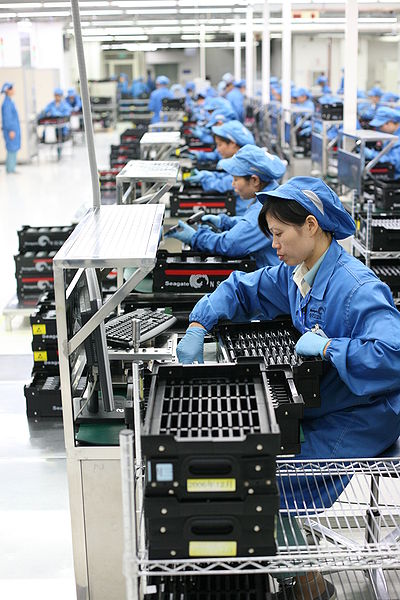
The International Federation of Robotics tracked a 50 percent jump in purchases of advanced industrial robots by Chinese manufacturers in 2011, to 22,600 units, and now predicts that China will surpass Japan as the world’s largest market in two years, Technology Review reports.
Foxconn, said last July that the Taiwan-based manufacturing giant would add up to one million industrial robots to its assembly lines inside of three years.
The aim: to automate assembly of electronic devices just as companies in Japan, South Korea, and the United States previously automated much of the production of automobiles.
But China’s leaders see employment as essential to maintaining a harmonious society. The imperative of creating jobs often trumps that of efficiency.
Also, Foxconn can’t replace human workers right away because automating assembly lines would require rejiggering its entire manufacturing process.

Comments (25)
by GFreeman
Currently the 1% needs the 99% to: a) provide labor for the production of goods and services and; b) provide wealth for the 1% to extract. Because the 99% has the power to vote the 1% has an interest and need to influence and control their political thought.
Current trends: a) more and more goods and services are being produced with intelligent automation replacing human labor; b)Wealth and income are moving to the higher income levels; c) political rhetoric and influence is being controlled by the very rich and; d) the 1% are reducing the political power of the 99% by suppressing their vote.
Future trends:
1. Government of the people, by the people, for the people is being replaced with government of the corporation, by the corporation, for the corporation. [Corporations are people too my friend- Mitt Romney]. The 99% will eventually have little or no political power.
2. Labor costs will continue to be reduced with the 99% moving to serfdom.
3. Unemployment will increase as human labor becomes more and more obsolete and is replaced with intelligent automation.
With no need for labor by corporations, welfare support of any type (food, clothing, shelter, education and health care) will be an unnecessary burden on the 1% as they will be paying for it with no return on their investment.
For the 99% there will be tendency for the 1% to, as in the words of Ron Paul supporters, let them die.
by Chrispium
I have reached the same conclusions as you have GFreeman. This is a message that needs to be spread to all.
by Steve Paesani
According to Freedman the 1% have the power to ‘let them die’.
The reality however is quite different. In fact the opposite
The laborers in China are letting the 1% and their coherts go on to their bitter end.
One need but consider the polutants the rich and their coherts have become:
Integrity:0
Honesty:0
Work ethic:0
Happiness:0
Discernment:0
Morals:0
Values:0
Peace Of Mind:0
Soul:0
The rich play, the rich pay.
They should have never thought of screwing anyone over in the first place.
God is good.
by josdorpjossie
The article doesn’t tell us why the manifacturer moves to robots. Are they cheaper or do they deliver better quality of work.
But no matter what the answer is, this has a major impact on the society. If this trend continues we are going to live in a different world. A world that is not about making money by working, but basically everybody will become a consumer without working for their money. I can’ even remotely see what such a world will look like.
I suspect it will be run by big heartless companies, just like in many scary sf movies. Brrr.
by Chrispium
Most of Foxconns workforce lives in huge barracks, their daily routine switches between life in the barracks and work in the factory. The stress involved with that has made several workers go mad and commit suicide. The bad press Foxconn has received from this has made them decide to phase out most of their workforce.
We might share what work is left to do among all of us and get payed in full for that or some might monopolize the remaining work and full pay and leave the rest on minimal benefits. There might be riots.
by Joe
or we might have more dog “whisper’s” that become millionaires and more app developers.
by mark
The way I see it in the tire industry is the china tires are crap and smell like chemicals and are junk but at least the are cheap but to me being in the tire industy for 20 years everybody loves the american brand and doesnt seem to trust the china made junk your life is in chinas hands but yet firestone went to hell because of the way they fly apart but yet china can get awy with it DUH DO NOT BUY CHINA MADE JUNK TIRES THEY SUCK!!!
by Nick
So tax the output of machines, and use that tax for distribution to society. If everybody is reduced to 8 hours work per week, and machines do the rest, tax the machines and spread the production benefits across society. After all, jobs are a way of spreading the benefits of production through society. If we don’t need as many worker-hours to make things, then tax the production and reduce work hours. We do not need to end up with workers and unemployed. But this is a social goal, agreed by society.
by Agrippa
Right on!!
by GFreeman
What is needed is some way to share the productivity increases resulting from labor repacement with the 99% of the population. George Magovern’s proposal of a negative income tax or Thomas Paine’s idea of a govenment gurenteed anual income for the citizens of the USA are examples of how to distribute the gains.
by GFreeman
Correction: George Mcgovern
by snake0
This article liberally switches the use of ‘Taiwan’ and ‘China’, even though the two are very different. Foxconn is a Taiwanese manufacturer, not Chinese. The Communist party’s ‘harmonious society’ trope is just a gimmick to turn the eyes of commoners away from the real state of political corruption in mainland China, it has NOTHING to do with the economy, especially not in Taiwan, who are experiencing a more stable ‘Japanese-like’ curve in growth as opposed to the mainland bubble which is based on false promises and cheating the international community (economic sanctions on American websites disguised as censorship, enacted to promote homegrown copies are a prime example of this).
When other countries advance to the level where manufacturing can be mostly automated, China will implode.
Presently there is an incentive to bolster the idea that China is a strong and upcoming economy. Through this lie, investors can make a quick buck on the backs of China’s paper economy. When the bubble bursts, they will run away, and people will finally realize that China was basically a country full of peasant farmers with a few hastily built slave camps disguised as factories.
by Jim
The reference to Taiwan is because although the company is owned by Taiwan they have most of their manufacturing on the Chinese Mainland. It was first announced last August.
by Gorden Russell
Communist Party officials take bribes from factory owners. The workers will not get any rights. If they try to organize they will be run down by tanks. But the price of rice will go up, global warming is bringing drought to half of the world. This just might bring a revolution to bring the government down.
by DeBee Corley
This is about 5 years sooner than I expected.
by gare
Assuming ‘unit’ = robot in this piece, there is a huge difference between:
2011 = 22,600
2012,2013, and 2014 combined = 1,000,000 (or 333,000 / year)
This statement by Foxconn sounds like propaganda and not in line with reality.
by Gorden Russell
I read this article before the one on the artificial finger. After reading that one, it looks like there could be robots to assemble I-Phones at Foxconn. If the factory owners can bribe enough Communist Party officials to get these robots on-line, there will be mass unemployment and mass unrest. It could even bring down the government.
by Bri
Unfortunately for china thier day in the sun is passing. I’ve written about this before. Thier cheap labor made them competitive before, but robots will usurp thier power also . Most of the billion peasants won’t ever get hired for a job. To ship goods to and from china, will become cost prohibitive.. They have over extended themselves in financial terms. With robots in the equation, labor cost drop out. A robot 24/7 in china is about the same as a robot in the US , or Germany, or Greece. No need to import or export!. Just wait till we get to nano engineering! No need for factories in the US, or Germany, or Greece! Whoopsssss! (twilight zone theme) your on a bus, with a talking shrunken head that says “we’re in for a bumpy ride!” music fades into the back ground. “Who’s gonna pay the wages, when robots keep taking in stages, sweet darling, whooooose gonnnnaaaa ppppaayyy those billlllllssss!
by Paul in Vancouver
With all due respect, installing robots in china will not raise manufacturing costs in China and it will not make goods from China prohibitively expensive. Quite the contrary, robots will lower production costs while improving quality for mass-produced items. It’s good news for consumers and business owners, but bad news for manufacturing workers all over the world unless you are manufacturing robots or servicing robots.
by Chrispium
Foxconn should make sure to place it’s robotics in Taiwan rather than in mainland China, just in case Beijing should get any funny ideas.
by Gorden Russell
Yes, Bri and Chrispium, you’re both right. When robots are cheaper than Chinese peasants, those of us in the West are in big trouble.
by GatorALLin
…so a friend of a friend posts on facebook that they don’t think they should accept a 43K job because they graduated school 3 years ago and expected to start at 80k or more…. they have the dignity and pride to hold out for what they deserve… really? you wait 3 years to get a job and one comes along (in this economy) and you hold out for 37K more because that is what you deserve… Lets me guess… Twinkies and video games on the couch are hard to compete with if you still get free rent at home or any assistance checks…or…. oh Never-mind…. but this is the crap that I think is wrong with the USA and why that job is being rightfully “stolen” by someone overseas right now. This is the learned helplessness and victim mentality I hope we can somehow dig our country out of…… Fail.
by Gorden Russell
That friend of a friend is doomed.
by GatorALLin
…as long as rice cost less than electricity, I don’t see any future threat of robots stealing jobs from the hard working Chinese on their assembly lines. These Chinese workers are tough, work long hours and very competitive. If anything all they lack is better training and better worker rights. Once they all get cell phones and share info and group together, they can change worker rights issues (yes even in communist china). China has been fully infected with the capitalist and entrepreneurial bug that America used to have decades ago. I fear the American spirit in the USA has been replaced with a sense of false world power status, sense of self indulgence and MeMeMe attitudes and if anything the American dream is replaced by the shortcut dreams of lotto tickets and lawsuits to make it big. Some healthy competition from the Chinese workers should wake us up, but all it seems to do is have America play the victim card of jobs being “stolen” away….. by who? people willing to actually work? (I am so tired of hearing about some poor American who expects his 80k a year pension because he delivered mail for 22 years). Or the Union member who joined to protect worker’s rights….then became the monster they were always fearing would take advantage of them. Its not fair we keep saying……Your right we have had the unfair advantage in the world for a long time….now may the best ideas win…..for all the right reasons.
by Dennis R.
I don’t think the cost of rice will enter into most of the decision making when robots are actually good enough to do more of the work that humans do. When that happens, manufacturing will probably occur closer to where the items will be sold. Jobs might be lost in China. They probably won’t be regained in the United States. That’s capitalism too.
Agree with the sentiment of “false world power” status in the US. But I think much of that world power status in the twentieth century was only possible because we were isolated from much of the actual combat of the two world wars. Yes, our troops fought. But our manufacturing occurred far from the conflict and our population wasn’t forced from their homes. Our infrastructure remained intact. We were the beneficiaries of a favorable geographic location and that’s what made us the manufacturer for the world. Once the wars stopped and overseas infrastructure and manufacturing was rebuilt, we lost much of our competitive advantage. I don’t think we were ever that much better competitively. But we had some advantages that gave us a big head start.