Moral machines
November 29, 2012
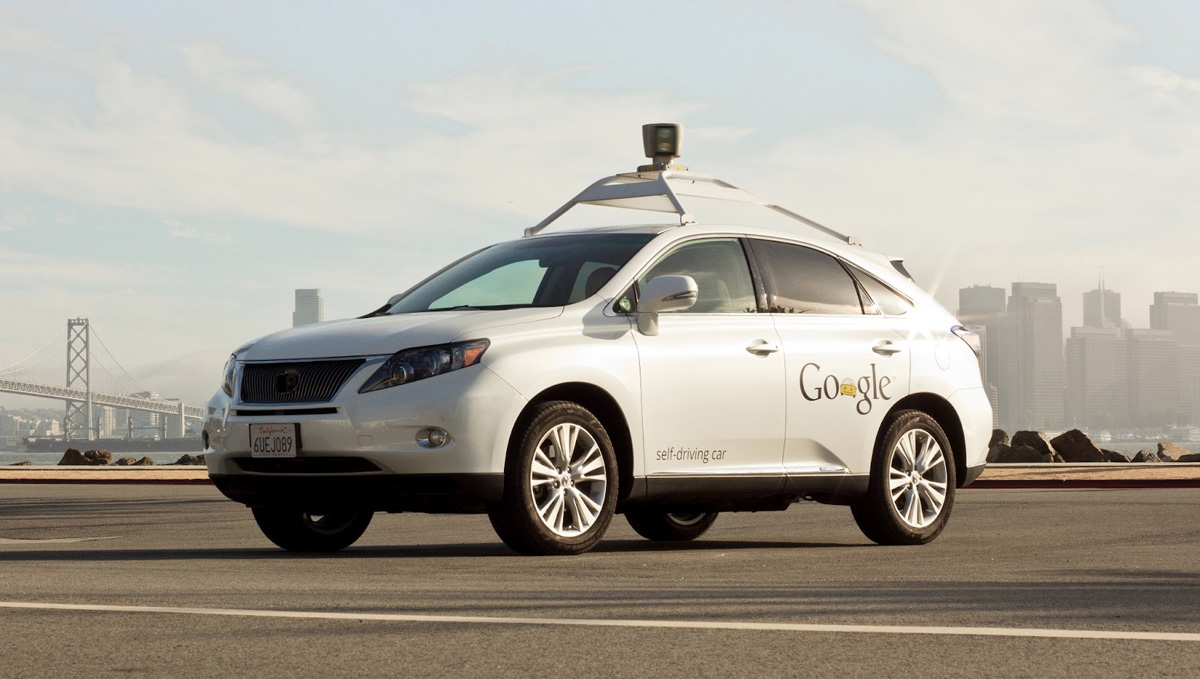
Google self driving car (credit: Google)
Google’s driver-less cars are already street-legal in three states, California, Florida, and Nevada, and some day similar devices may not just be possible but mandatory.
Eventually (though not yet) automated vehicles will be able to drive better, and more safely than you can; no drinking, no distraction, better reflexes, and better awareness (via networking) of other vehicles.
Within two or three decades the difference between automated driving and human driving will be so great you may not be legally allowed to drive your own car, and even if you are allowed, it would be immoral of you to drive, because the risk of you hurting yourself or another person will be far greater than if you allowed a machine to do the work. …
That moment will be significant not just because it will signal the end of one more human niche, but because it will signal the beginning of another: the era in which it will no longer be optional for machines to have ethical systems, NYU Professor of Psychology Gary Marcus writes in The New Yorker.
These issues may be even more pressing when it comes to military robots. When, if ever, might it be ethical to send robots in the place of soldiers? …
As machines become faster, more intelligent, and more powerful, the need to endow them with a sense of morality becomes more and more urgent. “Ethical subroutines” may sound like science fiction, but once upon a time, so did self-driving cars.
(More)
Human Rights Watch released a report entitled “Losing Humanity: The Case Against Killer Robots” earlier this week. It finds that fully autonomous weapons would not only be unable to meet legal standards but would also undermine essential non-legal safeguards for civilians.
DoD Directive 3000.09, Autonomy in Weapon Systems, has been signed by Deputy Secretary of Defense Ashton B. Carter, effective November 21, 2012.
Comments (34)
by Sudesh Kumar
How an unusual event be dealt with legally will determine the extent of commercial exploitation ? Would the owner or occupant in the driverless car be liable ?
by Damon Montano
I don’t think they will disallow classic cars from being operated on the road manually. When the technology is perfected all automated systems driving with a classic car nearby will know the older vehicle isn’t networked to the other cars on the highway and they will be keeping their scanners on the “anomaly”. If an older car started to fly into other lanes all networked cars would accelerate, decelerate, and move out of the way like a flock of birds. Older cars will not be disallowed on highways- like 1950 models they will eventually fade into history. If older cars were disallowed from operating on roads you would have a society that punishes people who cannot afford brand new cars, not going to happen….
by zombiefood
the removal of possibility of death from misadventure might take some excitement out of life, eh
by Bea Hooper
driver-less cars – if it will decrease my car insurance (especially with my teenagers) – bring it on!
by eldrtas
To forecast when driverlesss cars DC’s will be as good as humans, you can:
1. Reduce all good driving to an expert system by simple onboard monitoring computers (this could come @ the same time as DC’s & could be linked to the new tech)
2. Advent Artificial General Intelligence. This is much harder (Oxford Conference in December all welcome). For AGI you would have to achieve post human intelligence in software/other systems AND contain it.
Exert systems reduction in driving is not impossible in 5-10 years IMO IF Google can get enough into their expert systems which means enough monitoring.control onboard systems. Ten they can pigeon rank it like google search.
If they dont want either of those then they have to reduce an algorithm of every possible driving situation. The first death caused by a google car will halt them for years like stem cell research.
It may not matter if we can raise the dead!
https://sites.google.com/site/quantumarchaeology/
eldras
by Jim
Sure hope terrorist don’t program google cars to hunt people down and run over them.
Autonomous killer robots will have to shoot children or the enemy will hand a child a rock, hammer, or gun and tell them to disable it. Human backup will be a necessity.
by Ralph Dratman
Autonomous killing machines are SUCH a WONDERFUL idea, it is hard to see why ANYONE would have doubts. I mean, this is the greatest idea since the invention of WAR itself.
by Gorden Russell
Irony noted, Ralph Dratman. Yet they might just keep us out of some wars. Would the Taliban keep shooting schoolgirls if they knew we had Berserkers?
Would they strap on a suicide vest just to wreck one machine when we have more robots building more robots?
by McTruck
Now that drones have been unleashed on the battlefield, they will be far more difficult to defend against on our own turf if someone or some organization decides to use them against us. Goodbye, freedom. Goodbye, Constitution.
by Gorden Russell
If we continue to build more and better machines than anybody else, then we can keep our freedom.
by Matt
You know there is dozens and dozens of “free” countries don’t you? All with much less military weapons then the USA. Imagine that
by MechanicGuy
Well, according to Kurzweil, the Singularity cannot be prevented, it can be at most delayed. A nuclear World War 3 may draw our civilization back to stone age, but there would likely be (at least) some technological wastes upon which humanity can quickly revive the prewar technology level and exponential growth. After singularity, the posthuman civilization will formulate a “constitution” that is far more reasonable than any human made ones and is self-adapting (we can start now that by utilizing deep-learning to create robot-lawmakers). And, for the ultimate form of freedom, I recommend reading from this webpage: http://www.orionsarm.com/eg-article/45f7690b9524f
by Conrad Green
it would only destroy civilians. military has D.U.M.B.S (Deep underground military bunkers. ) it wouldnt do shit.
by Peter Koller
Before this planet has not agreed on a universal morality or find that we can exist peacfully without any I would stay away from implanting our narrow ideas into machines’ minds and prefer tham as narrow and funtionial as they are right now. Because at our level of intelligence the next thing people will want machines to have is religion.
by Gorden Russell
Well, Peter, if a robot Jesus comes to the fore, we’ll just have to crucify him before things get out of hand.
by eldrtas
why dont hanson robotics come off the fence and make a robot jesus?
by MechanicGuy
According to Dr Schmidhuber, We will soon be able to build artificial musicians, painters, comedians and even more. Why not an artificial religion starter? The robotic prophets/priests/gurus will not abuse you financially nor sexually. How nice! BTW since by then we are likely to be in a post-scarcity world, so they will not have compete for converts. No holy wars will have to be fought as all these robot-prophets can simply go colonize one of the many millions of planets in the galaxy, mass-produce (gullible IQ-stunted) human beings through bio-3D printer and build their own religiontopias. Jehobot’s Witnesses, the Church of Googllinium, Mechano-ananda Ashram to name a few.
by Cesar
“It finds that fully autonomous weapons would not only be unable to meet legal standards but would also undermine essential non-legal safeguards for civilians.”
I don’t see why. A robot wouldn’t rape a 14 years old girl after killing her family while his companions laugh and sneer like US marines.
by Bri
That’s not a tactic solely possessed by US Soldgiers. Rape has been a sad consequence of most wars.
by Mostly Foobar
Rape is a consequence of lawlessness brought about by loss of ‘moral infrastructure’ and a government with a monopoly on the right to use of coercive force to control adults.
These situations are common in war – destruction of government. destruction of infrastructure. In these circumstances any military commander will tell you that it is absolutely imperative that soldiers operate ethically. This is why honor is so important in military academies – an officer on the ground in a battlefield IS THE GOVERNMENT – he IS the ethical infrastructure. He needs to be ethical and moral (defining both of those words is horribly slippery… but forging on…) If officers – and by extension – soldiers are not highly ethical, a battlefield becomes fertile soil for atrocities of all imaginable sorts. (And truthfully not much imagination is required – they’ve all happened before at one time or another)
It’s because of this that the morality and ethics of drones is so important. Anyone who scoffs at the idea of moral machines, or throws up their hands because we as a society do not have operable, universal definitions of morality or ethics is opting out of an EXTREMELY important discussion.
Who is responsible for collateral damage of a drone in combat? Who is responsible when your robot car runs over a toddler on a tricycle? (Sorry, the battery on my camera was low and the shutoff malfunctioned.)
We absolutely need to be discussing a declaration of universal machine ethics. It will not be completely comprehensive, it will need to be fluid for a while. But we need to determine who is responsible for the behavior of an autonomous system. And how they are to be held accountable.
If we do not address this soon, every responsible company on the planet doing AI work is going to get sued out of existence (because – at least in the US – in the absence of definitive exemptions or protections… The party most responsible for something terrible that happened, is the party with the deepest pockets). and AI research will only be able to be conducted by rogue actors.
The morality of machines is a muddy subject in need of our serious attention. If we cannot get a handle on it, bring in some clarity at least, The implacable American legal system will bring AI research to a grudging (if not screeching) halt.
by Tom B.
It is a scary new world in which the technological capabilities of society are increasing faster than our social systems can adapt. Unfortunately, most of the world lives under leadership that is out of touch and powerless to make the bold changes necessary to keep up.
by Micha Sass
@Greg Scot, Singularity-ists have been offering humanity something so similar to religion (promise of salvation for the human race, an answer to the uncertainty of death) for years. It is no wonder they will now move into morality. Good people will choose technology. Have fun with that.
by Ian Clarke
Smite the non-believer!!!
I believe the Singularity will happen – it just seems inevitable to me – I don’t guard this belief with anything approaching religious fervour. If I see compelling evidence to cast doubt on this belief, I’ll change my mind.
I’m not sure why ‘morals’ are stirring up such hornet’s nest. GAI will have to have a basic understanding.
by Gorden Russell
“These issues may be even more pressing when it comes to military robots. When, if ever, might it be ethical to send robots in the place of soldiers? …”
Well of course it will be ethical. The robots will just be programmed to follow the Geneva Conventions. They won’t go insane from multiple deployments, they won’t seek revenge after seeing their comrades blown up by mines or shot down by snipers. They will stop shooting at a combatant a millisecond after he throws down his weapon, and they will treat prisoners well. They will have quick enough reflexes and a steady enough aim to make impossible shots…such as shooting a terrorist right through his left eye when he is hiding behind a civilian hostage. Also, all the robots will be equipped with electrochemical sniffers so they can tell which guy hiding in a crowd of civilians just fired a rifle or planted explosives.
These robots will be useful at border crossings too. Nobody will be able to get drugs past them…and they’ll get the job done before their human supervisors can blink an eye.
This will speed up getting through customs searches. When robots can print out and assemble robots, they will be so cheap that the customs people can have enough of them to walk down and sniff out all the cars waiting in line at the crossing.
by MechanicGuy
…they will be so cheap that the customs people can have enough of them to walk down and sniff out…
If they become cheap, does not that make us human beings cheaper?
They will not need us, sadly so.
If they are benevolent, in the best case scenario, when they take over they will simply upload (and augment) us for free.
If they are not, then we should wait patiently until we arrive at the Omega Point.
by John
Btw. since driverless cars are yet “only” narrow AI, they must be prone to hacking. It should be easy to come up with behavior from outside which makes the car do crazy things. Now there are few cars like that but when they are common, that might be a major problem.
by GatorALLin
Why do we keep thinking of ALL robot or all human? Dones we fly now to kill are using the combo of machine to reduce our risk of our pilots but are human controlled. Why cant a ground military robot be the same thing? I think we need to comine the best of both. And pull the trigger as if u know the world is watching. Video record everything like dash cams to watch cops but make them better. Wikileaks may show what u did someday.
Btw can we force DUI drivers to use self driving cars now in FL? Tack that on to ur cost if being addicted and self indulgent. Drunk passengers in these google cars make ideal crash test dummies. .
by Bri
VIKKI will have her day soon. People tend to have, shall we say human flaws. Take Hevessi for example. He was the NY state pension fund comptroller. He got caught doing the wrong thing. Think of the moral obligations of the people’s trust. Think about impartiality in discession making fields , such as grading tests or hiring. People tend to insert their own biases. VIKKI can have oversight by a similiar way that the Egyptian populous is rejecting their new presidents betrayal of public trust. Of the people, by the people, for the people. A more truer form of democracy can be implemented in a controlled way as these type moral decision are gradually assimilated. Humanity as a whole needs to engage in more discussions on morals and ethics. We can never truly be free. We are bound to each other in moral obligations. Screaming big brother about it doesn’t change the ramifications.
by Ian Clarke
Given a sufficiently advanced tech/GAI, you can imagine the first Moral Robot vs Human war to be a fairly bloodless affair (discounting ‘friendly fire’ or accident, with robots rushing to rescue and treat their injured foe). You can also imagine the first such war to be the last – well, at least I can.
by Greg Scot
“Immoral”?? Who is THIS person to dictate to anyone else what is “Moral” and “Immoral”? Haven’t we reached a phase — in the overall Darwinian scheme of things — where “Morality” is just whatever-anyone-wants-to-decide-it-is?? The whole idea of anyone telling someone else (or implying to anyone else) what they “ought” or “ought not” do – like driving a car when the software driver would be so much safer – is a little old-fashioned, don’t you think? Next thing you know, these types of articles will have RELIGIOUS overtones… Oh brother.
by Ian Clarke
That seems a bit extreme. Broadly speaking, I think we could all agree upon a set of moral codes. And I certainly wouldn’t associate morality with religion.
by Camaxtli
That’s exactly what morality is, in addition to what a preponderance of people agree is right or wrong. We haven’t reached a phase where morality is whatever-anyone-wants-to-decide-it-is, it’s never been anything else even if the religious erroneously claim some sort of absolute. That doesn’t make it invalid or not useful to society just because its subjective.
by Ryan Jackson
I look at the issue through the lens of Gödel’s incompleteness theorem. It essentially proves mathematically that within most non-trivial axiomatic systems, that there are truths (not mere opinions) which can’t be proven. Just because they can’t be proven does not mean that these truths are any less valid or accurate as other true statements that can be proven.
There is certainly room to debate whether or not this theorem applies to such things as ethics, but I think it does. I think that there are absolute moral truths that we should live by if we want to have a happy and civil society. These truths are not merely a matter of opinion.
One doesn’t need religion to accept that there are moral absolutes just as one doesn’t need religion to accept the fact that there are truths regarding relations between natural numbers which are mathematically unproveable. I don’t need religion to tell me that killing people just for the fun of it is wrong. I also don’t think that saying that it is wrong just happens to be my opinion, and that someone else’s opinion that it is our moral duty to kill others just for fun is equally valid.
By the way, I developed an artificial intelligence engine based on finite automata for my thesis in graduate school. I hope to commercialize the technology I developed someday. That means that for me, this debate is not just hypothetical. I actually have to apply it.
by Mostly Foobar
Never seen Godel’s incompleteness theorem pointed at morality before. Intriguing.
And woe be to a civilization that looks to religion to provide moral guidance. Religions have been responsible for more or less all of the really, really bad bits of human history.