Morality for robots?
September 5, 2012
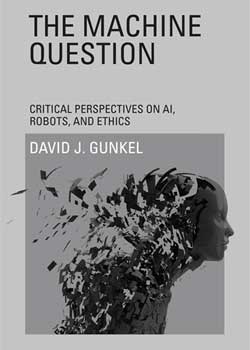
In new book, NIU Northern Illinois University Professor David Gunkel examines ethical questions raised by 21st century computers, robots and artificial intelligence.
On the topic of computers, artificial intelligence and robots, he says science fiction is fast becoming “science fact.”
Fictional depictions of artificial intelligence have run the gamut from the loyal Robot in “Lost in Space” to the killer computer HAL in “2001: A Space Odyssey” and the endearing C-3PO and R2-D2 of “Star Wars” fame.
While those robotic personifications are still the stuff of fiction, the issues they raised have never been more relevant than today, says Gunkel, an NIU Presidential Teaching Professor in the Department of Communication.
In his new book, “The Machine Question: Critical Perspectives on AI, Robots, and Ethics,” Gunkel ratchets up the debate over whether and to what extent intelligent and autonomous machines of our own making can be considered to have legitimate moral responsibilities and any legitimate claim to moral treatment.
“A lot of the innovation in thinking about machines and their moral consideration has been done in science fiction, and this book calls upon fiction to show us how we’ve confronted the problem,” Gunkel says. “In fact, the first piece of writing to use the term ‘robot’ was a 1920s play called ‘R.U.R.,’ which included a meditation on our responsibilities to these machines.”
Gunkel, who holds a Ph.D. in philosophy, notes that a cornerstone of modern ethical thought has been significantly challenged, most visibly by animal rights activists but also increasingly by those at the cutting edge of technology. “If we admit the animal should have moral consideration, we need to think seriously about the machine,” Gunkel says. “It is really the next step in terms of looking at the non-human other.”
Gunkle points out that real decision-making machines are now ensconced in business, personal lives and even national defense. Machines are trading stocks, deciding whether you’re credit-worthy and conducting clandestine Drone missions overseas.
“Online interactions with machines provide an even more pervasive example,” Gunkel adds. “It’s getting more difficult to distinguish whether we’re talking to a human or to a machine. In fact, the majority of activity on the Internet is machine to machine traffic. Machines have taken over; it has happened.”
Some machines even have the ability to innovate or become smarter, raising questions over who is responsible for their actions. “It could be viewed as if the programmer who writes the original program is like a parent who no longer is responsible for the machine’s decisions and innovations,” Gunkel says.
Some governments are beginning to address the ethical dilemmas. South Korea, for instance, created a code of ethics to prevent human abuse of robots — and vice versa. Meanwhile, Japan’s Ministry of Economy, Trade and Industry is purportedly working on a code of behavior for robots, especially those employed in the elder-care industry.
Ethical dilemmas are even cropping up in sports, Gunkel says, noting recent questions surrounding human augmentation.
He points to the case of South African sprinter and double amputee Oscar Pistorius, nicknamed “blade runner” because he runs on two prosthetic legs made of carbon-fiber. In 2008, Pistorius was restricted from competing in the Beijing Olympics because there was concern that he had an unfair advantage. This decision was successfully challenged, and Pistorius competed in the 2012 London Games.
Similar concerns about the fairness of human augmentation can be seen in the recent crisis “concerning pharmacological prosthetics, or steroids, in professional baseball,” Gunkel says. “This is, I would argue, one version of the machine question.”
But Gunkel says he was inspired to write “The Machine Question” because engineers and scientists are increasingly bumping up against important ethical questions related to machines.
“Engineers are smart people but are not necessarily trained in ethics,” Gunkel says. “In a way, this book aims to connect the dots across the disciplinary divide, to get the scientists and engineers talking to the humanists, who bring 2,500 years of ethical thinking to bear on these problems posed by new technology.
“The real danger,” Gunkel adds, “is if we don’t have these conversations.”
In “The Machine Question,” Gunkel frames the debate, which in recent years has ramped up in academia, where conferences, symposia and workshops carry provocative titles such as “AI, Ethics, and (Quasi) Human Rights.”
He concludes in his new book that the moral community indeed has been far too restrictive. “Historically, we have excluded many entities from moral consideration and these exclusions have had devastating effects for others,” Gunkel says. “Just as the animal has been successfully extended moral consideration in the second-half of the 20th century, I conclude that we will, in the 21st century, need to consider doing something similar for the intelligent machines and robots that are increasingly part of our world.”

Comments (23)
by anthrobotic
Related:
Robot Ethics Part 1: Robots Podcast’s interview with Noel Sharkey
(Noel says we’re in big trouble, maybe screwed) http://goo.gl/9uQ2n
Robot Ethics Part 2: Robots Podcast’s interview with Ronald Arkin
(Ronald says it’s manageable, and we’re working on it) http://goo.gl/O1iLn
Anthrobotic.com’s “Can a computer be as intelligent as a human? Or, Asking the Wrong Dumb Question. Get it?” http://goo.gl/rmzkn
(blathering about how “human-like” intelligence is a very different animal from “human-level” intelligence – and we shouldn’t sleep on that)
-Reno at Anthrobotic.com
by witsubrene
Seems odd nobody has mentioned the Asimov book I, Robot – particularly after the relatively recent Will Smith movie adaptation. Having proposed the “Three Laws of Robotics”, Asimov demonstrated clearly the moral dilemma of how/when the robots would have to interfere with human activity.
by GFreemanPHD
The sole goal of corporations is to accumulate wealth for itsellf. The humans have many goals besides accumulating wealth, such as helping and protecting other humans. Mitt Romney said coproations are people too, which inplies that people are corporations. Should a robot have the intelegence of Mitt Romney tor the intelegence of Michelle Obama?
by GFreemanPHD
Currently machilnes are no more self aware than insects, but this may change in the near future. The current trend is not artifical intelgence (AI) but Intelegent Automation (IA). These devices must be safe and effective in preforming the tasks that they are asigned. Their intelgence may exceed the abilities of humans but it won’t be human intelgence. Why whould want crazy robots, we have enough crazy humans now.
by GFreemanPHD
Your chat box should have spell checking.
by Gorden Russell
It checked my spelling. (Those wavy little red lines under your words mean that they are misspelled).
by Bri
What’s your PhD in? I’ve often thought that MD on licences plates stands for mentally deficient. You should see how high their accident rate is, or the really bone headed things the say to my 81 year old mother. I can’t spell well. Maybe I could get one of those plates too, or should I say two, I mean to. Maybe I didnt mean to. I meant two. Ahhhh just skip it!!!!
by Bri
(in case you didn’t realize my pun spell check can’t deferenciate between those spellings and what you mean. Anyway I just love when word press gives me the squeeze.)
by Bri
Who’s on first. What’s on second. What about yesterday? Shortstop!! Speaking of short this could be a new look for me!
by Peter Kinnon
There is one point in this article where we see Gunkel taking his head, which like most others, out of the anthropocentric sands.
The reported comment is:
“Online interactions with machines provide an even more pervasive example,” Gunkel adds. “It’s getting more difficult to distinguish whether we’re talking to a human or to a machine. In fact, the majority of activity on the Internet is machine to machine traffic. Machines have taken over; it has happened.”
At last the drum have been beating for many years is beginning to be heard. To repeat what I have observed so often before:
Those of the transhumanist cult (and for that matter, most others who give any thought to such matters) still seem unable to break away from the tired old SF paradigm of “robot revolutions”, while overlooking the emergence of a new life-form that is occurring right under our noses. Very real evidence indicates the rather imminent implementation of the next, (non-biological) phase of the on-going evolutionary “life” process from what we at present call the Internet.
It can already be observed as a a work-in-progress. And effectively evolving by a process of self-assembly. You may have noticed that we are increasingly, in a sense, “enslaved” by our PCs, mobile phones, their apps and many other trappings of the net. We are already largely dependent upon it for our commerce and industry and there is no turning back. What we perceive as a tool is well on its way to becoming an agent.
Consider this:
There are at present an estimated 2 Billion internet users. There are an estimated 13 Billion neurons in the human brain. On this basis for approximation the internet is even now only one order of magnitude below the human brain and its growth is exponential.
That is a simplification, of course. For example: Not all users have their own computer. So perhaps we could reduce that, say, tenfold. The number of switching units, transistors, if you wish, contained by all the computers connecting to the internet and which are more analogous to individual neurons is many orders of magnitude greater than 2 Billion. Then again, this is compensated for to some extent by the fact that neurons do not appear to be binary switching devices but can adopt multiple states.
Without even crunching the numbers, we see that we must take seriously the possibility that even the present internet may well be comparable to a human brain in processing power. And, of course, the degree of interconnection and cross-linking of networks within networks is also growing rapidly.
The culmination of this exponential growth corresponds to the event that transhumanists inappropriately call “The Singularity” but is more properly regarded as a phase transition of the “life” process.
The broad evolutionary model that supports this contention is outlined very informally in “The Goldilocks Effect: What Has Serendipity Ever Done For Us?” , a free download in e-book formats from the “Unusual Perspectives” website
by anthrobotic
This is an interesting perspective, somewhat in line with the notion of us waiting for necessarily human-like abilities to emerge, forgetting that there is no such prerequisite for intelligent, self-aware cognition. Any given non-biological intelligence needs only to achieve approximately human-level abilities – then the game changes in a big way… “Can a computer be as intelligent as a human? Or, Asking the Wrong Dumb Question. Get it?” http://goo.gl/rmzkn
by DrDubious
The religion of the Free Market says that money, corporations and property are more important than people, so it only makes sense to grant full citizenship to the robots who will soon control the masses on behalf of their owners.
After all, they will be the children of corporations.
by Ian Clarke
As technology advances and human-robot interaction becomes more ‘natural’, I think people will treat robots much as they do their fellow man. People who treat people badly, will also treat robots badly, etc.
Now if robots were programmed to power-down after poor treatment (effectively staging a strike), perhaps that behaviour would be forced to modify and have positive knock-on effects with regards human-human interaction.
We love to anthropomorphise pets, and we’ll probably start off doing the same with robots. But this will change. Robots may eventually become trusted friends and perhaps lovers.
Predictions for the first human-robot marriage, anyone? :)
by Bri
I think that if corporations can have political rights, as if they are human. Then personal home assistance robots should be able to vote and form their own organizations!…….. Not!!!! Let’s here it for autonomous robots, after all, they’re only human!!! ( oh boy, are we in for a tough decision.)
by Gorden Russell
It hadn’t even occurred to me, but you just made a great point, Bri. If corporations have rights, why not your robo-nurse?
by Bri
How about a robo nurse for president. Gets my vote.
by Bri
I suppose that it would be dependent on where it was made. Only American made robo nurses can run for office.
by GatorALLin
I agree that companies have legal rights and become their own entity to protect share holders from lawsuits and many other examples of companies having rights. But a company does not have the same rights as a human, for example they are not a citizen or companies can not vote.
Any company that has shareholders to report to has an agenda and of course they have power or influence that could in many ways prove much more powerful than the single vote they don’t have rights to.
I think we care about what happens to robots for lots of reasons and the more we care or the more we think of them as human like, then the more rights they will have (like we monitor a Semi Truck now to see how many times the driver nails the brakes to see if he is a high risk driver, or if parts are performing normally, or we monitor the average speed or gas milage, but only because it helps cut costs, not because we care about the rights of the truck. we care about the owner of the truck or the owner’s rights). Any company that monitors the robots will want to give them the best profitability and if that proves rights=money, then that idea will win. If the rights of the owner of the robot suffer and thus hurt profitability then I think rights will be removed, so my guess is that rights for robots will not prove profitable and if any rights are given they are more likely to match a company than a person. If the robots become self aware, then the game changes of course. As soon as the company that makes the robot finds a way to make more money when they robots are self aware, then it will happen on a larger scale. I am sure some hacker will attempt to make a robot self aware just to see what happens. I think the Human like qualities to make the robots effective will also drastically blur the line of how we care or feel about robots and what rights they have or deserve.
Robots could also become self aware if they are made as copies to us and we setup our rights to transfer to them when/if we were to die. Lets say you teach a robot to act like you so that it does all the hard work you do, and you get to be the clone that has all the fun? What if you die in a freak accident, could one of these robots continue to carry out your wishes and even work or protect your family on your behalf? Would you will your assets to this group of robots like an LLC (at first to avoid tax issues, later to keep it going forever, like a company that has an agenda that you would have wanted to continue/protect if you were alive). What if this robot was your best self in every way…. wouldn’t you want to live forever in this way if you could not yourself? (imagine you have no kids or family to leave money to. why not leave it to a robot designed to carry out your wishes for ever? assuming you can’t live forever of course)?
by MrFriendly
I think this is absolutely an important matter to deal with in the coming years, regardless of when AGI happens. There’s no doubt in my mind that it WILL happen, at some point, and we all know that it’s going to be extremely volatile technology, to say the least.
by DeBee Corley
Does DARPA developed “killer” robots, have to obey the “ethics” of the professor?
Will being a “uncertified” programmer, be illegal?
by MrFriendly
I wouldn’t worry too much about DARPA’s autonomous robots just yet.
The SyNAPSE project is pretty much dying, as most of the labs involved have been pruned off, and the guy who conceived it left DARPA in Feb.
However, I’m sure this won’t be their last crack at AI-driven war machines. In 15-20 years, who knows what they’ll be able to deploy (i’m betting on semi-autonomous, myself).
by Gorden Russell
DARPA won’t want robots that kill our own troops, so their “friend or foe” ID system will have to be excellent. They’ll need to stop shooting at any enemy who throws down his gun and raises his hands. But if the enemy throws down his gun and runs in terror, the robot has to be fast enough to run after him and seize him it its claws. DARPA has already issued orders for a great improvement in batteries, so the fast killer robot will be built.
When the economy recovers, they just might bring back that SyNAPSE project. Especially when the Taliban resurges and invites al Qaeda back to Afghanistan after 2014. According to Moore’s Law, there will two doublings of processor power by 2015. That will make the robots a lot better.
by Gorden Russell
It’s been a long time since I read that play, but looking back, I think the message of “R.U.R.” was that people were already being treated like machines in the new factories of the Twentieth Century. The question of moral considerations for robots in that play was really just how poorly can you treat human workers before they rebel.
#
With DARPA having all these robots designed for the military, somebody there is bound to realize that the Geneva Conventions have to hard-wired into combat robots to keep them from performing their own My Lai massacre.
#
As for how well they treat the robots, there are already rules about machinery abuse. A soldier can be written up for over-revving an engine and spinning the tires on the pavement. And as for the ethics of robot abuse, just how well do you think they are treating the human soldiers now? Have you seen how many repeated tours of duty the people have been sent on today?