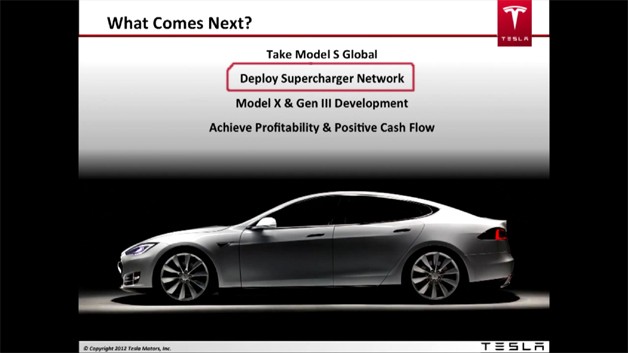
Too bad it doesn’t look a little cooler. I know they are aiming at the mass market, but c’mon, give us something unique, this looks like every other sedan out there-
Low center of gravity is not a new idea. What happens to batteries when you run over something hard in the road.
While I like Tesla Motors I still believe that a vehicle 30 yrs from now will float in midair. Of course, I don’t know that will happen, but still, I presage so.
The carbon footprint is miniscule and dwindling. It’s mostly a story cooked up to support the fossil fuel engine.
Regarding the performance, I’ve seen a prototype vehicle with the electric engine integrated with the brake system and installed in each wheel. it’s a 4WD 600 HP car.
Bad ideas on top of bad ideas. Just because the electrical outlet on your wall is clean doesn’t mean the coal they burn to generate your electricity is clean — or even efficient. Electric cars leave such a huge carbon footprint, I don’t see how anyone could drive one with a clear conscience.
They are actually much more efficient than the alternative even considering the electrical current being derived from a coal plant. Also, because of centralization, powering cars on something like wind, solar, or nuclear is actually tenable. So, for now, they are decent options. In the long run they are absolutely necessary.
When we switch to solar, wind, wave, and geothermal power plants this won’t be a problem.
Do you drive your gas car with a clear conscience?
Don’t critize people trying to solve the problem while doing nothing yourself.
Someone with solar panels on the roof of their house doesn’t contribute to the problem you describe.
A coal power plant is a much cleaner provider of energy for locomotion than a diesel or a gasoline powered engine. The reason being the coal power plant have much bigger and much more effective filtering of it’s emissions than an auto engine.
More and more electricity is being produced by greentech causing emissions to reduce at an increasing pace. Denmark, as an example, is moving towards a fossil fuel free future and is required by law to reach that goal by no later than 2030. I’m sure other countries have the same ambitions.
As far as efficiency, electric cars are the most efficient of all. They also currently have the smallest carbon footprint of all vehicles and that footprint is only set to wither away.
Godot, while there is a 70% chance that the power comes from a fossil-fuel source, there is a 100% certainty that the fossil fuel used in cars will leave a carbon footprint. Quite simple actually
Not all fossil fuels are created equal: 100% of the energy derived from coal produces CO2, while part of the energy derived from HYDROcarbons produces H2O.
Standard transmission losses in the power grid range from 7 to 50%, depending on your location relative to the power plant.
The portion of electricity CURRENTLY being generated from solar our wind is insignificant. If it becomes significant, I’ll reconsider electric cars. Until then, use of electric cars is irresponsible, and based on wishful thinking.
If you drive every day, batteries based on current technology only last about 3 years. The ecological burden of disposing of these dead batteries is horrendous — not to mention the energy cost to manufacture and dispose of them.
Further efficiency considerations: In both battery-powered and combustion cars, the energy derives from chemical bond energy. With a battery, you must pay to accelerate 100% of the weight of chemical energy storage all the time — even when the battery is run down. You don’t have to pay to accelerate combustion fuel you have already burned. Combustion derives about half its chemical energy from ambient O2
in the air, which you also don’t have to pay to accelerate. On avg, that’s two 50% advantages, for a factor of 4 in efficiency of mass of fuel you don’t have to haul.
The actual amount of energy reclaimed thru regenerative breaking has proved to be minuscule — so much so that it may be more efficient to save car weight by leaving out regenerative equipment.
This is not rocket science. It only requires a spreadsheet — and the ability to avoid wishful thinking and vaporware.
I can fill up with liquid fuel in less than 5 minutes. Charging a battery takes much longer. I can drive cross country non-stop using liquid fuel. I have to stop to recharge an electric car once or twice per day.
…..is there a reason we can’t slide in a dozen 2Liter sized batteries at a gas station of the future where batteries are on charge all day, we just swap them out in the same time you would take to fill up with gas? Maybe batteries could be interchangeable (imagine batteries so cheap they had no value, that the value was only in the charge itself. Maybe batteries not part of the car as they are now, maybe owned by gas stations.
There is a company operating in Isreal that is doing the swap idea. It has merit. Some very automated concepts have been proposed. It’s a lot like your analysis of the cost to run per mile. The time and labor involved, not to mention training and possible problems, start to become to significant. I think high density ultra capacitors are a better option, but they have their drawbacks too. Not the least of which is we have to increase the energy density. Let’s face it. Gas packs a lot of punch into a relatively stable molecule. Increasing the strength of the car frame while reducing the weight helps the electric car be more viable and also make fuel powered cars get more out of every gallon. We will probably have petroleum powered vehicles for quite awhile. Each tech has it’s area of excellence. Besides, we will need carbon in the atmosphere once we start to use it for everything under the sun. It’s just a very versatile element and we will be sucking it out of the atmosphere in vast quantities soon!
@Bri.. Good point… Yes, I have to agree…. prices are crazy high on these electric cars. When you factor out the tax refund from IRS and also factor in the cost of needing new batteries in the future and up front cost they are still too expensive per mile (even if work let you charge up for free!).
Comments (20)
by Julian
Very nice looking car, a bit like a Jag. Think it will be very popular in Europe
by Max
Too bad it doesn’t look a little cooler. I know they are aiming at the mass market, but c’mon, give us something unique, this looks like every other sedan out there-
by Chrispium
It’s meant to look like that, if you want unique check out their Roadster. Or their model X SUV
by Bob Vasquez
The Romney ad on the right is cute. Is the pregnant lady also barefoot?
by Bennie Beaver
Low center of gravity is not a new idea. What happens to batteries when you run over something hard in the road.
While I like Tesla Motors I still believe that a vehicle 30 yrs from now will float in midair. Of course, I don’t know that will happen, but still, I presage so.
by Matt Knowles
@godot, perhaps for some people the lure isn’t a lower carbon footprint, but greater performance.
by Chrispium
The carbon footprint is miniscule and dwindling. It’s mostly a story cooked up to support the fossil fuel engine.
Regarding the performance, I’ve seen a prototype vehicle with the electric engine integrated with the brake system and installed in each wheel. it’s a 4WD 600 HP car.
Ride the lightning :)
by godot
Bad ideas on top of bad ideas. Just because the electrical outlet on your wall is clean doesn’t mean the coal they burn to generate your electricity is clean — or even efficient. Electric cars leave such a huge carbon footprint, I don’t see how anyone could drive one with a clear conscience.
by Rue Tournelle
The USA consumer spends $40 BILLION PER MONTH for foreign oil.
by Mark
They are actually much more efficient than the alternative even considering the electrical current being derived from a coal plant. Also, because of centralization, powering cars on something like wind, solar, or nuclear is actually tenable. So, for now, they are decent options. In the long run they are absolutely necessary.
by DanCQ
When we switch to solar, wind, wave, and geothermal power plants this won’t be a problem.
Do you drive your gas car with a clear conscience?
Don’t critize people trying to solve the problem while doing nothing yourself.
Someone with solar panels on the roof of their house doesn’t contribute to the problem you describe.
by Chrispium
A coal power plant is a much cleaner provider of energy for locomotion than a diesel or a gasoline powered engine. The reason being the coal power plant have much bigger and much more effective filtering of it’s emissions than an auto engine.
More and more electricity is being produced by greentech causing emissions to reduce at an increasing pace. Denmark, as an example, is moving towards a fossil fuel free future and is required by law to reach that goal by no later than 2030. I’m sure other countries have the same ambitions.
As far as efficiency, electric cars are the most efficient of all. They also currently have the smallest carbon footprint of all vehicles and that footprint is only set to wither away.
by Amit
Godot, while there is a 70% chance that the power comes from a fossil-fuel source, there is a 100% certainty that the fossil fuel used in cars will leave a carbon footprint. Quite simple actually
by godot
Not all fossil fuels are created equal: 100% of the energy derived from coal produces CO2, while part of the energy derived from HYDROcarbons produces H2O.
Standard transmission losses in the power grid range from 7 to 50%, depending on your location relative to the power plant.
The portion of electricity CURRENTLY being generated from solar our wind is insignificant. If it becomes significant, I’ll reconsider electric cars. Until then, use of electric cars is irresponsible, and based on wishful thinking.
If you drive every day, batteries based on current technology only last about 3 years. The ecological burden of disposing of these dead batteries is horrendous — not to mention the energy cost to manufacture and dispose of them.
Further efficiency considerations: In both battery-powered and combustion cars, the energy derives from chemical bond energy. With a battery, you must pay to accelerate 100% of the weight of chemical energy storage all the time — even when the battery is run down. You don’t have to pay to accelerate combustion fuel you have already burned. Combustion derives about half its chemical energy from ambient O2
in the air, which you also don’t have to pay to accelerate. On avg, that’s two 50% advantages, for a factor of 4 in efficiency of mass of fuel you don’t have to haul.
The actual amount of energy reclaimed thru regenerative breaking has proved to be minuscule — so much so that it may be more efficient to save car weight by leaving out regenerative equipment.
This is not rocket science. It only requires a spreadsheet — and the ability to avoid wishful thinking and vaporware.
by godot
I can fill up with liquid fuel in less than 5 minutes. Charging a battery takes much longer. I can drive cross country non-stop using liquid fuel. I have to stop to recharge an electric car once or twice per day.
by GatorALLin
…..is there a reason we can’t slide in a dozen 2Liter sized batteries at a gas station of the future where batteries are on charge all day, we just swap them out in the same time you would take to fill up with gas? Maybe batteries could be interchangeable (imagine batteries so cheap they had no value, that the value was only in the charge itself. Maybe batteries not part of the car as they are now, maybe owned by gas stations.
by Bri
There is a company operating in Isreal that is doing the swap idea. It has merit. Some very automated concepts have been proposed. It’s a lot like your analysis of the cost to run per mile. The time and labor involved, not to mention training and possible problems, start to become to significant. I think high density ultra capacitors are a better option, but they have their drawbacks too. Not the least of which is we have to increase the energy density. Let’s face it. Gas packs a lot of punch into a relatively stable molecule. Increasing the strength of the car frame while reducing the weight helps the electric car be more viable and also make fuel powered cars get more out of every gallon. We will probably have petroleum powered vehicles for quite awhile. Each tech has it’s area of excellence. Besides, we will need carbon in the atmosphere once we start to use it for everything under the sun. It’s just a very versatile element and we will be sucking it out of the atmosphere in vast quantities soon!
by Bill
So how many Model S’s have been actually built and how many have been delivered to customers to date?
by Bri
It’s about time. Let’s get those prices down, so the average consumer can afford one!
by GatorALLin
@Bri.. Good point… Yes, I have to agree…. prices are crazy high on these electric cars. When you factor out the tax refund from IRS and also factor in the cost of needing new batteries in the future and up front cost they are still too expensive per mile (even if work let you charge up for free!).