Nanoscale printers may bypass factories
June 22, 2012
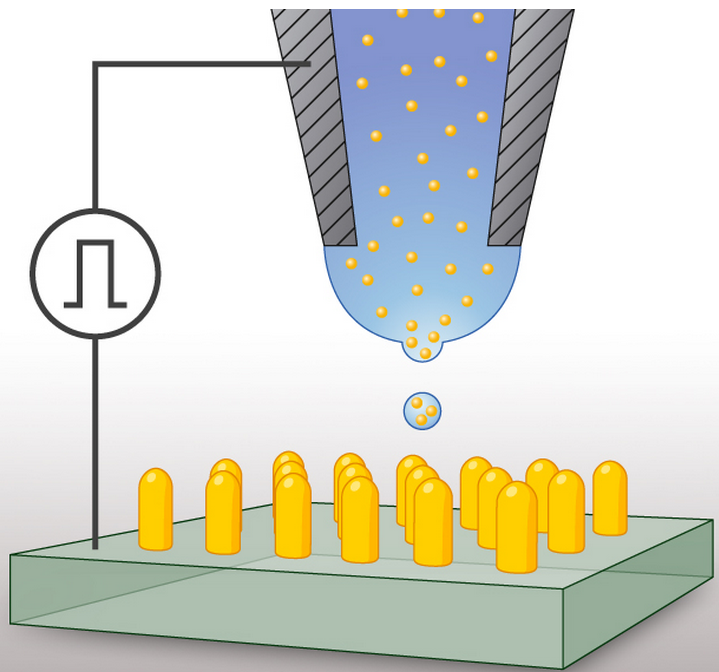
Solvent containing nanoparticles (yellow dots) flows out of a capillary and forms controllably ultra-small droplets. The solvent evaporates rapidly from the droplets, leaving a structure made of accumulated nanoparticles in its wake (credit: Patrick Galliker/ETH Zurich)
ETH-Zurich researchers have developed an economic, fast and reproducible method for printing micro- and nanoscale (<100 nm) structures in a manner similar to an ink-jet printer printing art.
The trick: ultrafine particles are transferred onto a surface from a capillary with the aid of an electrical field. Depending on how long material accumulates at the same spot, the structure can be a dot or nano-tower, or even an arch.
Surfaces modified with nano-structures can absorb, concentrate and transmit light instead of reflecting it.
Applications
- Increased efficiency of thin-film solar cells by capturing the light and channeling it directly towards the active layer, for instance, instead of reflectng part of the light and letting another part escape unused.
- Camouflage suits
- New kinds of faster, more selective and highly sensitive detectors and sensors might be feasible.
- Special light microscopes in which light nanoantennas trigger fluorescence, enabling individual molecules to be observed.
- Wherever material needs to be applied on a nanoscale in a targeted fashion — a CPU printed on the spot, for example.
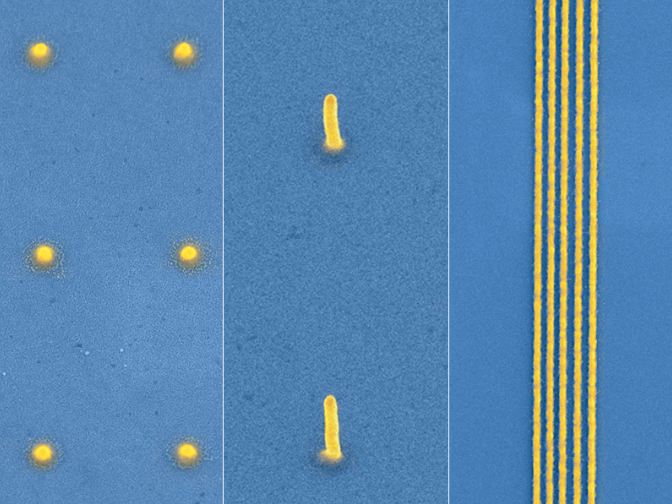
Using the new method, researchers can print dots, small towers, lines and other structures at the nanoscale (SEM image) (credit: Patrick Galliker / ETH Zurich)
Advantages
- Structures can be applied to different surfaces in a quick and reproducible manner.
- Fast because the printer can be programmed in such a way that material is applied precisely where it is needed.
- Removal and waste of excess material no longer required.
- Less expensive — no large-scale facilities, high calssification cleanrooms, exceedingly high temperatures or special pressure ratios, and laborious and time-consuming vacuum steps.
- Throughput and size of the printed surfaces may be increased considerably during industrial production.
- Prototyping at the smallest scale could be performed fast and affordably.
The researchers next plan to develop a print head containing several individually addressable capillaries to increase throughput and enable stacking layers of different materials.