Nanoscale technologies to cut DNA sequencing costs
September 26, 2012
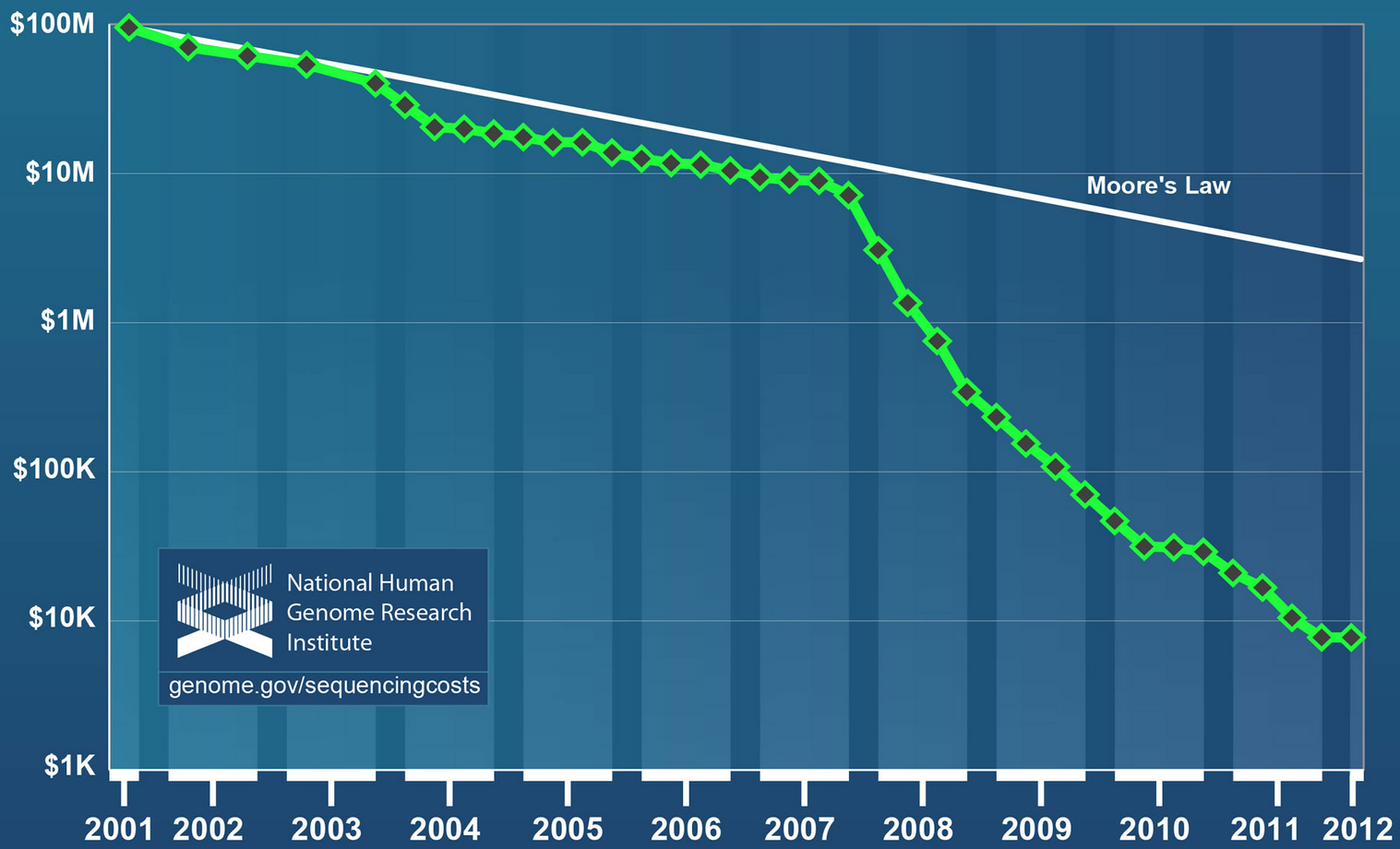
Grants of almost $19 million will help to develop technologies to dramatically reduce the cost of DNA sequencing, the National Human Genome Research Institute (NHGRI), part of the National Institutes of Health, has announced.
During the past decade, DNA sequencing costs have fallen dramatically (see www.genome.gov/sequencingcosts), fueled by tools, technologies and process improvements developed by genomics researchers. In 2004, NHGRI launched the Advanced DNA Sequencing Technology Program to accelerate improvements in DNA sequencing technologies.
By 2009, the program had surpassed its initial goal of producing high-quality genome sequences of roughly 6 billion base pairs — the amount of DNA found in humans and other mammals that receive roughly 3 billion base pairs from each of their parents — for $100,000 each.
Today, the cost of sequencing a human genome using these next-generation DNA sequencing technologies has dipped to just under $8,000.
Price is one hurdle in the way of widespread use of genomics in research and clinical care. Speed and accuracy are among other factors. The grants will attempt to address all of these challenges.
“We can now access data we could not dream of getting in 2004 when we started this program — tens of thousands of human genome sequences have been generated,” said Eric D. Green, M.D., Ph.D., NHGRI director. “And yet, the information we would truly like to get for understanding disease and, eventually, for treating patients, requires much better quality sequence data. That is the direction we would like to go with these grants.”
The use of nanoscale devices for sequencing, reflected in many of these projects, is accelerating. To say that nanoscale devices function on a very small scale is an understatement. A human hair is 100,000 nanometers in diameter and a single strand of DNA is 2 nanometers in diameter.
“Several of the investigative teams will explore novel nanoscale sensing modes and approaches for manipulating DNA molecules with great precision by using nanoscale structures,” noted Jeffery A. Schloss, program director for NHGRI’s Advanced DNA Sequencing Technology Program.
The 2012 awards are:
Genapsys, Inc., Redwood City, CA.
Hesaam Esfandyarpour, Ph.D.
Funding amount: $1.2 million in fiscal 2012 (total $3.3 million over three years subject to the availability of appropriations)
Aim: Develop easy-to-use, chip-based DNA sequencing that combines multiple sample processing steps with sequencing in a single device called the Gene Electronic Nano-Integrated Ultra-Sensitive platform.
Harvard University, Cambridge, Mass.
Jene Golovchenko, Ph.D., and Daniel Branton, Ph.D.
Funding amount: $1.2 million in fiscal 2012 (total $3.6 million over three years subject to the availability of appropriations)
Aim: Develop a scalable graphene nanopore sequencing device that will identify DNA subunits on unlabeled, single-stranded genomic DNA molecules. Graphene is a special arrangement of a single layer of carbon atoms. The nanopore is a hole in the graphene about two nanometers in diameter.
GnuBIO, Inc., Cambridge, Mass.
Tal Raz, Ph.D., with David Weitz, Ph.D., Harvard University
Funding amount: $1.5 million fiscal 2012 (total $4.5 million over three years subject to the availability of appropriations)
Aim: Increase the throughput of the current single channel microfluidic instrument to enable whole genome sequencing in about six hours, including data analysis, genome alignment and variant calling. Microfluidics refers to plastic devices in which fluids move through tiny channels that are the diameter of a human hair.
Columbia University, New York City
Kenneth Shepard, Ph.D., with Marija Drndic, Ph.D., University of Pennsylvania, Philadelphia
Funding amount: $500,000 in FY2012 (total $1.5 million over three years subject to the availability of appropriations)
Aim: Develop much faster and more sensitive electronics to enable sequencing based on arrays of nanopores.
Intel Corp., Santa Clara, Calif., University of Twente, Enschede-Noord, Netherlands, Columbia University, Pacific Biosciences, Menlo Park, CA
Madoo Varma, Ph.D., Oguz H. Elibol, Ph.D., Xing Su, Ph.D., Serge Guy Lemay, Ph.D., Kenneth Shepard, Ph.D., Stephen Turner, Ph.D.
Funding amount: $1.2 million fiscal 2012 (total $5 million over four years subject to the availability of appropriations)
Aim: Develop a real-time, single-molecule sequencer that detects electrically active tags that will be attached to each of the four DNA subunits
Northeastern University, Boston, Pacific Biosciences
Meni Wanunu, Ph.D., and Jonas Korlach, Ph.D.
Funding amount: $300,000 fiscal 2012 (total $825,000 over 3 years subject to the availability of appropriations)
Aim: Reduce the cost of Pacific Biosciences’ single-molecule real-time (SMRT) DNA sequencing by reducing the amount of DNA needed to picogram levels. A picogram is 1 trillionth of a gram.