NASA aims for human rendezvous at Mars in 2033
May 24, 2012
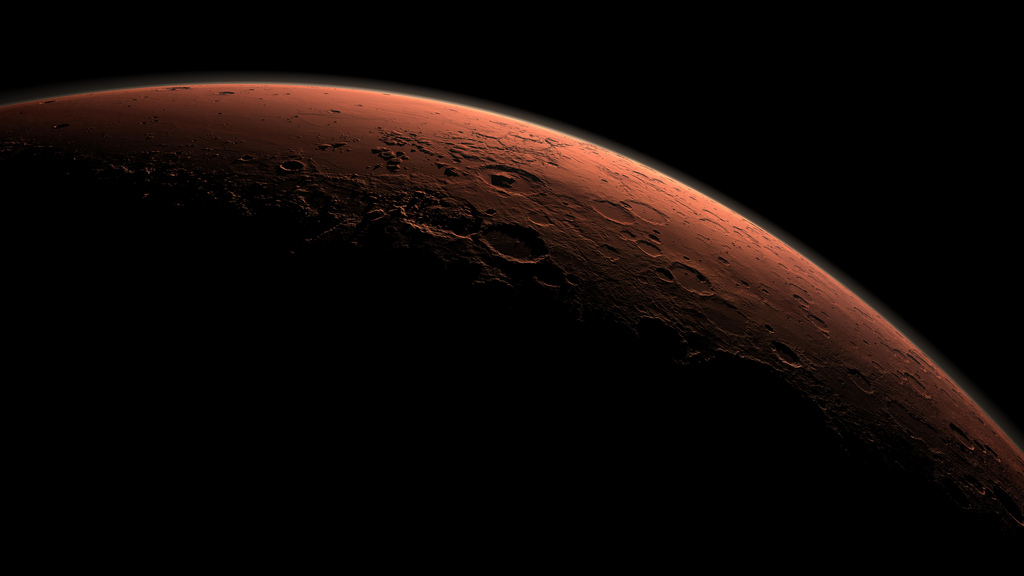
It would be the most precious cargo since the Apollo astronauts returned Moon rocks to Earth.
In 2033, humans would arrive in Mars orbit to pick up and return to Earth a small collection of Mars rocks that would have been previously collected and put into orbit.
An internal NASA study group, tasked with replanning the agency’s beleaguered Mars program, revealed on Tuesday that it was using this working scenario and date as a goal, Nature News Blog reports.

Comments (40)
by brad
Wow. Peter you’re such a pessimist. And a know-it-all who clearly doesn’t.
by Joe
Peter Simmons, do you read the info on these threads? Or do you just know everything already?
by Gorden Russell
Using Moore’s Law you can see that by 2033 robots will have processing power equal to 4.0960 x 10 13 neurons. That’s about 41 trillion brain cells. Robots will be capable of building the entire colony before any people get there.
by Editor
Gordon: Moore’s law refers to transistor density in a silicon substrate, which will reach a limit of ~7 nm in 2024, according to the ITRS roadmap, so if that’s true, Moore’s law will no longer be relevant. There are other substrates and technologies that promise to replace silicon, of course.
by GatorALLin
If we don’t send humans to the Mars surface by 2033 I will be disappointed… who cares if we bring a few rocks back….??? That is what robots are for!
by Giulio Prisco
I am afraid the pioneer spirit has left NASA and the public sector in the U.S. and all the “Western” world, and while I hope it will come back someday, I don’t think it will be soon. Therefore I watched with interest and enthusiasm the historic launch of SpaceX‘s Falcon 9 rocket and Dragon spacecraft the other day.
I watched it online, using the video streaming technology developed by scientists and engineers who probably decided to studied science because they were space enthusiasts. This shows that exciting and momentous space project are needed to motivate new generations of scientists and engineers, who will realize the dreams of previous generations.
by Lord Penguin
That reminds me of this one organization:
http://www.buildtheenterprise.org/
Although we don’t need something so extreme, we really do need something much bigger than what we have now (metaphorically or literally) to really inspire people.
by Lord Penguin
NASA and other space agencies around the world should lead the way to exploring space. However, once we’ve set up research and such, we should continue onwards, to Jupiter’s moons, the Kuiper Belt, and eventually other star systems. Unless, of course, something non-profitable or too large for companies to tackle is beneficial (ex. terraforming mars).
There’s a certain tipping point, where being in space becomes limitlessly profitable. Planetary Resources looks like its going to get us over it, and then the space industry will boom. As soon as space mining begins to bring back more in profits than was spent, more and more will be added to increase the profit.
Once we get mining in space, better rockets, safety measures, and almost everything else space related will be advanced, and then landing on Mars shouldn’t be too hard.
by Pedro
This is the most anemic goal I have ever seen. And to think, it will only take 21 more years to realize it. Way to capture a generation NASA. I know. You could do it faster if there was a budget for it. Way to go Obama.
by Gorden Russell
To Laura C.
I took your advice and Googled Robert Zubrin: The Case For Mars.
Found this Wikipedia entry:
http://en.wikipedia.org/wiki/The_Case_for_Mars
It looks like Marlin McKelvy is right. Richard Branson could rent robots from Planetary Resources to build a hotel of Martian brick. With those big geodesic domes they could grow plenty of food. They could even build cowbarns of brick and raise hay in the domes. You could have barbecue on Mars.
by Peter Simmons
So that is the extent of your imagination; burn some flesh on Mars. Pathetic.
by Gorden Russell
Also, I would not be surprised to see that Charles Simonyi supplys the toolbox for the robot that mines the asteroids.
by Gorden Russell
Well, Melajara, NASA’s problem come from all the budgets cuts made by Republicans to give tax breaks to the 1 percent. So only members of the 1 percent will be able to go to outer space.
So, John Doe, don’t worry about the government spending any more money on transporting people to far off places in space. It will all be done with private money when the asteroid miners become trillionaires.
Charles Simonyi will make it to Mars before a NASA astronaut does.
by Peter Simmons
No one will make it to Mars. In the fifties and sixties we read sci-fi, we knew it was fiction just like other fiction, we didn’t think it was real or could happen, it was exervising imagination. Since movies like Star Wars and CGI, there appear to be several generations who think it’s real, despite NASA managing nothing but some orbiting satellites in the last 30 years – while all other science has exploded with inventions. How come the light drive, the anti-gravity drive and all the other preposterous invented methods of traversing distances that make a nonsense of our puny little efforts haven’t materialised? Don’t say dried up funding, the funding has dried up BECAUSE there’s no future in the fantasy of space travel and some people there have figured it out.
Come down to Earth and start caring about this planet, which we’re well on the way to trashing with our selfishness and greed, while dreaming of leaving the trash and going elsewhere [in space this time] which is the story of humans really. Perhaps if you weren’t lost in fantasy you’d be doing something about the planet which supports and sustains you. Another fifty years and hominids will be extinct on Earth, there isn’t any time to go elsewhere, even if our pathetic skin-encapsulated egos could discover a way of protecting our vulnerable little bodies from space radiation. Oh yes, it’ll be the light drive, hurry up and invent it someone or Dan Dare/Flash Gordon/Luke Skywalker won’t be able to fly the galaxies! LOL
by melajara
NASA is an impressive case of government agency fossilization.
Soon enough it will be of interest only for social anthropologists!
by Gorden Russell
Another thing, John Doe…once the asteroid mining is running full tilt, there will be a constant chain of deep-space ships coming in from L-5 to pick up people in near-earth orbit. The hard part will be getting people up there and Richard Branson will figure that part out.
Solar cells will be a lot better by then, so hydrogen will be cheaper…and if we do get fusion power we will be able to fill up all the Virgin Galactic Ships that Branson can build. We will have hydrogen to burn.
And a lot more people will want to go exploring when their extended life-spans and computer implants get them to that place in life where they will have “been there, seen that, done that.”
by Gorden Russell
Dear John Doe,
Yes, I am afraid that we will have driverless cars in the future. At least the semi-trailers will be driverless too…and they will be programmed not to tail-gate you like so many of the human drivers who have roared up behind me in their 18-wheelers.
Your future will not be bodieless, however. By the time we can upload your mind into a computer, we will already have nanos in our bodies that stop aging and disease. You will be able to live in your fleshly body as long as you want — until you get bored of living. That could very well happen with the extended life-spans of the future. Bordedom could very well become the biggest crises of the future. With computers in our bodies, we will think so fast that we will get bored in a New York nano-second.
by Peter Simmons
Perhaps you would like also to explain [along with your certainty of the future being boredom] where exactly all these people will live, given that there are already 9 billion of us and people like to have sex and babies? Then there’s the matter of food, we’re already on the brink and scientists trying to invent clever ways of getting more from less, and famine hasn’t exactly gone away has it? What extended lifespans? In case you are under the impression that human lifespans have lengthened, let me explain this fallacy.
The AVERAGE life expectancy has got bigger because the AVERAGE is a result of all people’s lifespans, and some die at birth [but fewer now so an increase] some die in childhood [but fewer now so that increases the average] and many diseases which once cut people down are largely curable now. Then there are the accidents which we recover more from now with trauma surgery etc. Humans don’t live any longer than ten thousand years ago, just more survive, raising the average lifespan. Got it now? There will be no extended life-spans, just years or decades of exstended old age on cocktails of drugs to keep you ‘alive’, but would you want to be? The only people in care homes are those without the guts to end their own lives when the quality diminishes. That is the way out now and it will remain so.
by John Doe
I can’t believe we’re wasting a damn penny on researching transporting human beings to far off places in space.
Can’t we invest more in making humans less fragile first? Won’t that serve so many greater purposes in additon to space travel? It amazes me how many aspects of research prejudice the future capabilities of other research areas. It all becomes very misguided and myopic, just like how the UK’s 20 Year Transport Plan only briefly mentioned the “possibility” of driverless vehicle technologies playing a “part”. It’s plainly damn obvious that our future is driverless and our far future is bodyless.
Let’s stop planning for a meat based future.
by Peter Simmons
Whatever happened to the nuclear cars and helicopters we were promised in the sixties? But you’re right, our future is bodyless; we will all die. A ‘meat based future’ indeed, oh dear.
by Gorden Russell
It looks like Elon Musk is a great success:
http://www.space.com/15434-private-rocket-launches.html
He should have an even better booster and capsule by 2021. But even if he doesn’t, it shouldn’t take that many launches to get the robot and the bits and pieces of the mining ship up to where the robot can assemble them. Dragon capsules could even be used as modules on the ship.
by Gorden Russell
Now, if you apply Moore’s Law to a starting date of 2015, you will see a wafer with the power of 160 billion human neurons by 2021.
A robot with this wafer will be able to do anything that a human can do, including building other robots.
And if 160 billionis neurons isn’t enough to make a von Neumann macine, just wait 18 months.
by Gorden Russell
Here is an excerpt from that Space.com article:
The computational crunching power of robots was addressed by Brian Wilcox, manager of Space Robotics Technology at NASA’s Jet Propulsion Laboratory in Pasadena, Calif.
“Moore’s law has been operating for 50 years, with about an order of magnitude increase in computational throughput every five years,” Wilcox said.
This means that the throughput per wafer — at a roughly constant fabrication cost of under $10,000 — has increased from about the equivalent of one neuron on a 1.5-inch wafer using 1965 fabrication technology, to about 10 billion neurons using 2015 fabrication technology on an 18-inch wafer. Those wafers are just now going into production around the world, he said.
by Gorden Russell
Now, read the Space.com article, “How Telerobotics Could Help Humanity Explore Space”
http://www.space.com/15585-space-exploration-telerobotics-technology.html
by Gorden Russell
Also, check out this entry on Lagrangian Points:
http://en.wikipedia.org/wiki/Lagrangian_point
by Gorden Russell
Here, check out this Wikipedia entry on von Neumann machines:
http://en.wikipedia.org/wiki/Self-replicating_machine
by Gorden Russell
Once that von Neumann machine has copied itself 29 times, you will have 536,870,912 robots. Even if it costs a billion dollars to get that first robot out there chasing asteroids, you will end up with $1.86 tied up in each one of the copies.
The only question is: How fast can they double their numbers?
by Gorden Russell
Elon Musk will make it to Mars before 2033. Even if he doesn’t, the visionary billionaires who formed Planetary Resources will. They only need to get a single von Neumann machine to Lagrange point five with a couple of asteroids. Once they have a metallic asteroid and a carbonaeceous asteroid they will be able to make more mining ships and many more robots. In short order they will have the ships and robots to haul back thousands of asteroids. Even before then, they will smelt down the platinum group and rare earth metals to make return capsules. With fuel from the carbonaeceous asteroids they can launch those capsules back to Earth and melt them down to make ingots.
This will turn those billionaires into trillionaires.
Then they can go anywhere they want in the solar system with their own money.
by Peter Simmons
Given that the money that makes ‘billionaires’ comes from people, don’t you think these people should be regarded as criminals rather than the answer to mankind’s dreams? You appear to worship them, how plebian.
by RobinSongs
So much for Go fever.
by Aaron
That is really sad. Not only do they keep pushing the date back they are now going to go there and not even land. LAME!
by Bill
2033? That is incredibly depressing and ridiculous. Part of the reason for handing over low earth transport to private industry such as SpaceX was so that NASA could focus on deep space missions. And given that, 2033 is the best that they can envision? And not even land??
Here’s to hoping that private space can get there sooner or that other nations have more ambition than the United States and use private space industry services to get there themselves.
by Eamon Bobowski
What a worthless and small-minded ambition. It’s the most disappointing thing I’ve heard from NASA since they announced that their goal for the ORION project was to go back to the moon.
Clearly the only way humanity will meaningfully expand its presence beyond the Earth is through the commercialization of space.
by Laura C.
A better idea — Zubrin: “The Case for Mars”
by Marlin McKelvy
Send people all the way to Mars and not land? That’s like going to DisneyWorld and staying in the parking lot – what’s the point? If you can boost the rock samples into Mars orbit it can certainly dock with an automated return vehicle and bring the samples back to Earth far more inexpensively. The whole point of our program should be to get a human presence on Mars. This shows how totally adrift our space program has become. I suggest a contest between Elon Musk and Richard Branson and I bet they could have a hotel on Mars in a decade.
by Mortran
The difference is that you don’t need to launch a huge payload from the surface of Mars back into orbit. It’s actually a big difference. Mars is not the moon. It is a planet with a significant escape velocity.
by David Luzar
Certainly sound amazing… from current perspective. But I think that by 2030 we will have different worries and ambitions.
by Khannea Suntzu
Bla. By 2025 the US and NASA won’t even exist any more.
by Luzarius
Oh ya? You win the batshit crazy post of the day! Here I thought I smoked good stuff!
by Peter Simmons
There are plenty of crazy posts here to choose from, especially the asteroid miners. It’s pretty certain NASA will have been closed down, the US will have been bancrupted by then also, so any space travel will be Chinese, or Indian. Not that they’ll get very much further than previous ‘explorers’.