NASA eyes plan for deep-space outpost near the Moon
February 14, 2012 | Source: Space.com
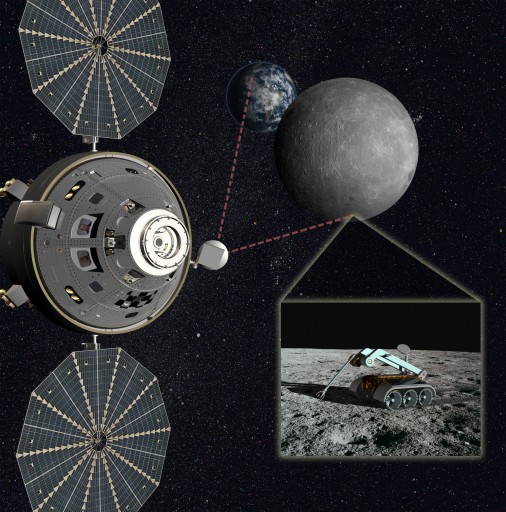
Artist's concept of astronauts in an Orion capsule helping direct robotic teleoperations on the moon's farside (credit: Lockheed Martin)
NASA is pressing forward on assessing the value of a “human-tended waypoint” Earth-moon libration point 2 (EML-2) — a places in space where the combined gravitational pull of the Earth and Moon roughly balance each other out, allowing spacecraft to essentially “park” there.
EML-2 could serve as a gateway for capability-driven exploration of multiple destinations, such as near-lunar space, asteroids, the moon, the moons of Mars and, ultimately, Mars itself, according to NASA officials.
Comments (3)
by Rick Thurman
The points are several.
1. Planets and satellites are the obviously interesting places, but they’re also expensive to get to/from, because they’re gravity wells. Continuing to make a series of one-shot trips from the bottom of our well to the bottoms of all the other wells is actually the most expensive way to travel, comparable in complexity, expense and hazards to flying a submarine from the bottom of New York Bay into the air, becoming a plane for a while, then diving back into the sea and becoming a sub again at Tokyo Bay. If we’re truly serious about a permanent presence in space, we need to start building craft for specific purposes: launch/re-entry for Earth-surface to Earth-orbit; a comparable fleet for launch/return to/from Lunar surface and local orbit; perhaps craft for travel among Earth, Moon and local libration points (5 of them); and real interplanetary craft for travel to points beyond.
The challenges and opportunities faced by each of these types of trips are unique enough to create specialized vehicles. It will be cheaper, safer and more comfortable.
Along with the above, it makes sense to build orbital and libration-point stations to dock these vehicles and transfer to the craft appropriate to the next leg of any given journey. It may also make sense to use orbital or libration point stations as “base camps” for any sustained campaign to explore, survey, develop and settle any planet. Base camps need to have solid communications with the “outside world”, no matter where your expedition is headed, and orbital/libration positions fill that function more easily than surface camps on Moon or Mars.
As for why NASA should pick L2 now as the next step in this multi-stage campaign, I’ll let them defend their choice. But I think it’s worth seeing this in a larger context that includes commercial supply ventures like Planetary Resources (officially announced yesterday), other national space programs, and a conscious shift away from one-shot stunts with expensive chemical rockets, and towards more efficient means of lift (laser or microwave thermal launch seem most promising for Earth launch right now), plus building the components of an international transport, deep space communications, and resource-extraction infrastructure off-Earth. It’s the next logical move.
by The SHM
….
So…
Like…
THE MOON?! Any immediate plans, any plans whatsoever, to actually get us to the moon? Or is the government still saying, “Oh, that’s such a good idea, but it just costs too much money (it doesn’t have to!!!!) and there are so many safety problems… Besides, we don’t even have the technology to get to the moon.”
I lol’d when I heard that… heh.. heh… No, seriously, a billionaire with a few high friends could go to the moon within a year if they wanted to. After all, there’s no Planetary Police… right?
by Tony
I’m sorry, but what’s the point? Shoot multiple people and tons upon tons of hardware to a point with literally nothing there… to shave 2 seconds off telepresence time, when you could just send a relay satellite?