NASA-NOAA satellite reveals new views of Earth at night
December 4, 2012
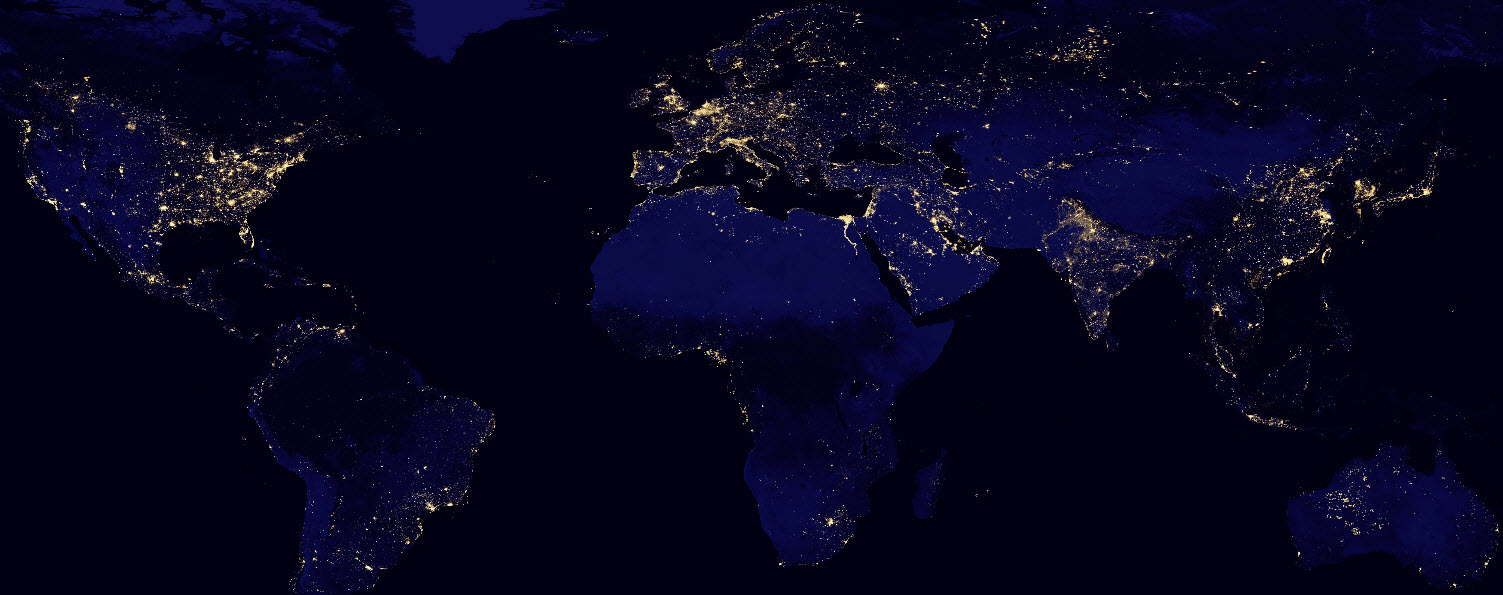
Composite map of the world assembled from data acquired by the Suomi NPP satellite in April and October 2012 (credit: NASA Earth Observatory/NOAA NGDC)
Scientists have unveiled an unprecedented new look at our planet at night. A global composite image, constructed using cloud-free night images from a new NASA and National Oceanic and Atmospheric Administration (NOAA) satellite, shows the glow of natural and human-built phenomena across the planet in greater detail than ever before.
Many satellites are equipped to look at Earth during the day, when they can observe our planet fully illuminated by the sun. But with a new sensor aboard the NASA-NOAA Suomi National Polar-orbiting Partnership (NPP) satellite launched last year, scientists now can observe Earth’s atmosphere and surface during nighttime hours.
The new sensor, the day-night band of the Visible Infrared Imaging Radiometer Suite (VIIRS), is sensitive enough to detect the nocturnal glow produced by Earth’s atmosphere and the light from a single ship in the sea. Satellites in the U.S. Defense Meteorological Satellite Program have been making observations with low-light sensors for 40 years. But the VIIRS day-night band can better detect and resolve Earth’s night lights.
The new, higher resolution composite image of Earth at night was released at a news conference at the American Geophysical Union meeting in San Francisco. This and other VIIRS day-night band images are providing researchers with valuable data for a wide variety of previously unseen or poorly seen events.
With its night view, VIIRS is able to detect a more complete view of storms and other weather conditions, such as fog, that are difficult to discern with infrared, or thermal, sensors. Night is also when many types of clouds begin to form.
The day-night band observed Hurricane Sandy, illuminated by moonlight, making landfall over New Jersey on the evening of Oct. 29. Night images showed the widespread power outages that left millions in darkness in the wake of the storm.
“NOAA’s National Weather Service is continuing to explore the use of the day-night band,” said Mitch Goldberg, program scientist for NOAA’s Joint Polar Satellite System. “The very high resolution from VIIRS data will take forecasting weather events at night to a much higher level.”
Unlike a camera that captures a picture in one exposure, the day-night band produces an image by repeatedly scanning a scene and resolving it as millions of individual pixels. Then, the day-night band reviews the amount of light in each pixel. It has a high dynamic range: if it is very bright, a low-gain mode prevents the pixel from oversaturating; if the pixel is very dark, its signal is amplified.
“It’s like having three simultaneous low-light cameras operating at once and we pick the best of various cameras, depending on where we’re looking in the scene,” Miller said. The instrument can capture images on nights with or without moonlight, producing crisp views of Earth’s atmosphere, land and ocean surfaces.
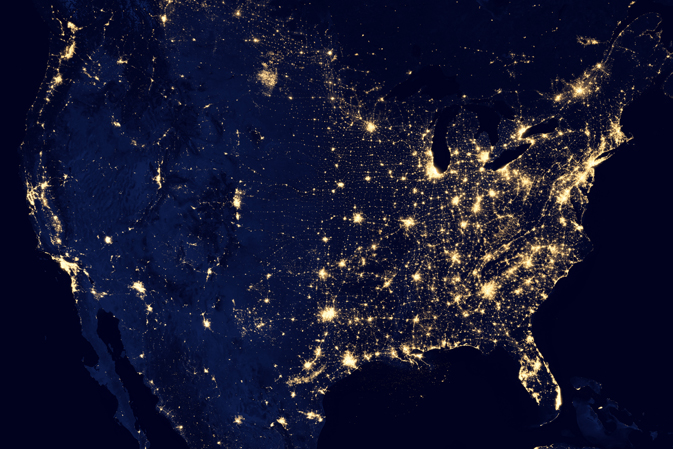
This image of the continental United States at night is a composite assembled from data acquired by the Suomi NPP satellite in April and October 2012. The image was made possible by the satellite’s “day-night band” of the Visible Infrared Imaging Radiometer Suite (VIIRS), which detects light in a range of wavelengths from green to near-infrared and uses filtering techniques to observe dim signals such as city lights, gas flares, auroras, wildfires and reflected moonlight. (Credit: NASA Earth Observatory/NOAA NGDC)