NASA rover finds old streambed on Martian surface
September 28, 2012
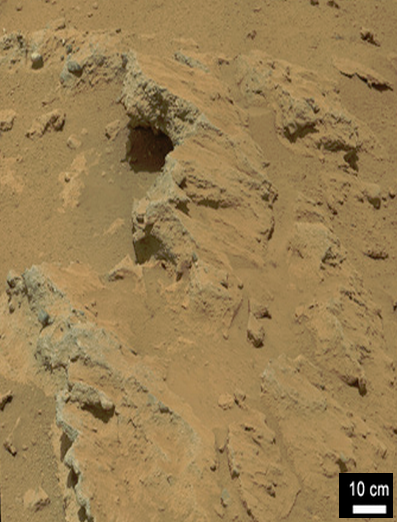
NASA’s Curiosity rover found evidence for an ancient, flowing stream on Mars at a few sites, including the rock outcrop pictured here, which the science team has named “Hottah” after Hottah Lake in Canada’s Northwest Territories (credit: NASA/JPL-Caltech/MSSS)
NASA’s Curiosity rover mission has found evidence a stream once ran vigorously across the area on Mars where the rover is driving.
There is earlier evidence for the presence of water on Mars, but this evidence — images of rocks containing ancient streambed gravels — is the first of its kind.
Scientists are studying the images of stones cemented into a layer of conglomerate rock. The sizes and shapes of stones offer clues to the speed and distance of a long-ago stream’s flow.
“From the size of gravels it carried, we can interpret the water was moving about 3 feet per second, with a depth somewhere between ankle and hip deep,” said Curiosity science co-investigator William Dietrich of the University of California, Berkeley. ”
Plenty of papers have been written about channels on Mars with many different hypotheses about the flows in them. This is the first time we’re actually seeing water-transported gravel on Mars. This is a transition from speculation about the size of streambed material to direct observation of it.”
The finding site lies between the north rim of Gale Crater and the base of Mount Sharp, a mountain inside the crater. Earlier imaging of the region from Mars orbit allows for additional interpretation of the gravel-bearing conglomerate. The imagery shows an alluvial fan of material washed down from the rim, streaked by many apparent channels, sitting uphill of the new finds.
The rounded shape of some stones in the conglomerate indicates long-distance transport from above the rim, where a channel named Peace Vallis feeds into the alluvial fan. The abundance of channels in the fan between the rim and conglomerate suggests flows continued or repeated over a long time, not just once or for a few years.
The slope of Mount Sharp in Gale Crater remains the rover’s main destination. Clay and sulfate minerals detected there from orbit can be good preservers of carbon-based organic chemicals that are potential ingredients for life.
“A long-flowing stream can be a habitable environment,” said Grotzinger. “It is not our top choice as an environment for preservation of organics, though. We’re still going to Mount Sharp, but this is insurance that we have already found our first potentially habitable environment.”
During the two-year prime mission of the Mars Science Laboratory,esearchers will use Curiosity’s 10 instruments to investigate whether areas in Gale Crater have ever offered environmental conditions favorable for microbial life.