NASA’s new Mars Rover sends higher-resolution image
August 6, 2012
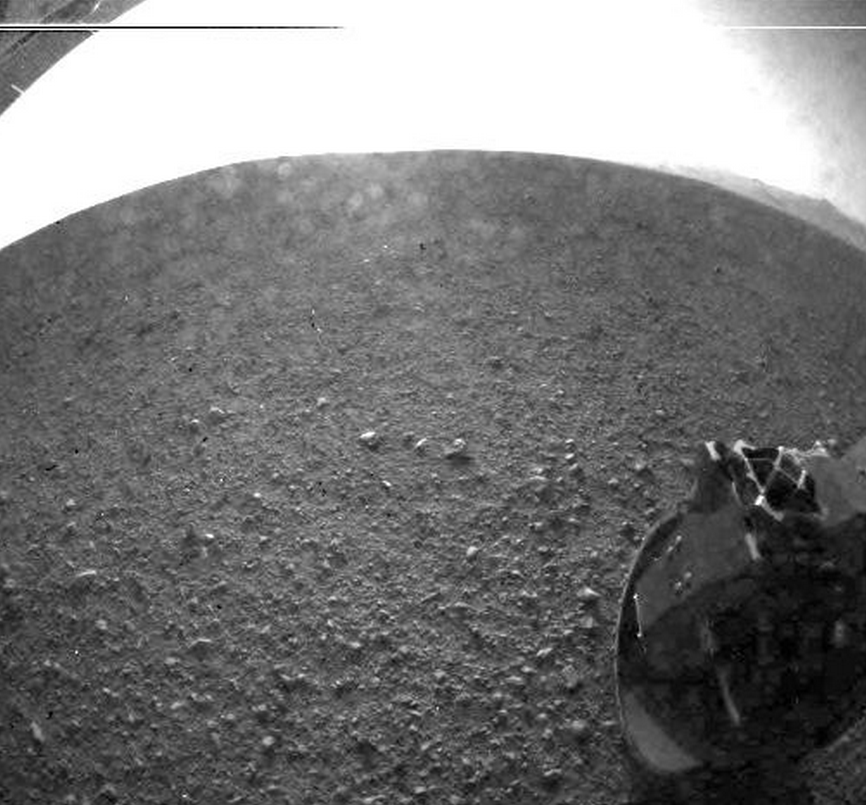
one of the first images taken by NASA’s Curiosity rover, which landed on Mars the evening of Aug. 5 PDT (morning of Aug. 6 EDT). Image credit: NASA/JPL-Caltech
About two hours after landing on Mars and beaming back its first image, NASA’s Curiosity rover transmitted a higher-resolution image of its new Martian home, Gale Crater.
“Curiosity’s landing site is beginning to come into focus,” said John Grotzinger, project manager of NASA’s Mars Science Laboratory mission, at the California Institute of Technology in Pasadena.
“In the image, we are looking to the northwest. What you see on the horizon is the rim of Gale Crater. In the foreground, you can see a gravel field. The question is, where does this gravel come from? It is the first of what will be many scientific questions to come from our new home on Mars.”
Curiosity landed at 10:32 p.m. Aug. 5, PDT, (1:32 a.m. EDT, Aug. 6) near the foot of a mountain three miles (about five kilometers) tall inside Gale Crater, 96 miles (nearly 155 kilometers) 7in diameter.
During a nearly two-year prime mission, the rover will investigate whether the region has ever offered conditions favorable for microbial life, including the chemical ingredients for life.
For more information on the mission, visit: http://www.nasa.gov/mars and http://marsprogram.jpl.nasa.gov/msl.
Follow the mission on Facebook and Twitter at http://www.facebook.com/marscuriosity and http://www.twitter.com/marscuriosity
Comments (9)
by Michael Graybill
In awe of the accomplishment on so many levels.
by Bdubbs
Mars Direct should be next!
by SpottedMarley
Mars is where bigfoot lives. I hope the rover is safe
by GatorALLin
some more info here http://www.ustream.tv/NASAJPL
by Starheart
Awesome accomplishment.
Still, out of curiosity: is there any reason to have image lens-distorted and monochrome? I’m pretty sure this thing is sophisticated enough to have proper optics and digital camera aboard and transmission bandwidth isn’t an issue – lightspeed lag is.
by GatorALLin
I was wondering that also…. I heard at first they had dust caps on to protect the lens during landing. I would agree everyone would want and benefit from great color images 360 degrees….
by Marcos Marin
“The first Mars pictures expected from Curiosity are reduced-resolution fisheye black-and-white images received either in the first few minutes after touchdown or more than two hours later. Higher resolution and color images from other cameras could come later in the first week. Plans call for Curiosity to deploy a directional antenna on the first day after landing and raise the camera mast on the second day.”
You ppl should AT LEAST read the whole newsletter.
by Lord Penguin
That picture was taken by one of the navigation cameras, and a lower resolution version was sent back to Earth. The picture is in black and white because color isn’t needed, the camera is just for making sure the rover doesn’t run into things and knows how to adjust the wheels. Sometime in the few days, the mast will be deployed with a high resolution camera.
by GatorALLin
Thumbs up on sticking the 10 point landing NASA! A 2 year mission filled with pictures, updates and exciting new discoveries should help recharge our US focus on space, science and curiosity in Mars. Nice work!