Neuroscience: the mind reader
June 14, 2012 | Source: Nature News
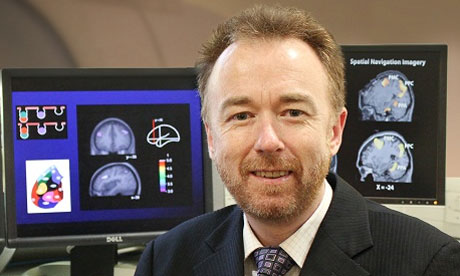
Adrian Owen (credit: Adrian Owen)
Adrian Owen has found a way to use brain scans to communicate with people previously written off as unreachable in a so-called “vegetative state.” Now he’s fighting to take his methods to the clinic.
Patients in these states are usually written off as lost.
Owen took fMRI scans of a 23-year-old woman in a vegetative state while he asked her to imagine playing tennis and walking through the rooms of her house. When healthy, conscious adults imagine playing tennis, they consistently show activation in a region of the motor cortex called the supplementary motor area, and when they think about navigating through a house, they generate activity in the parahippocampal gyrus, right in the centre of the brain.
The woman, who had been unresponsive for five months after a traffic accident, had strikingly similar brain activation patterns to healthy volunteers who were imagining these activities, proving, in Owen’s mind, that she was conscious.
Other researchers contended that the response was not a sign of consciousness, but something involuntary, like a knee-jerk reflex. Daniel Greenberg, a psychologist at the University of California, Los Angeles, suggested in a letter to Science that “the brain activity was unconsciously triggered by the last word of the instructions, which always referred to the item to be imagined”.
But Owen went on to bolster his case. Working with neurologist and neuroscientist Steven Laureys from the University of Liège, Owen showed that of 54 patients in a vegetative or minimally conscious state, five responded in the same way as the first woman. Four of them were in a vegetative state. After refining their methods, the researchers asked patient 23 to use that capability to answer yes-or-no questions: imagine playing tennis for yes, navigating the house for no. They then asked about things that the technicians scoring the brain scans couldn’t possibly know.
But Parashkev Nachev, a clinical neuroscientist at Imperial College London, criticizes the work for “assuming that consciousness is a binary phenomenon”. Many patients, such as those having certain types of epileptic seizures, exhibit limited responsiveness without being conscious. Nachev says that more data are needed to indicate where in the continuum of cognitive abilities people in vegetative states fall.
Currently, there are tens of thousands of people in a vegetative state in the United States alone. Owen reckons that up to 20% of them are capable of communicating; they just don’t have a way to do so. “What we’re seeing here is a population of totally locked-in patients,” Owen says.
Owen now wants to put his technique into the hands of clinicians and family members.
An early goal of the program was to repeat the fMRI findings using an electroencephalogram (EEG). An EEG lacks fMRI’s precision. But other tasks — imagining wiggling a finger or toe — produce signals that, through repetition, become clear. An EEG is also cheap, relatively portable and fast (with milliseconds of lag compared with 8 seconds for fMRI), meaning that the research team can ask up to 200 questions in 30 minutes. Now, using an EEG, Owen is planning to study 25 people in a vegetative state every year.
One goal is to identify other brain systems, such as smell or taste, that might be intact and usable for communication.
Owen’s methods raise more difficult dilemmas. One is whether they should influence a family’s or clinician’s decision to end a life. If a patient answers questions and demonstrates some form of consciousness, he or she moves from the “possibly allowed to die” category to the “not generally allowed to die” category, says Owens.
Even more ethically fraught is whether the question should be put to the patients themselves. Owen hopes one day to ask patients that most difficult of questions, but says that new ethical and legal frameworks will be needed. And it will be many years, he says, “before one could be sure that the patient retained the necessary cognitive and emotional capacity to make such a complex decision.”
So far, he has stayed away from the issue. “It might be a little reassuring if the answer was ‘no’ but you can’t presuppose that.” A “yes” would be upsetting, confusing and controversial.
Ref.: Martin M. Monti et al., Willful Modulation of Brain Activity in Disorders of Consciousness, New England Journal of Medicine, 2010, DOI: 10.1056/NEJMoa0905370